For an open-plan kitchen near your workspace, start by comparing the noise emissions and noise class of the exact model you’re considering. A delay-start function can help you avoid running it during meetings, but it won’t make the dishwasher quieter while it’s on. Next, check whether the Eco programme’s duration fits your schedule, then choose a capacity that suits the amount of washing-up you actually accumulate. The figures on the EU energy label also let you compare water and energy use based on the Eco programme, but they won’t necessarily reflect how other programmes perform.
Who should think about this choice?
People who work near the kitchen
If your dishwasher runs just a few metres from your desk, its noise could be distracting during calls or tasks that need concentration. Compare the declared noise emissions and noise class before focusing on secondary features.
Households that plan cycles around when they’re at home
You might load the dishwasher during the day but prefer to run it after meetings or while you’re out. Check the delay-start range for the specific model; app-based scheduling may have additional requirements.
Smaller households with limited space
A slimline or worktop model needs to fit the washing-up you usually have, not just the space available. Consider its width, place settings and basket layout together.
What should you look for?
In an open-plan kitchen, start by thinking about when a cycle might interrupt you, then compare noise, scheduling options and capacity. For energy and water use, the European Commission explains that dishwasher energy labels show, among other things, energy use per 100 Eco cycles, water use per cycle and the duration of that programme.
| What matters |
What to check |
What shoppers are looking for |
| Noise while working |
Compare the noise emissions in dB and the noise class of the exact model, with similar size and capacity. |
When I take calls near the kitchen, I want to keep audible noise to a minimum without having to wait for the cycle to finish before I can speak; around 36% of consumers would put a quiet environment first. |
| When the cycle starts |
Check the delay-start range and, for app-based scheduling, the terms of use for the app. |
If I load the dishwasher between meetings, I’d rather it started when my workspace is free; around 29% of consumers would make control over the start time their priority. |
| Capacity and space |
Match the width, place settings and basket layout to the dishes and utensils you usually use. |
In a small kitchen, I want enough space for the washing-up I’ve accumulated without giving too much room to the appliance; around 21% of consumers would prioritise this balance. |
| Water, energy and cycle time |
Look at the kWh per 100 Eco cycles, litres per cycle, Eco programme duration and capacity together. |
If I plan to use the Eco programme often, I want to know how long it takes as well as how much energy and water it uses before deciding when to run it; around 14% of consumers would compare these figures first. |
Mistakes to avoid
-
Relying only on the word ‘quiet’
That description alone won’t tell you how much the appliance can hold or how long its Eco programme will take.
Compare the dB rating and noise class for the exact model, then check its capacity and Eco programme duration before you choose.
-
Assuming delay start makes it quieter
It changes when the cycle starts. If the dishwasher runs while you’re still at home, you’ll still need to consider its noise.
Choose a start time that works around your meetings and check the noise emissions separately. For a connected feature, also check the service requirements.
-
Comparing only the energy rating letter
According to the European Commission, the energy, water and duration figures on the label relate to the Eco programme. They don’t automatically describe a quick or intensive cycle.
Read these figures together and consider which programme you’re likely to use most often.
-
Choosing a slimline model without checking how it loads
The number of place settings alone won’t show you how your dishes and utensils will fit in the baskets.
Compare the dimensions and interior layout with the dishes you usually use. The French Agency for Ecological Transition (ADEME) recommends waiting until the dishwasher is full before running it, whenever your needs allow.
Brands to consider
These product ranges and models are examples to help you identify features worth comparing; the figures and functions mentioned don’t apply to every appliance from the same brand.
Bosch
Bosch’s product information for the fully integrated XXL SBV4HCX07E dishwasher lists 42 dB, a B noise class and 9.0 l per Eco cycle.
- This model gives you specific figures to compare with appliances of a similar capacity.
- According to Bosch, its Home Connect features require a Home Connect account, a SingleKey ID account and an internet connection.
Siemens
Siemens offers cycle scheduling via Home Connect on its compatible smart dishwashers.
- The option to set a start time is worth considering if you want to avoid running a cycle during meetings.
- Check that your chosen model supports the feature and review the app’s terms of use; don’t assume it’s available across the whole range.
Miele
Miele’s French range includes dishwashers in different sizes, with declared noise levels that vary by model.
- Some model specifications list noise levels of 41 or 42 dB, so you can assess each appliance alongside its capacity and size.
- The noise level and basket layout of one model don’t represent other Miele dishwashers.
Electrolux
The Electrolux EES42210L is a 45 cm integrated model listed for 9 place settings, with 44 dB noise emissions and a 24-hour delay start.
- This combination lets you consider the size, capacity, declared noise level and cycle scheduling together.
- Electrolux lists lower noise levels for other models; don’t assume they apply to the EES42210L.
Dishwashers to consider on Joybuy
These worktop models are most relevant if space and the amount of washing-up you produce are key factors in your choice. If you work nearby, compare each model’s noise figures and delay-start options with your schedule: a compact dishwasher won’t necessarily meet all your needs.
 Image unavailable
Heinrich's HTG 8840 Schwarz, 6-place-setting worktop dishwasher
Worth considering if you want to load the dishwasher during the day and run it outside your call times.
The product listing states that it has a 24-hour delay start, 47 dB noise emissions, seven programmes and a D energy rating. Check its noise class and Eco programme duration to see whether it suits your workspace.
View on Joybuy
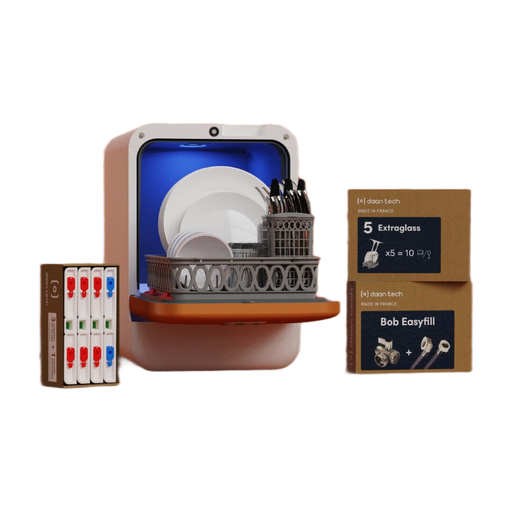 Image unavailable
Bob The Eco-Compact Dishwasher, All-Options Pack, white/copper
This compact model is worth considering if you’re short on space and don’t produce much washing-up.
Before using it near a workspace, check the model’s noise level, usable capacity and the duration of the programme you plan to run.
View on Joybuy
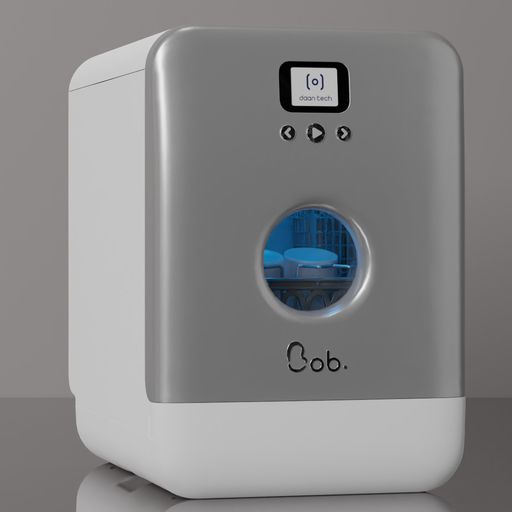 Image unavailable
Bob Mini Dishwasher, 3 place settings, 34 cm, metallic grey/white
Its size could suit a small amount of washing-up, as long as 3 place settings are enough for your usual loads.
Its listed width is 34 cm. In an open-plan kitchen, also compare the noise level and the duration of the cycle you plan to use before settling on this size.
View on Joybuy
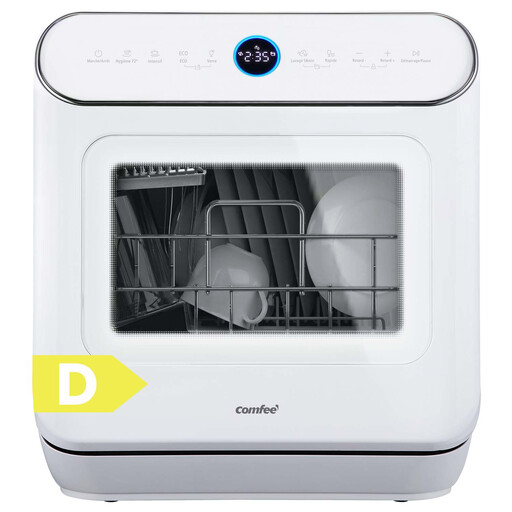 Image unavailable
COMFEE CDWMT305WD, white worktop dishwasher
Worth considering if you want to delay the start of a compact dishwasher until after your meetings.
The product listing states that it has seven programmes, a 24-hour delay start and a D energy rating. Check its noise emissions and whether its capacity suits your dishes before planning to run a cycle while working from home.
View on Joybuy
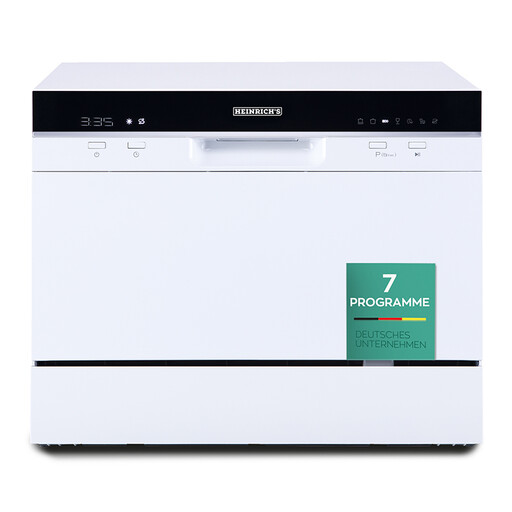 Image unavailable
Heinrich's HTG 8840 Weiss, 6-place-setting worktop dishwasher
This version is worth considering if you need space for 6 place settings and want to schedule the start around your working hours.
The product listing states that it has 47 dB noise emissions, a 24-hour delay start, seven programmes and a D energy rating. Check the noise class and Eco programme duration for the exact model before deciding when to run it.
View on Joybuy
Frequently asked questions
What should I compare on a dishwasher energy label?
Compare the noise level and noise class, capacity, energy use per 100 Eco cycles, water use per cycle and the Eco programme duration. The European Commission says this information is shown on the labels for applicable dishwashers. Compare models with a similar capacity and size, and don’t assume these figures apply to quick or intensive programmes.
Is delay start enough to keep things quiet while I work?
No. It lets you avoid running a cycle at certain times, but it doesn’t reduce the dishwasher’s noise while it’s operating. Check both the delay-start range and the model’s noise emissions; if you choose app-based scheduling, also check what’s required to use it.
Why should I check the Eco programme duration?
It helps you plan when the dishwasher can run near your workspace. The Eco programme duration is shown on the EU energy label, so compare it with the hours you’ll be at home and consider whether you can delay the start.
How can I use less water day to day?
The French Agency for Ecological Transition (ADEME) recommends avoiding pre-rinsing and waiting until the dishwasher is full before running a cycle. Water use also depends on the model and programme you choose: use the Eco programme’s water-use figure to compare appliances, then consider your own habits.


