Which criteria should you compare ?
First work out where the appliance could go and how much washing-up you’d have for each load. Then compare models with a similar capacity using their energy labels.
Freestanding
Worth considering : if there’s a suitable space available and shared loads regularly fill the machine.
Bear in mind : the appliance will be visible, and you should check the noise level for each model individually, even at 45 cm wide.
Built-in
Worth considering : if your kitchen has a suitable housing unit and a seamless look with the cabinets is important to you.
Check : that the cabinet and door panel are compatible; a built-in installation doesn’t guarantee quiet operation.
Compact
Worth considering : if a larger appliance won’t fit in your kitchen and your loads are small.
Check : the space required, capacity, and the exact model’s water supply and drainage requirements.
Washing by hand
Stick with this option : if you can’t confirm there’s a suitable space or you wouldn’t regularly have enough washing-up to fill a machine.
The trade-off : you’ll still need to wash everything by hand, and water use depends on how you do it.
| Criteria |
What to check |
Everyday needs |
| Noise |
Compare the dB(A) rating and noise emission class on the energy label for appliances with a similar capacity. The ADEME states that an increase of three decibels corresponds to almost twice the noise level. |
I want to be able to run a cycle without disturbing conversations or anyone relaxing in the living area. |
| Capacity |
Compare the stated number of place settings with the washing-up you accumulate between cycles. Check the capacity of the exact model, including for an appliance measuring 45 cm wide. |
In a shared kitchen, I need enough room for our usual loads without having to wait too long to fill the machine. |
| Water, energy and duration |
Check the litres per cycle, kWh per 100 cycles and duration of the Eco programme. These figures don’t automatically tell you how a quick or intensive programme performs. |
I want to compare like for like and know how long the Eco programme will keep the machine occupied. |
| Size |
Measure the height, width, depth and clearance required. Check the model’s instructions for its water supply, drainage and electrical requirements. |
With a limited amount of worktop or housing space, I need to know whether the appliance will fit and work in that setup. |
| Repairability |
Check the repairability index for the model you’re considering. The Ministry of the Economy describes it as a way to assess how easy or difficult a dishwasher is to repair. |
If several appliances meet my space, noise and capacity requirements, I also want to take their repairability into account. |
What should you look for in different brands ?
Manufacturer ranges can help you identify different formats, but you’ll need to check each model’s specifications to compare noise, dimensions and energy use.
Bosch
Bosch offers several formats, including countertop models and compact built-in appliances. This is a useful starting point when every centimetre counts in your kitchen.
- Bosch lists dimensions of 45 × 55,1 × 50 cm for its small countertop dishwashers; check the dimensions of the model you choose.
- A compact format alone doesn’t tell you how noisy a model is, how much it holds or how much it uses.
Beko
Beko’s 45 cm freestanding models let you explore slimline options without making assumptions about their noise levels.
- Beko lists 10 place settings for the BDFS26041XQ and DVS05024X models.
- The manufacturer states noise levels of 41 and 49 dB(A) respectively for these models. Their shared width doesn’t replace the need to compare their specifications.
Miele
Miele offers freestanding and integrated configurations to consider based on the space available and your kitchen layout.
- Miele’s French range includes a fully integrated model rated at 41 dB.
- This noise level applies to a specific model. Also compare capacity, Eco programme data and the repairability index for the model you’re considering.
Models to suit your kitchen layout
These Joybuy options illustrate three different setups: small loads with a countertop appliance, shared loads with a 60 cm freestanding model, or a fitted kitchen with a built-in appliance. Compare their stated specifications with the space you have and your washing-up habits.
 Image unavailable
Heinrich's HTG 8840 Schwarz countertop dishwasher
This countertop model is listed as having six place settings, making it suitable for kitchens where loads are small.
The specifications list 47 dB, 6,5 L per cycle, 49 kWh per 100 uses and an Eco programme duration of 215 min. Compare these stated figures with those of appliances with a similar capacity.
Before buying, check the exact dimensions, available space and connection requirements in the instructions.
View on Joybuy
 Image unavailable
Hotpoint H4FD641A, 60 cm freestanding, 14 place settings
Its stated capacity of 14 place settings could suit shared loads if your kitchen has a suitable 60 cm space.
The specifications list 41 dB, around 9,5 L for the Eco cycle and an energy rating of C. These are stated specifications, not independent measurements.
Before comparing it with other appliances, confirm the dimensions, connection requirements, kWh per 100 cycles and Eco programme duration for this model.
View on Joybuy
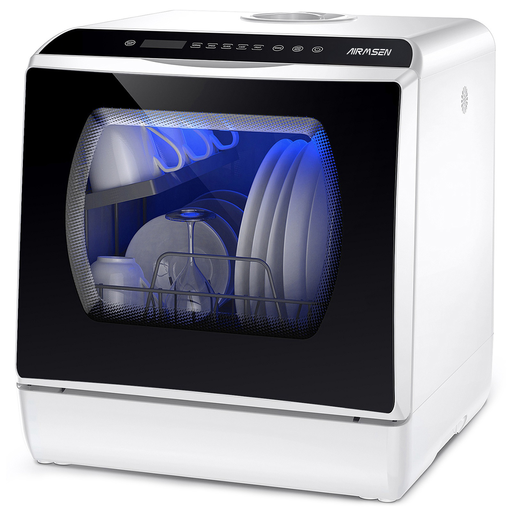 Image unavailable
AIRMSEN countertop dishwasher with 5 L tank
This model is listed as having four place settings. It’s worth considering if you have small loads and want the option of using a water tank.
The specifications list dimensions of 45,8 × 42,8 × 42,5 cm and provide the option of using either the 5 L tank or a water inlet. In tank mode, the instructions describe draining into a container, so check that this setup will work in your chosen location.
For an open-plan kitchen, check the stated noise level and noise class for this model before choosing.
View on Joybuy
 Image unavailable
Samsung DW80H72YBB0U1, 60 cm built-in, 13 place settings
This fully integrated model is designed for a kitchen with a compatible housing unit and loads of up to its stated capacity of 13 place settings.
The specifications list an energy rating of B, a noise level of 44 dB(A) and 42 dB(A) for the Extra Silence programme. These figures apply to different operating conditions, so don’t confuse them when making comparisons.
Before buying, confirm the housing unit dimensions, cabinet compatibility, connections and Eco programme data. The specifications state that installation should be carried out by a qualified professional.
View on Joybuy
Frequently asked questions
What noise level should you look for in an open-plan kitchen ?
Check the dB(A) rating and noise emission class on the energy label, then compare models with a similar capacity. According to ADEME, an increase of three decibels corresponds to almost twice the noise level, so even a small difference in the figures is worth looking into.
What can you compare using the energy label ?
It lets you compare factors including capacity, noise, litres per cycle, kWh per 100 cycles and the duration of the Eco programme. Ideally, compare appliances with a similar capacity: Eco programme figures don’t necessarily reflect those for a quick cycle.
Is a 45 cm dishwasher always quieter ?
No : width alone doesn’t determine how noisy an appliance is. Beko states 41 dB(A) for its BDFS26041XQ and 49 dB(A) for its DVS05024X. Both are 45 cm models listed as having 10 place settings. Check the rating for each model you’re considering.
Can you install a compact model without checking anything else ?
No. Measure the available space and read the instructions for the exact model to check its water supply, drainage and electrical requirements. Even an appliance that uses a water tank needs a suitable drainage solution, as set out in its instructions.
When should you stick with washing by hand instead of buying a machine ?
Washing by hand remains an option if you can’t confirm there’s a suitable space or you wouldn’t have enough washing-up to fill the appliance regularly. However, it takes time, and water use depends on how you wash up, so don’t assume one option uses less water just because it’s done by hand or machine.


