Who is this type of dishwasher for?

Households that use their living space while the dishwasher is running

If your dishwasher runs during mealtimes, while you’re working from home or while you’re watching TV, its stated noise level deserves just as much attention as its capacity. Que Choisir particularly highlights how important this is in an open-plan kitchen.

Households fitting out a kitchen with a designated space

An alcove, a cabinet front and the available connections will help determine whether you need a freestanding or integrated model. Check these requirements before comparing programmes.

Smaller households with limited space

A compact model may suit smaller loads. GIFAM puts this size at around 6 place settings. Also check that it can fit your dishes, and consider the model’s noise level and connections.

Which criteria should you compare first?

Freestanding

Worth considering: if there isn’t a kitchen unit designed to house the appliance.

Bear in mind: the appliance will be visible. Freestanding design alone tells you nothing about how noisy it is.

Integrated

Worth considering: if your kitchen has an alcove and, depending on the model, a compatible cabinet door.

Bear in mind: fitting depends on the dimensions and connections, and doesn’t guarantee a quieter appliance.

Compact

Worth considering: when space is limited and your everyday loads are small.

Bear in mind: capacity will be lower, but don’t assume a smaller model will be quieter.

CriteriaWhat to checkWhat you need
Noise Compare the dB and noise class on the energy labels, using the same programme as a basis and, ideally, models with similar capacities. According to ADEME, an extra 3 dB corresponds to almost double the noise. I want to run a cycle without causing too much disruption to conversations, the TV or work in the open-plan living space.
Installation Measure the space and check the connections. For an integrated model, also check the alcove dimensions and that the cabinet door is compatible. For a compact model, check there’s room on the worktop. My chosen model needs to fit in my kitchen as it is, without assuming one type of installation will be quieter.
Capacity GIFAM generally puts the capacity of a 60 cm freestanding model at 12 to 15 place settings, a 45 cm model at 9 to 10, and a compact model at around 6. Also look at the basket layout. I want to fit my usual dishes and pans, not just reach a stated number of place settings.
Consumption The European energy label lets you compare energy use in kWh per 100 cycles and water use in litres per cycle, based on the Eco programme. Check how long it takes too if you expect to use another programme regularly. If I mainly use short cycles, I don’t want to assume the Eco figures reflect all my usage.
After-sales support Check the repairability index shown and find out about the availability of spare parts for the model you’re considering. I want to consider repair options before choosing an appliance I expect to use regularly.

What mistakes should you avoid?

  • Relying on the word ‘quiet’ alone

    A marketing claim doesn’t give you a consistent way to compare two dishwashers.

    For an open-plan kitchen, compare the decibel ratings and noise classes on the energy labels, using the same programme as a basis.

  • Overlooking a difference of a few decibels

    According to ADEME, an extra 3 dB corresponds to almost double the noise. So this difference is worth considering if the appliance will be running in your living space.

    When comparing two models that suit your space and typical loads, use their stated dB ratings and noise classes to help you judge how noisy they are.

  • Assuming a compact model is quieter

    Size is primarily about making the most of limited space. For example, the product listing for this particular model, the Electrolux ESF2400OS at BUT, states 52 dB and noise class D.

    Choose a compact model because its size and capacity suit your needs, then check the noise level and connections of the specific appliance separately.

  • Looking only at place settings or the energy class

    The number of place settings alone doesn’t tell you how much room there is for larger items. The energy label’s consumption figures are based on the reference Eco programme.

    Check that the baskets suit the dishes you usually use, then compare litres per cycle, kWh per 100 cycles and the Eco programme duration.

A few brands and models to consider

Bosch

A useful benchmark for a 60 cm freestanding appliance, with acoustic and consumption details provided on its French product listing.

  • Bosch’s listing for the SMS4ETI16E states 44 dB, noise class B, energy class B and 9,0 L per Eco cycle.
  • These figures apply to the SMS4ETI16E, not to all Bosch dishwashers.

Siemens

A range of integrated models to consider if your kitchen has units designed to house an appliance.

  • Siemens offers integrated and fully integrated models, with layouts and features varying from model to model.
  • Check the product listing for the model you choose to confirm its noise level, capacity, alcove dimensions and cabinet door requirements.

Candy

An option to consider if limited space points you towards a compact worktop model.

  • Candy describes the CP 6E51LS as a 6-place-setting model measuring 550 × 501 × 443 mm, which connects directly to the water supply.
  • Its size doesn’t tell you how noisy it is or whether it can fit the larger dishes used in your household.

Hotpoint

A semi-integrated option for a kitchen with an alcove designed to take a cabinet door.

  • Electro Dépôt’s product listing states that the HA3PB14BN7A0X has 14 place settings and a noise level of 41 dB.
  • This model requires a decorative door, which is not supplied. Check the alcove and cabinet door before choosing it.

Dishwashers to explore on Joybuy

These models include freestanding dishwashers and one integrated model. Compare their installation requirements and capacities before checking each model’s acoustic details. The compact models mentioned above are designed for a different space-saving need.
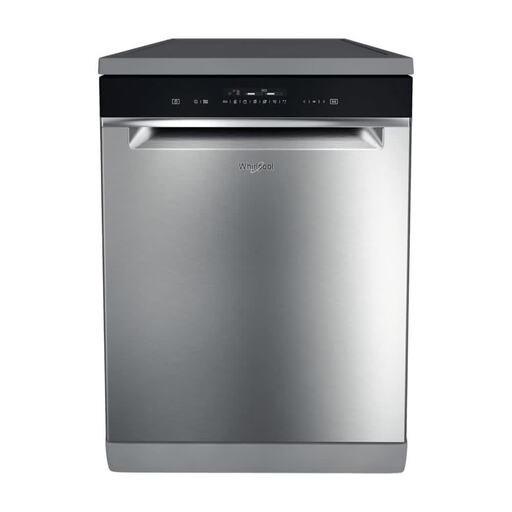
Whirlpool WFP5O41PLGX freestanding dishwasher

Whirlpool WFP5O41PLGX, freestanding, 14 place settings

Its 14-place-setting capacity is worth considering for household loads in an open-plan kitchen. The product name states that it is 60 cm wide and has energy class C. Check the exact dimensions before settling on this space, and check the noise level on the energy label too.

View on Joybuy
Hotpoint H4FD641A freestanding dishwasher

Hotpoint H4FD641A, freestanding, 14 place settings

For an open-plan space, compare the 41 dB noise level stated in the product name with that of appliances with a similar capacity. This model is listed as 60 cm wide, with energy class C. Check the available height and installation instructions if you plan to fit it under a worktop.

View on Joybuy

Samsung DW60M6050FS freestanding dishwasher

Samsung DW60M6050FS, freestanding, 14 place settings

Its 14-place-setting capacity may suit larger loads, and the product name also mentions 7 cycles. To see how well it suits an open-plan kitchen, compare its noise level and energy use on the energy label, then check the space needed for installation.

View on Joybuy

Samsung DW80H72YBB0U1 integrated dishwasher

Samsung DW80H72YBB0U1, integrated, 13 place settings

This 60 cm model is designed for a kitchen with a suitable space. Its name states that it has 13 place settings and energy class B. Check the alcove dimensions, cabinet door and connections, then compare the noise level for the reference programme rather than for a specific programme.

View on Joybuy

Indesit D2F HK26 S freestanding dishwasher

Indesit D2F HK26 S, freestanding, 14 place settings

With 14 place settings and a stated width of 60 cm, this freestanding model is worth considering if it suits your space and typical loads. Its name states energy class E. For an open-plan kitchen, also check the dB rating, noise class and consumption figures on the energy label.

View on Joybuy

Frequently asked questions

How can you compare the noise levels of two dishwashers in an open-plan kitchen?

Compare the decibel ratings and noise classes on their energy labels, using the same programme as a basis and, if possible, models with similar capacities. According to ADEME, noise classes A or B indicate particularly quiet appliances, while an extra 3 dB corresponds to almost double the noise.

Is an integrated dishwasher necessarily quieter than a freestanding model?

No. ‘Integrated’ describes how the appliance fits into your kitchen units, not the noise level of every model in this category. Check each appliance’s dB rating and noise class, along with the alcove dimensions and cabinet door requirements.

What capacity should you look for in each size?

GIFAM generally puts a 60 cm freestanding model at 12 to 15 place settings, a 45 cm model at 9 to 10, and a compact model at around 6. Also check that the baskets can hold your usual pans, dishes and glasses.

Does a compact worktop dishwasher avoid the need for connections?

Not necessarily. Candy states that its compact CP 6E51LS connects directly to the water supply. Before choosing a model, check its dimensions, water supply, drainage and installation instructions.

How should you read the consumption figures on the energy label?

To compare dishwashers based on the Eco programme, look at the kWh per 100 cycles and litres of water per cycle shown on the European energy label. If you mainly plan to use other programmes, don’t assume their consumption will match the Eco figures.