Who is this advice for?
Where the dishwasher is positioned and when you run a cycle will affect which features matter most.
People working from home near the kitchen
If your workspace looks onto an open-plan kitchen, it’s worth paying particular attention to noise during calls or tasks that require concentration. UFC-Que Choisir highlights the importance of this feature when a dishwasher shares your living space.
Households that can run the dishwasher later
If you don’t need clean dishes straight away, check the length of the eco programme and whether the model you’re considering has a delay-start function. This lets you choose a start time that fits around your day.
Smaller households with limited kitchen space
A slimline or worktop model can free up space, as long as its capacity and washing frequency suit your needs. UFC-Que Choisir notes that slimline 45 cm models with space for 9 place settings can be an option for a small family, although they may need to run daily.
Which features should you compare?
First decide whether the dishwasher will need to run while you’re working or whether you can run cycles at another time. Then compare its features with the amount of washing-up you generate and the space available.
| Feature |
What to check |
Think about your needs |
| Noise |
Compare the dB level and noise rating on the energy label. If an independent test assessing noise disturbance is available for the models you’re considering, check that too. |
I work or take calls nearby, so I need to decide whether the noise during a cycle will be acceptable at those times or plan to run it at another time. |
| Timing and duration |
Check how long the eco programme takes, which other programmes are available and what settings the delay-start function offers. It postpones the start without changing how noisy the appliance is. |
The dishes can wait until after my working day. On days when I need them sooner, I’ll check how long the programme I’ll actually use takes. |
| Water and energy |
Check the energy rating, water consumption and length of the eco cycle. The European Commission’s energy-labelling rules base these comparisons on the eco programme, so don’t assume they apply to quick programmes. |
I want to compare consumption on a like-for-like basis while also taking into account the programme I’ll use most often. |
| Capacity |
Compare the number of place settings, the layout of the racks and how many cycles your usual load of dishes would require. |
If I choose a smaller appliance to save space, I may need to run it more often. |
| Installation |
Measure the height, width and depth, including the space needed to open the door. For an integrated model, also check the cabinet niche, door panel and connections against the model’s instructions. |
I need an appliance that fits the space and can be connected to the water supply, drainage and electricity in line with its instructions. |
Brands worth considering
The features below relate to specific models and don’t apply to every dishwasher from the same brand.
Bosch
Freestanding and integrated models to consider, depending on your kitchen layout.
- Bosch Electroménager France lists dimensions of 845 × 600 × 600 mm and water consumption of 9.0 l for the freestanding SMS4EVW36F.
- These figures don’t describe other Bosch models, so check the product details and manual for the model you choose.
Siemens
A brand to consider if you’re comparing programmes and scheduling options on an integrated model.
- Siemens Electroménager France lists smartStart, a 1-hour programme and varioSpeed Plus for the SN63HX16CE.
- Check the conditions for using these features and the dimensions of the specific model before choosing it.
Miele
A delay-start function can be useful if you want the wash to begin after your working hours.
- Miele France lists a delay-start setting of up to 24 hours for the fully integrated G 5663 SCVi Active E.
- This feature is listed for this model. For any other model you’re considering, check the settings and whether it will fit the cabinet niche.
Dishwashers available on Joybuy
This selection includes worktop models, a freestanding dishwasher and an integrated model. First choose a format that suits your kitchen, then compare the noise and scheduling details that matter for your working-from-home routine.
 Image unavailable
Heinrich's HTG 8840 Schwarz — 6 place settings
For a small household that can run the dishwasher outside call times: the product name lists a 24-hour delay start, 7 programmes and a stated noise level of 47 dB. Check the dimensions and connections required for your chosen space. This noise figure alone doesn’t tell you how disruptive the appliance will be in your room.
View on Joybuy
 Image unavailable
Samsung DW60M6050FS — freestanding, 14 place settings
Worth considering if you have space for a freestanding model and more dishes to wash; the product name lists 7 cycles. Before planning to run it near your workspace, compare its stated noise level and check its dimensions and any scheduling settings that could suit your routine.
View on Joybuy
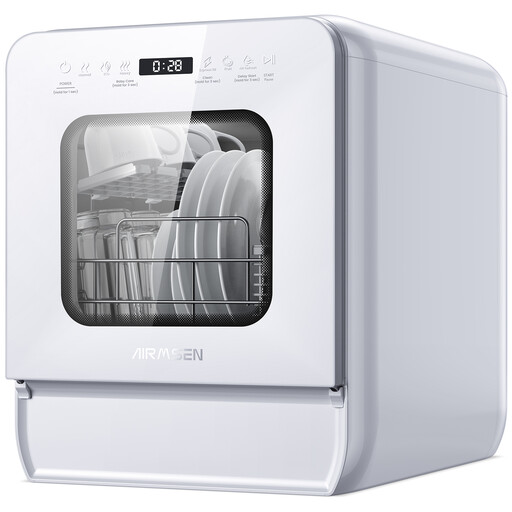 Image unavailable
AIRMSEN — worktop model, 5 L tank
If space and wash times matter in your kitchen, the product name lists 9 programmes and a delay start of 1 to 24 hours. Check the exact depth before buying and confirm how it connects to the water supply and drainage. If you plan to run it while working, check its noise level too.
View on Joybuy
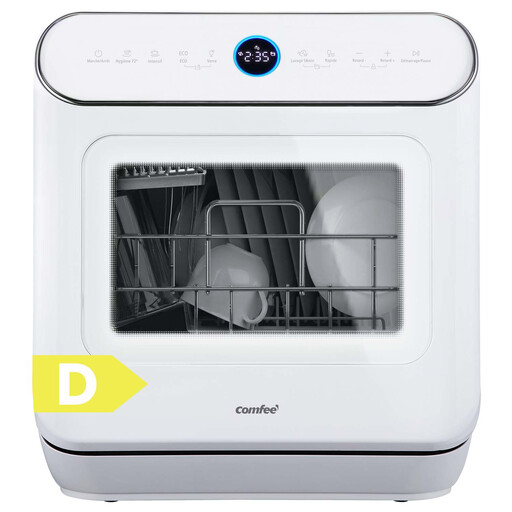 Image unavailable
COMFEE CDWMT305WD — worktop dishwasher
This compact model may suit you if you have smaller loads and want to run the dishwasher after work. The product name lists 7 programmes and a 24-hour delay start. Check the available space and installation instructions, and find out how noisy it is before running it near your workspace.
View on Joybuy
 Image unavailable
Samsung DW80H72YBB0U1 — 60 cm integrated, 13 place settings
Worth considering if you already have a suitable cabinet niche and want the appliance to blend into your open-plan kitchen. The product name lists an energy rating of B. Check the niche, door panel and connections against the installation instructions, then compare the noise level of the programme you’ll use during working hours.
View on Joybuy
Frequently asked questions
What should I check for noise in an open-plan kitchen?
Compare the dB level and noise rating on the energy labels of the models you’re considering. If the dishwasher will be running during calls, an independent test that also assesses noise disturbance is a useful addition. UFC-Que Choisir includes this assessment in its testing process.
Should you always use the eco programme when working from home?
No, not if you need your dishes back quickly. UFC-Que Choisir describes the eco programme as taking longer in return for controlled water consumption, and the European energy-label figures are based on this programme. Compare the duration and consumption of any other cycles you plan to use separately.
Does a delay-start function make a dishwasher quieter?
No. It changes when the cycle starts, not how noisy the appliance is. It can help you run a wash after calls or your working day, as long as the function and its scheduling options suit your routine. For example, Miele France lists a setting of up to 24 hours on the G 5663 SCVi Active E.
What should you measure before choosing an integrated model?
Measure the cabinet niche and check the door panel, door clearance and connections specified in the instructions for the exact model. A Bosch manual, for example, lists the water supply, drainage and electrical connection separately, so the stated width alone won’t confirm that the appliance can be installed.
Does a commercial warranty replace your legal protection if there’s a fault?
No. In France, for a new dishwasher bought from a professional seller, the Ministry of the Economy states that you can claim under the legal guarantee of conformity for two years if the product doesn’t conform to the contract. Any commercial warranty is in addition to this protection, not a replacement for it.


