You don’t have the connections in place
If you haven’t identified a suitable water supply, drain or electrical connection, start by checking whether installation is feasible. The available space alone won’t tell you which appliance you can install.


If your kitchen has no dedicated space for a dishwasher, check the available room and the water supply, drainage and electrical connections before choosing a size. A 45 or 60 cm freestanding model may work if it can be installed; a compact countertop model with a water tank can sometimes avoid the need for a fixed water supply, but it still needs drainage and has a more limited capacity. If connections or units need modifying, get these changes assessed before you order.
If you haven’t identified a suitable water supply, drain or electrical connection, start by checking whether installation is feasible. The available space alone won’t tell you which appliance you can install.
A slimline model is worth considering if you have limited room on the floor. Also measure the height and depth, check the door clearance and allow for the hoses. As Bosch points out, width alone doesn’t tell you how much space you need.
A compact countertop model could suit you if you have a suitable surface and a way to drain it. The Bob model featured by Daan Tech shows the trade-off: it can be filled from a tank, but its stated capacity is two place settings.
First, work out whether an appliance can be installed in your kitchen as it is, or whether changes are needed. Then compare the size and capacity of the formats that could work, followed by their energy, water and noise figures.
| What to consider | What to check | Who this matters to |
|---|---|---|
| Connections and modifications | Get the water supply, drainage and electrical connection checked. If changes are needed, treat them separately from simply installing the appliance. | If I’m not sure where the appliance can be connected, I want to make sure the project is feasible before choosing a format; around 36% of consumers would put this first. |
| Available space | Measure the width, height and depth, check the door clearance and allow for the hoses. For a built-in model, check the installation diagram for the exact model. | In a small kitchen, my first priority is finding an appliance that leaves enough room to use it; around 29% of consumers would prioritise space. |
| Capacity | Compare the number of place settings and the basket layout with the crockery you use regularly. Don’t judge capacity by width alone. | If dirty dishes pile up between cycles, I want to be able to load the items I actually use; around 21% of consumers would prioritise capacity. |
| Water, energy and noise | Among models that can be installed, compare the kWh per 100 cycles, litres per cycle and noise level shown on the energy label. | Once installation is feasible, I want to compare how the appliances perform day to day; around 14% of consumers would put this first. |
A slimline freestanding model saves width, but not necessarily depth or height. If there’s no suitable floor space, you could consider a compact model with a water tank on a suitable surface, provided you also have a way to drain the wastewater. ADEME lists energy and water use, capacity and noise as factors for comparing appliances; they don’t replace checking whether installation is possible.
A 45 or 60 cm appliance may still be too tall or too deep for the space, or its door may not open properly. Bosch recommends measuring all three dimensions of the space.
Compare your measurements and the planned hose route with the installation diagram for the exact model, and share them with the person installing it.
You may need to modify the unit or worktop if the appliance doesn’t fit the space.
Electrolux’s pre-installation guide explains that its service connects appliances to compliant installations, but doesn’t carry out plumbing, electrical or carpentry work.
Ask exactly what the proposed service includes, and get any necessary new connections or modifications assessed separately.
These changes may require a separate visit before the appliance can be installed.
A tank can replace a fixed water supply on some compact models, but wastewater still needs to be drained. Their capacity may also limit how many dishes you can wash in a cycle.
Check the drainage route in the manual and make sure the stated capacity suits the amount of washing-up you have.
Two appliances that fit your kitchen may still differ in water use, capacity and noise. According to ADEME, the energy label includes figures such as kWh per 100 cycles and litres per cycle.
Once installation has been confirmed as feasible, compare these figures on the labels of the models you’re considering.
Bosch’s information on its 45 and 60 cm dishwashers can help you assess whether a freestanding model will fit your kitchen.
The brand offers a compact built-in model and distinguishes between installation and preparatory work in its pre-installation service.
The Bob compact countertop dishwasher is worth considering if a fixed water supply is a problem.
These countertop models with water tanks are worth considering if you don’t have a suitable space on the floor. Before choosing, check the space needed on the surface, drainage, electrical supply and installation requirements in the manual for each model.
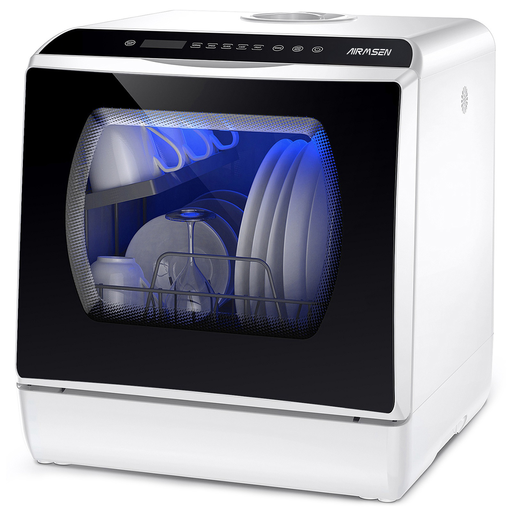 Image unavailable
Worth considering if you’re looking for a countertop appliance that can be filled without a fixed water supply.
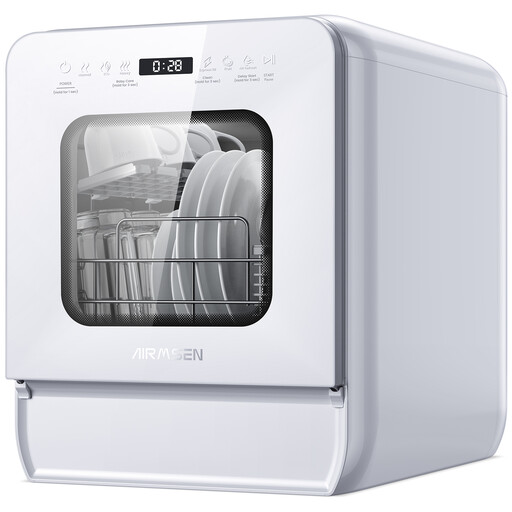 Image unavailable
Consider this model if you have limited worktop width, but remember to check the other dimensions too.
 Image unavailable
Another water-tank option to consider if you don’t have space on the floor.
First, check whether a water supply, drain and electrical connection can be provided. Then measure all the space the appliance needs, including room for the door to open. For a built-in model, compare your measurements with the installation diagram for the exact model, rather than relying on its stated width alone.
Not necessarily. Electrolux’s pre-installation guide says its service connects appliances to compliant installations, but doesn’t carry out plumbing, electrical or carpentry work. Ask the installer what’s included, and get any necessary modifications assessed separately.
Yes, if the model can be filled from a water tank. Daan Tech, for example, says this is possible with Bob. You’ll still need to drain the wastewater, so also check the capacity and installation requirements of the model you’re considering.
Compare their capacity with the amount of washing-up you have, then check the performance figures on the energy label. According to ADEME, this includes electricity use in kWh per 100 reference cycles and water use in litres per reference cycle. Also check the noise level of the exact model.