What should you check before choosing?
Start with the amount of washing-up you accumulate between washes, then rule out sizes that won’t fit the available space or connections. You can then compare capacity, consumption and noise using the information for the specific model.
| Criterion |
What to check |
Who is this important to? |
| Capacity and frequency |
Compare the stated place settings with the amount of washing-up you produce between cycles, including pans and dishes. Check the rack layout. |
When washing-up builds up after every meal, I want to avoid running extra cycles or leaving dishes out. Around 31% of consumers put loading capacity first. |
| Space and installation |
Measure the space and door clearance; for an integrated model, check the housing and door panel. Confirm the water, drainage and electricity connections. |
In a small kitchen, I need to be able to install and open the appliance without blocking the available space. This is the top priority for around 25% of consumers. |
| Water and energy |
Check the kWh per 100 cycles and litres per cycle on the exact model’s energy label. Factor in how many cycles your load will require. |
If the appliance is used regularly, I want to compare its water and electricity use on a like-for-like basis. Around 25% of consumers put consumption ahead of other criteria. |
| Noise and duration |
Compare the dB, noise class and Eco programme duration shown on the label. |
With an open-plan kitchen or cycles to fit around mealtimes, I’m looking for noise levels and programme times that suit my daily routine. Around 19% of consumers prioritise fitting cycles into their schedule. |
For these comparisons, ADEME explains that the energy label shows details including capacity, kWh per 100 cycles, litres per cycle, Eco programme duration and noise level. You can’t work out an appliance’s consumption from its width alone.
Dishwashers for different loads
These Joybuy models include freestanding dishwashers for larger loads and a compact tabletop model for smaller amounts of washing-up. For each one, check the available space, connections and details on the energy label.
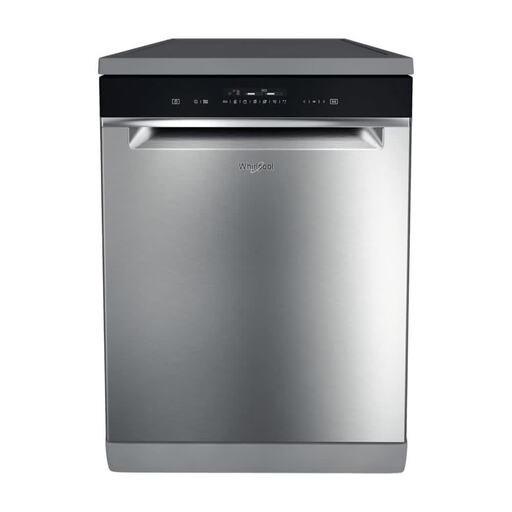 Image unavailable
Whirlpool WFP5O41PLGX, freestanding, 14 place settings
Worth considering if you build up a large load between washes. The listing states a capacity of 14 place settings and a C energy rating. Before deciding where to put it, confirm the model’s exact width: the detailed dimensions don’t match the stated width. Also check the Eco programme duration if it affects when you can run a wash.
View on Joybuy
 Image unavailable
Samsung DW60M6050FS, freestanding, 14 place settings
Its stated capacity may appeal to households that regularly fill their dishwasher after meals. The product name lists 14 place settings and 7 programmes. To compare it with other models for regular use, check the label for the exact model, particularly water use per cycle and Eco programme duration.
View on Joybuy
 Image unavailable
Indesit D2F HK26 S, 60 cm freestanding, 14 place settings
This size is worth considering if your mealtime washing-up calls for a stated capacity of 14 place settings and your kitchen can accommodate a 60 cm appliance. The product name lists an E energy rating. Check the model’s label to compare kWh per 100 cycles and Eco programme duration.
View on Joybuy
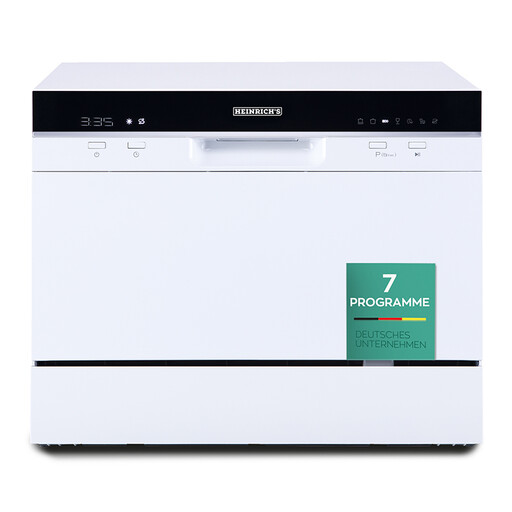 Image unavailable
Heinrich's HTG 8840 Weiss, compact tabletop, 6 place settings
A tabletop model is worth considering if space is limited and six place settings are enough between washes. The product name lists 7 programmes, 47 dB and a D energy rating. Check that your usual pans and dishes will fit, and that you have enough worktop space and the necessary connections.
View on Joybuy
 Image unavailable
Hotpoint H4FD641A, 60 cm freestanding, 14 place settings
Consider this for a large load if you have space for a 60 cm freestanding model. The product name lists 14 place settings, 41 dB and a C energy rating; check the label for kWh per 100 cycles and Eco programme duration. The description notes that some soldered components contain lead at a concentration above 0.1%: check the product’s substance information if this affects your choice.
View on Joybuy
Frequently asked questions
Is a 45 cm dishwasher big enough for everyday meals?
Yes, if its capacity suits the amount of washing-up you produce between cycles. UFC-Que Choisir says that 45 cm models with 9 place settings can suit a small family, although they may need to be run every day. Also check that there’s room for your pans and dishes.
What should you look for on the energy label?
Compare capacity, kWh per 100 cycles, litres per cycle, Eco programme duration and noise level. ADEME says dishwasher labels show these details as well as the energy and noise classes. Use the figures for the exact model rather than relying on its width alone.
What should you check before installing an integrated dishwasher?
Measure the housing and check the door-panel fitting, installation plan, and water, electricity and drainage connections. Bosch recommends using a professional to install its integrated appliances.
How can you compare the noise levels of two models?
Check the decibel figures and noise class on the labels for both models. According to ADEME, an increase of three decibels represents almost twice the noise, so it’s worth paying particular attention to this difference in an open-plan kitchen.


