What should you check before choosing?
Choose the right size before comparing energy labels. The appliance needs to handle your daily load, fit in the space you have and be installed correctly.
Mini model with a water tank
Worth considering: if you have worktop space but no accessible water supply for the appliance, and only a small amount to wash each cycle.
Limitations: the Comfee' CDWMTO201D (W), listed as requiring no plumbing, holds just 2 place settings. You’ll need to fill the tank, and you should check how the waste water is drained.
Connected 6-place-setting countertop model
Worth considering: for a moderate load, if your worktop space, water supply and drainage are suitable.
Limitations: this size takes up worktop space and needs the connections specified for the model.
45 cm freestanding model
Worth considering: if you have floor space and your load is too large for a countertop model to handle comfortably.
Limitations: a narrower width doesn’t mean you can overlook depth, door clearance or connections.
| Consideration | What to check | What you need |
|---|
| Space |
Measure the width, depth and height, then allow room for the door to open, the hoses and the remaining workspace. Bosch lists the freestanding SPS4EMI17E as measuring 845 × 450 × 600 mm. |
I want to install the appliance without blocking the way or losing worktop space I need for cooking. |
| Installation |
Check whether the model uses a water tank or connects directly to the water supply. Consult the instructions for the water inlet, drainage and electrical supply. Candy says the CP 6E51LW connects directly to the water supply. |
Without a nearby water supply, I’d look for a model specifically designed for manual filling, while checking where the waste water can drain. |
| Capacity |
Estimate how much washing-up you generate in a day, including pans. The manufacturers list capacities ranging from 2 place settings for the Comfee' CDWMTO201D (W) to 10 for the Beko BDFS26040X. |
If I cook often, I want to avoid choosing a capacity that would mean running cycles too frequently. |
| Water, energy and noise |
Compare capacity with the kWh per 100 cycles, litres per cycle and noise level shown on the label. ADEME recommends looking at these figures rather than just the energy-efficiency class. |
In an open-plan kitchen, noise matters to me just as much as consumption in relation to how I plan to use the appliance. |
A few leading brands and models
These specifications apply to the models mentioned, not to every appliance made by each brand.
Comfee'
If you’re considering a mini dishwasher with a water tank, the CDWMTO201D (W) is one example of a model Comfee' lists as requiring no plumbing.
- Comfee' lists a capacity of 2 place settings and dimensions of 435 × 435 × 420 mm for this model.
- Its capacity is suited to a very small load; check how to fill the tank and drain the water too.
Candy
The Candy CP 6E51LW is an example of a connected countertop model with a capacity of 6 place settings.
- Candy lists dimensions of 550 × 501 × 443 mm for this model.
- It connects directly to the water supply, so check the connections before making room for it on your worktop.
Beko
The Beko BDFS26040X is an example of a 45 cm freestanding model for a kitchen with floor space available.
- Beko lists a capacity of 10 place settings for this model.
- Allow for its depth, door clearance and connections too. Width alone isn’t enough to confirm it will fit.
Bosch
The Bosch SPS4EMI17E lets you compare the stated dimensions and consumption of a 45 cm freestanding model.
- Bosch lists dimensions of 845 × 450 × 600 mm and water consumption of 8,7 L per Eco cycle for this model.
- These figures apply to the SPS4EMI17E. Compare the labels of the specific models you’re interested in.
Compact dishwashers available on Joybuy
These countertop models fit the bill if you’re looking for an appliance to sit on your worktop. Compare how each one is supplied with water, and check the available space and drainage before choosing.
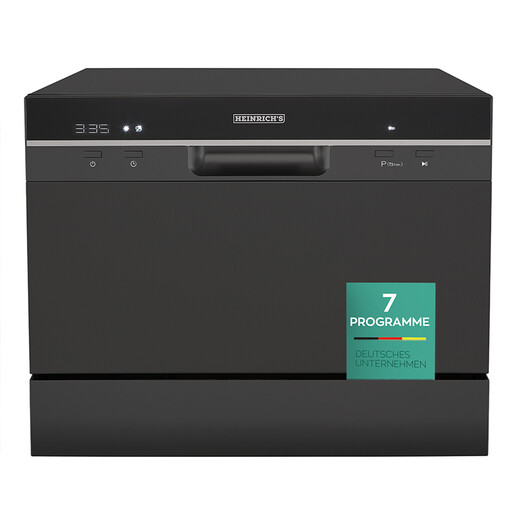 Image unavailable
Heinrich's HTG 8840 Black, 6 place settings
Worth considering for a moderate load if you have worktop space and a suitable water supply. The listing states 7 programmes, a D energy-efficiency class and 47 dB. Check the overall dimensions, drainage and electrical supply for your intended location.
View on Joybuy
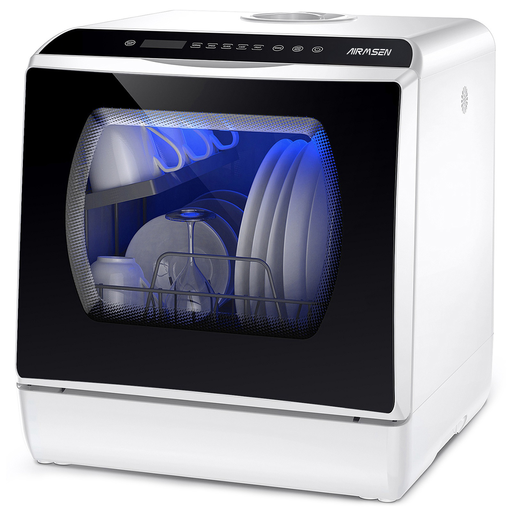 Image unavailable
AIRMSEN countertop model, 5 L water tank
The stated water tank could suit a kitchen without a nearby water supply for the appliance. The listing says it has 5+1 wash cycles. Before choosing, check that its capacity suits your needs, along with the dimensions, clearance and position of the drain hose.
View on Joybuy
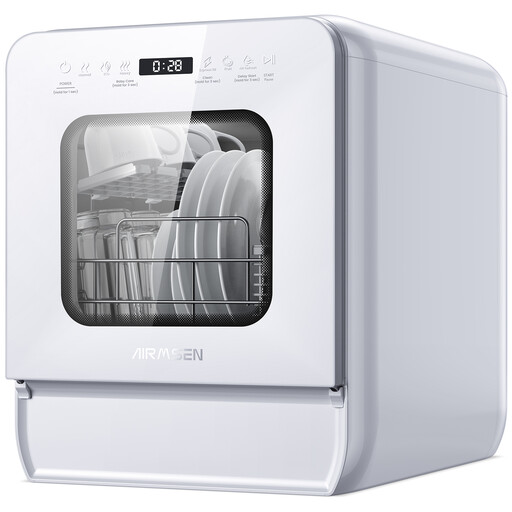 Image unavailable
AIRMSEN countertop model, 37 cm, 5 L water tank
Its stated width of 37 cm is worth considering if side-to-side space is limited. The listing says it has 9 programmes and a D energy-efficiency class. Confirm the exact model’s depth and height, then check door clearance and drainage before measuring the final space.
View on Joybuy
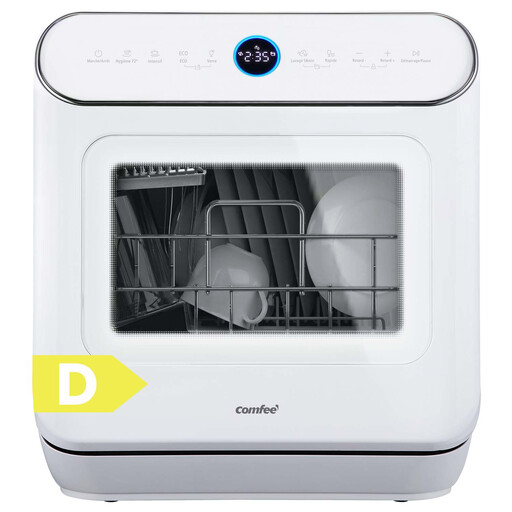 Image unavailable
COMFEE CDWMT305WD, 3 place settings, white
This small capacity is worth considering for a limited load rather than lots of pans and plates. The listing states 7 programmes and a D energy-efficiency class. Check the instructions for filling, drainage and the clearance needed on your worktop.
View on Joybuy
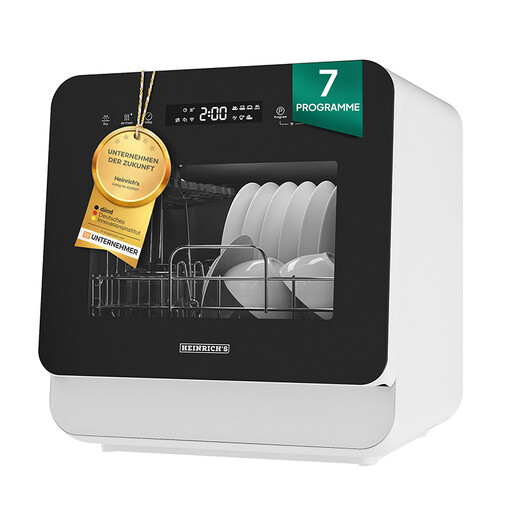 Image unavailable
Heinrich's HTG 8855, 3 place settings
This countertop model is designed for a limited load; the listing states 7 programmes and a C energy-efficiency class. Check the overall dimensions, water supply method and drainage. To compare noise levels, check the figure given for the exact variant.
View on Joybuy
Frequently asked questions
Can a mini dishwasher work without a water supply?
Yes, if the model is specifically designed to be filled from a water tank. Comfee' lists the CDWMTO201D (W) as requiring ‘no plumbing’, but this doesn’t apply to all countertop appliances. Check the instructions for filling and drainage too.
What do you need to install a connected countertop model?
Check the water supply, drainage and electrical supply needed for your chosen model, as well as the space required for the hoses and door to open. For example, Candy says the CP 6E51LW connects directly to the water supply.
Is a 6-place-setting dishwasher enough for everyday use?
It could suit a moderate load if one cycle can handle your usual washing-up. If you cook often or use lots of pans, compare its layout with that of a larger-capacity freestanding model. Beko, for example, lists a capacity of 10 place settings for the BDFS26040X.
How do you read the energy label when comparing different sizes?
Compare the energy-efficiency class, kWh per 100 cycles, litres per cycle, Eco programme duration, capacity and noise level, as ADEME recommends. Then relate these figures to how much washing-up you expect to do: a smaller capacity alone doesn’t determine which consumption level is right for your needs.


