What should you check before choosing?
Start by considering how much washing-up you produce between loads, then check that your chosen format will fit the space and compare the figures for the specific model. “Freestanding” describes the installation type, not a fourth capacity category.
| Priority |
What to check |
Depending on your needs |
| Amount of washing-up |
Compare the stated place settings with your usual loads, then check the height and layout of the baskets for larger dishes. Que Choisir generally gives a capacity of 12 to 17 place settings for a freestanding 60 cm model, 9 to 10 for a 45 cm model and fewer than 9 for a compact one. |
“I build up enough washing-up to fill a large dishwasher” points towards a 60 cm model. “My loads are small” suggests looking at a 45 cm or compact model; if your loads are very irregular, you could also stick with washing by hand. |
| Space and installation |
Measure the space, access route and clearance needed to open the door. Check the water inlet and waste connection. If you plan to install the appliance under a worktop, check the height and whether the top can be removed for the model you're considering. |
I want to avoid choosing a capacity that won't fit in my kitchen. For a compact worktop model, make sure the water supply and drainage will work in the space you've chosen. |
| Water and electricity |
According to ADEME and the European Commission, the label shows figures including kWh per 100 cycles, litres per cycle and the Eco programme duration. Check the figures for other programmes separately if you expect to use them often. |
I want to compare appliances using the same reference cycle, without assuming that a quick programme uses as much as the Eco programme. |
| Choosing when to run cycles |
Check the Eco cycle duration, available programmes and the interior layout of the model. Make sure the pans, glasses and dishes you use at home can be loaded without blocking the spray arms. |
A long cycle may fit into my routine, or lead me to choose another programme more often. The stated capacity is no use if my usual dishes don't fit properly in the baskets. |
| Maintenance and repairability |
Check how easy it is to access the filter, the maintenance instructions, the repairability index out of 10 and the information available about spare parts for the model. The French Ministry for Ecological Transition describes the index as an indication of how easy or difficult it is to repair the products it covers. |
I’d rather know which maintenance tasks I can do myself and what repair information I can refer to after buying. |
Which brands should you compare?
These examples from different ranges can help you identify formats and features to compare; they don't necessarily reflect the appliances available in the selection below.
Bosch
Bosch France lists freestanding dishwashers in 45 cm and 60 cm widths. Compare both sizes with the space you have and the amount of washing-up you produce.
- Having both widths to choose from lets you explore different capacities within the range.
- Compare the dimensions, energy label and interior layout of each model rather than assuming its features based on the brand.
Beko
Beko France lists, among others, two 60 cm freestanding models: the BDFN26446G, with a stated capacity of 14 place settings, and the LVV1347W, with 13.
- These models let you compare two stated capacities in the same width.
- Check the programmes and features of each model individually; the specifications of one model don't represent the whole range.
Miele
Miele France's product page for the freestanding G 7210 SC states a capacity of 14 place settings, water consumption of 8,4 L per Eco cycle and energy use of 54 kWh per 100 Eco cycles.
- These figures for the G 7210 SC let you compare its Eco cycle performance with another model on the same basis.
- They apply to this model alone and don't describe its other programmes or the entire Miele range.
Whirlpool
Whirlpool France describes the WSFO 3T223 P as a 45 cm freestanding dishwasher with a capacity of 10 place settings and a stated noise level of 43 dB.
- This model is a useful example of the capacity to consider if a 60 cm appliance won't fit.
- Check the dimensions, programmes and energy label figures for the model you're considering; these features don't apply to the entire range.
Joybuy models in two formats
This selection includes large-capacity freestanding dishwashers and compact worktop models. Compare their capacity with how often you do the washing-up, then check the installation requirements and running figures for each model.
 Image unavailable
Hotpoint H4FD641A freestanding dishwasher, 14 place settings, 60 cm
Worth considering if you regularly fill a large dishwasher and have a 60 cm space available. The product description states a capacity of 14 place settings, a noise level of 41 dB and an energy rating of C. Check the full dimensions, connections and Eco cycle figures before comparing its running performance with another model.
View on Joybuy
 Image unavailable
Samsung DW60M6050FS freestanding dishwasher, 14 place settings
If you have a large load every day, compare its stated capacity of 14 place settings with the space your dishes actually take up. The product description lists seven cycles; check the model specifications for their duration, Eco cycle figures and the dimensions needed for installation.
View on Joybuy
 Image unavailable
Indesit D2F HK26 S freestanding dishwasher, 14 place settings, 60 cm
Its stated width of 60 cm and capacity of 14 place settings make it suitable for a space and loads that can accommodate a large dishwasher. The product description gives it an energy rating of E; check the Eco cycle figures, full dimensions and connections, particularly if you plan to install it under a worktop.
View on Joybuy
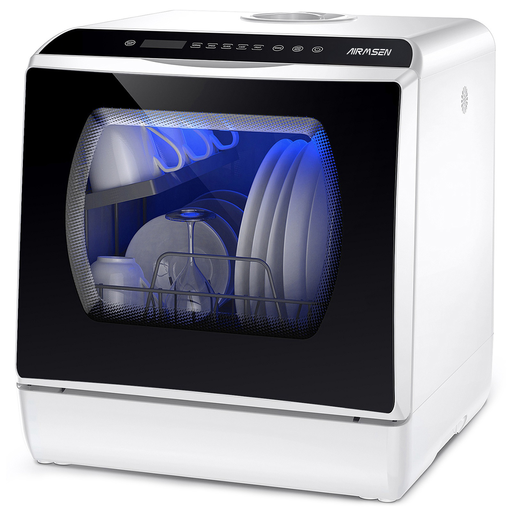 Image unavailable
AIRMSEN worktop dishwasher, 5 L water tank, 5+1 cycles
This worktop format is worth considering if you have small loads and no room for a full-size appliance. The product description mentions a built-in 5 L water tank and 5+1 cycles; check the capacity in place settings, the space on your worktop and how to fill and drain the appliance.
View on Joybuy
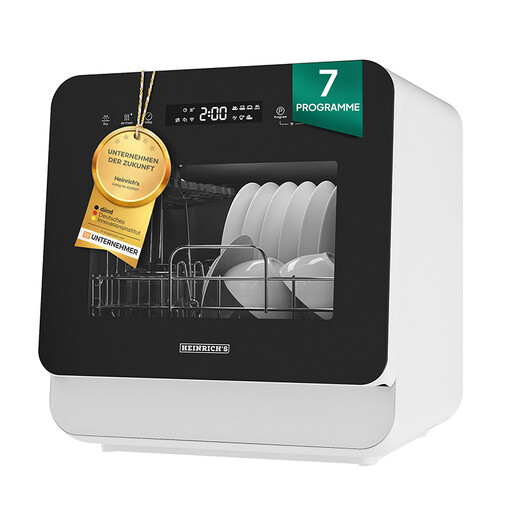 Image unavailable
Heinrich's HTG 8855, 3 place settings, 7 programmes
The stated capacity of 3 place settings is suited to small loads. Compare it with your everyday washing-up to avoid running the dishwasher too often. The product description also lists seven programmes, a noise level of 56,3 dB and an energy rating of C; check the dimensions and water supply and drainage options.
View on Joybuy
Frequently asked questions
Is a freestanding dishwasher always small?
No. “Freestanding” describes how the appliance is installed, not its capacity. According to Que Choisir, freestanding models include 60 cm appliances, which generally hold 12 to 17 place settings, and 45 cm appliances, which usually hold 9 to 10; compact models hold fewer than 9.
What should I compare on the energy label?
Compare the capacity, kWh per 100 cycles, litres per cycle, Eco programme duration and noise level. ADEME and the European Commission explain that the consumption figures shown are based on this reference cycle, so they don't automatically tell you how much a quick or intensive programme will use.
Does a dishwasher use less water than washing up by hand?
It may use less, but the comparison depends on how you wash by hand and how much washing-up you do. Que Choisir suggests that a dishwasher can use two to three times less water than traditional hand washing; compare this with your own washing-up habits and the Eco cycle water consumption of the model you're considering.
How should I factor in repairability?
Check the repairability index for the specific model, then look at the information available about spare parts and access to components that need maintenance. The French Ministry for Ecological Transition says this score out of 10 indicates how easy or difficult the products covered are to repair; it doesn't replace checking the details for the model itself.
When is it better to keep washing up by hand?
If your loads are small or too irregular to fill even a compact dishwasher sensibly, or if you can't install one in your home, you can continue washing up by hand. If washing-up builds up every day, compare the amount you need to wash with the stated capacities and the space you have available.


