Which households is it for?

Households using the dishwasher several times a week

To keep recurring consumption under control, compare kWh per 100 cycles and litres per Eco cycle, then check that the capacity is sufficient to avoid running several small loads. ADEME and the European Commission present these figures as key points of reference on the energy label.

Households with an open-plan kitchen or evening wash cycles

If noise could disturb mealtimes, working from home or sleep, compare the noise level in dB and the noise class rather than relying on a marketing description. ADEME states that this information appears on the label.

Small households or kitchens with limited width

You will need to balance the space available against the number of place settings. UFC-Que Choisir states that a 45 cm model may suit a small family, but its price and label figures should still be compared model by model with those of a 60 cm appliance.

Key selection criteria

60 cm freestanding

Consider it if: you have a 60 cm space available and generally want a large capacity without keeping a kitchen door panel.

Check: the format does not guarantee either quiet operation or low consumption; compare the full dimensions and the label for the exact model.

45 cm freestanding

Consider it if: width is limited and your household is happy with a smaller capacity or more frequent cycles.

Check: a slim appliance is not necessarily cheaper or more economical than a 60 cm model.

Built-in or fully integrated

Consider it if: your kitchen is designed to accommodate the appliance and a seamless frontage is a priority.

Check: the housing space, door panel or door, plinth and connections must match the chosen model precisely.

Priority What to check Your needs
Water and electricity consumption Compare the A to G class, kWh per 100 cycles and litres per Eco cycle. Use the same programme basis when comparing two appliances. I want to limit consumption from repeated washes without confusing the energy class with all the other useful figures.
Noise Check the noise level in dB and the noise class. Compare them between models with a suitable capacity and format. A cycle run during mealtimes, while working from home or in the evening must be suitable for an open-plan kitchen or a nearby living area.
Capacity and storage Check the number of place settings, width, baskets, cutlery drawer and height adjustments if you wash dishes or large glasses. The capacity should match the household’s mealtime routine and the crockery actually used, while still fitting the available space.
Eco programme duration Compare the displayed duration with the litres per cycle and kWh per 100 cycles. Do not apply these figures to a quick or intensive programme. I want to know whether the reference cycle duration fits the household’s routine and how quickly the crockery needs to be available.

Mistakes to avoid before buying

  • Choosing based solely on the energy class letter

    Two appliances in the same class can have different water consumption, Eco programme durations, capacities and noise levels. The letter does not replace the figures shown on the label.

    Compare the class, kWh per 100 cycles, litres per Eco cycle, Eco programme duration, place settings and dB readings together.

  • Assuming a quick cycle uses the same amount as the label cycle

    Label data is based on the Eco programme. Auto, quick and intensive programmes are designed for different uses; UFC-Que Choisir measures them separately in its testing protocol.

    If you will often use a short cycle, check the manual or comparable test results for that programme rather than estimating its consumption from the Eco label alone.

  • Ordering a built-in model without checking the housing space and door panel

    The installation type is a prerequisite: the dimensions of a built-in appliance vary by model and cannot be determined from its nominal width alone.

    Measure the height, width, depth, plinth and position of the connections, then compare them with the exact model’s specifications before buying.

    An incompatibility may require adjustments to the cabinet, door panel or installation.

  • Overlooking repairability and spare parts

    Low energy consumption during use does not, by itself, tell you about maintenance or repairs. The French repairability index and European rules on spare parts provide separate information.

    Check the repairability index for the exact model, the documentation available and the after-sales service arrangements before comparing washing performance alone.

Brand guide

Bosch

The French range includes freestanding, built-in and fully integrated dishwashers in 45 and 60 cm formats. It is worth considering if you are weighing up width, your existing installation and the figures on the energy label.

  • French specifications for individual models give details including dimensions, energy class, water consumption on the Eco cycle and noise class.
  • These figures apply to each model and cannot be generalised to the entire Bosch range.

Beko

An option to consider for households looking for a high stated capacity in a 60 cm freestanding format, with detailed product information for the model concerned.

  • According to Beko France’s specifications, the BDFN26450XP offers up to 15 place settings, a B energy class and 41 dB(A).
  • These manufacturer claims relate to this model and do not allow conclusions to be drawn about other Beko dishwashers.

Miele

The French range includes 60 cm and 45 cm freestanding and built-in dishwashers. It may be relevant if you are looking for an A energy class and a low stated noise level.

  • Miele France specifications for the G 5812 SC Active Plus and G 7042 SC AutoDos state an A energy class with 42 dB and an A energy class with 43 dB respectively.
  • The 20-year tested service life mentioned on some product pages is a brand claim, distinct from an independent test result.

Joybuy options

Joybuy options for everyday washing-up, including a 60 cm freestanding dishwasher for family-sized loads and a mini model designed for smaller volumes or very compact spaces.

Hotpoint H4FD641A dishwasher, 14 place settings

Hotpoint H4FD641A, 14 place settings, 60 cm

A freestanding option for a household with a 60 cm space available and looking for a stated capacity of 14 place settings.

Stated specifications include 41 dB, energy class C and approximately 9.5 L on the Eco cycle; a removable top and adjustable height are indicated for under-counter installation.

Check the 590 mm depth, under-counter height, connections and the model’s complete energy label before buying. The automatic door opening at the end of the cycle means you must follow the safety instructions relating to hot steam.

Joybuy
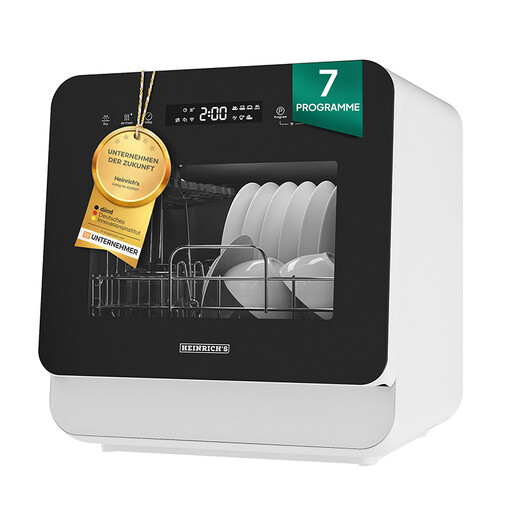
Heinrich's HTG 8855 mini table-top dishwasher

Heinrich's HTG 8855, mini dishwasher, 3 place settings

This table-top solution is best suited to small quantities of washing-up, a compact kitchen or a property without a permanent water supply.

Stated specifications include a capacity of 3 place settings, seven programmes, a 205-minute Eco cycle, consumption of 4.2 L per wash and a noise level of 56.3 dB. It is stated to work with either a 5 L tank or a direct tap connection.

Capacity is limited for large loads and bulky dishes. Check the dimensions, kWh per 100 cycles, noise class and drainage arrangements according to the installation you choose.

Joybuy

Frequently asked questions

What do the figures on a dishwasher’s energy label mean?

Since 1 March 2021, the European label has ranged from A to G. According to the European Commission and ADEME, it shows information including energy consumption per 100 cycles, water consumption per cycle, capacity, Eco programme duration and noise emissions. Compare these figures between appliances in a suitable format, bearing in mind that they relate to the Eco programme.

Does a very long Eco programme necessarily use more energy?

No. The Eco programme is the reference cycle for the label information, while its duration is shown separately. So do not estimate water or electricity consumption from the duration alone: also compare litres per cycle and kWh per 100 cycles.

Which noise level should you look at in an open-plan kitchen?

Check the noise level in dB and its noise class on the label. ADEME states that an increase of three decibels corresponds to an almost doubling of the noise, so it is better to compare the displayed figure than rely on a simple marketing claim.

Is a 45 cm dishwasher always more economical than a 60 cm model?

No. A slim format primarily addresses space and capacity constraints. UFC-Que Choisir points out that 45 cm models are not necessarily cheaper than appliances with a larger capacity; compare the label figures for the model you are considering rather than the format alone.

Is the repairability index useful when choosing a new dishwasher in France?

Yes. France’s Ministry for Ecological Transition states that the repairability index is a score out of 10 provided to consumers for new dishwashers. It complements the energy label by providing a reference point for aspects such as access to spare parts, ease of disassembly and documentation.