What to look for
| What matters to you |
What to check before buying |
Who this is especially relevant to |
| Making daily washing-up easier |
Make a note of how much washing-up you produce and how often you could run a suitable load. |
If I want to cut down on a chore that comes round after every meal, I check that an appliance makes sense for my routine. Around 25% of consumers prioritise daily washing-up. |
| Making room for the appliance and connecting it |
Measure the space and check the water inlet, waste outlet and power supply specified in the instructions. |
If my kitchen is small or the installation needs to work with the existing layout, I check every connection before choosing a size. Around 25% of consumers prioritise this. |
| Matching the capacity to the washing-up you produce |
Compare the stated place settings and basket layout, particularly for dishes and pans. |
If I need all my usual cookware to fit, I look at the interior as well as the stated capacity. Around 20% of consumers prioritise usable capacity. |
| Keeping resource use and running costs in check |
Compare kWh per 100 eco cycles, litres per eco cycle and cycle duration on the same basis. |
To work out what it could mean for my day-to-day life, I compare the label information with how often I’ll use the appliance and my tariffs. Running costs are the priority for around 20% of consumers. |
| Keeping noise to a minimum |
Compare the noise level shown on the labels of models that are already suitable for your kitchen. |
In an open-plan kitchen, I pay attention to the noise during a cycle. Around 10% of consumers put quiet operation at the top of their list. |
The European Commission lists information including electricity use per 100 eco cycles, water use per cycle, cycle duration, capacity and noise emissions. ADEME publishes appliance consumption benchmarks, but your actual costs depend on how you use your appliance and your tariffs.
Joybuy products to suit your needs
This selection includes compact, freestanding and integrated dishwashers, so you can compare models suited to different load sizes and kitchen layouts.
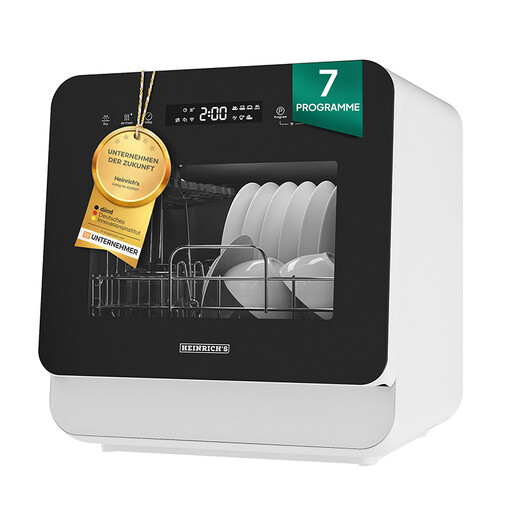 Image unavailable
Heinrich's HTG 8855
Worth considering for smaller loads if a countertop appliance suits your kitchen.
- Stated capacity: 3 place settings
- 5 L tank or direct connection to the tap
- Stated water use: 4,2 L per cycle
- 7 programmes; stated noise level: 56,3 dB
View product on Joybuy
 Image unavailable
Whirlpool WFP5O41PLGX
Worth looking at if you want a 60 cm freestanding model with a large capacity.
- Stated capacity: 14 place settings
- C energy rating
- 75 kWh per 100 eco cycles and 9,5 L per eco cycle
- Stainless steel finish
View product on Joybuy
 Image unavailable
Indesit D2F HK26 S
Worth considering for a kitchen that can fit a 60 cm freestanding model and loads of up to 14 place settings.
- Stated capacity: 14 place settings
- E energy rating
- 9,5 L per cycle
- 6 programmes; stated noise level: 46 dB
- Grey finish; removable worktop
View product on Joybuy
 Image unavailable
Samsung DW70H72WCB0U1
Worth considering if your kitchen has a space that’s compatible with a fully integrated model.
- 60 cm integrated model
- Stated capacity: 13 place settings
- C energy rating
- Middle basket adjustable to three positions
View product on Joybuy
 Image unavailable
Samsung DW80H72YBB0U1
Worth considering for a kitchen that can accommodate a 60 cm fully integrated dishwasher.
- Stated capacity: 13 place settings
- Energy rating stated in the product title
- Adjustable middle basket
- Sliding door and automatic opening at the end of the cycle
View product on Joybuy
Frequently asked questions
Which connections should I check before buying a dishwasher?
Check the space, water inlet, waste outlet and power supply specified in the model’s instructions. Bosch outlines these connections for installation. Electrolux’s pre-installation guide explains that its described service doesn’t include plumbing, electrical or carpentry work.
Can I alter a rented kitchen to install an appliance?
If your plans involve altering the rented property or its fittings, get your landlord’s written permission before starting work. This doesn’t mean that every straightforward appliance connection needs permission: check what changes are involved.
How can I compare energy use without overestimating savings?
The European energy label includes information such as electricity use per 100 eco cycles, water use per eco cycle, cycle duration and capacity. Compare figures calculated on the same basis, then factor in how many cycles you’ll run and your tariffs. ADEME publishes usage benchmarks, not a prediction of your future bill.
What should I plan for routine maintenance?
Check your model’s instructions and make sure you clean the filter. Bosch explains that, on its appliances, a clogged filter can affect washing performance and provides instructions on how to clean it.
What protections and information should I ask the retailer about?
In France, the legal guarantee of conformity is compulsory when a business sells goods to a private individual. The Ministry of the Economy states that you have two years to claim under it. Also check the repairability index and the criteria it covers, where it applies to the dishwasher in question.


