Clean dishes ready for your next meal
You load the dishwasher after several meals and need clean dishes by a specific time. Compare the programme duration, delay start and remaining-time display.


For meals at different times, start by thinking about when you need your clean dishes: compare the programme duration with the earliest possible start time, then check the delay start and remaining-time display on the specific model. Next, weigh up the stated noise level, capacity and consumption. A compact model mainly solves a space constraint; it doesn’t automatically mean greater efficiency.
You load the dishwasher after several meals and need clean dishes by a specific time. Compare the programme duration, delay start and remaining-time display.
You’re considering running a wash while other people in your home are resting. Compare the stated noise levels, but don’t assume that the appliance will be inaudible in your home.
You need to check whether a standard or compact appliance will fit the available space and hold the dishes you usually use. Dimensions and real-world loading matter just as much as the stated format.
Start by working out when your dishes need to be ready, taking account of the delay before the programme starts and its full duration. Then choose a size to suit the space and your load, before comparing noise and consumption figures for the exact model.
| What matters | What to check | Who is this important for? |
|---|---|---|
| Dishes ready in time | Check the Eco programme duration, delay start and remaining-time display separately. Electrolux states that the ESA47210SW has a 24-hour delay start and an Eco programme lasting 4:00. | If I load the dishwasher after the last meal, I want to know whether the dishes will be ready before I need them again. This matters to around 28% of consumers who choose according to when their dishes will be ready. |
| Noise while people are resting | Compare the stated noise levels and noise classes: Bosch lists 42 dB and noise class B for the SMS4EMW06E; Electrolux lists 44 dB(A) for the ESA47210SW. These figures can’t predict how noisy the appliance will be in your kitchen. | If the dishwasher may run while other people are resting, I want to take noise into account without assuming there’ll be no disturbance. Around 22% of consumers prioritise the comfort of people in the home. |
| Loading dishes from several meals | Compare the stated capacity and basket layout with your dishes. Electrolux lists 13 place settings for the ESA47210SW and Beko 14 for the BDFN26440WP; it’s also worth checking how their interiors are arranged. | If I’d rather combine dishes from several meals, I check whether the baskets can hold the items I use. Combining loads is a priority for around 22% of consumers. |
| Programme duration and consumption | The energy label shown by the European Commission includes electricity use per 100 Eco cycles, water use per cycle and the Eco programme duration. Electrolux states that the ESA47210SW uses 94 kWh/100 cycles and 9,9 litres per cycle, with an Eco programme lasting 4:00. | If I can wait for the programme to finish, I compare consumption with the duration, using the same reference programme. Around 17% of consumers prioritise running costs. |
| Available space | Measure the height, width and depth, and check the installation type. Bosch lists dimensions of 450 × 551 × 500 mm for the compact SKS62E32EU and 845 × 600 × 600 mm for the SMS4EMW06E, in height × width × depth order. | If my kitchen space won’t accommodate a standard-sized model, I check the dimensions and installation restrictions before comparing programmes. Around 11% of consumers prioritise a compact fit. |
Delay start postpones the beginning of the cycle; it doesn’t make the cycle shorter. Electrolux lists an Eco programme duration of 4:00 for the ESA47210SW.
Work backwards from when you need the dishes, then check the available delay, the cycle duration and the remaining-time display together.
Size is primarily about fitting the appliance into your space. For the compact SKS62E32EU, Bosch lists an F energy rating and 8,0 litres per Eco cycle. These figures can’t be generalised to all compact models.
Choose a size to suit the space and your actual load, then compare the stated consumption of the specific models separately.
A stated noise level doesn’t guarantee that the appliance will be inaudible in your home or that you can use it at any time.
Service Public and the Ministry of the Interior note that noise can constitute an abnormal disturbance, and that permitted hours aren’t the same everywhere in France. Check the local rules that apply to your home.
These examples show the stated specifications of specific models; they aren’t recommendations for entire product ranges.
The SMS4EMW06E is an example of a standard-sized model with connected features, while the SKS62E32EU is a compact model.
The Series 300 AirDry, represented here by the ESA47210SW, includes a stated delay start and an adjustable basket.
The BDFN26440WP is an example of a standard-sized dishwasher with a stated capacity of 14 place settings.
These tabletop and worktop models are worth considering for kitchens where space is a concern. Check their dimensions, loading capacity and programme settings to make sure they suit the way you’ll use them.
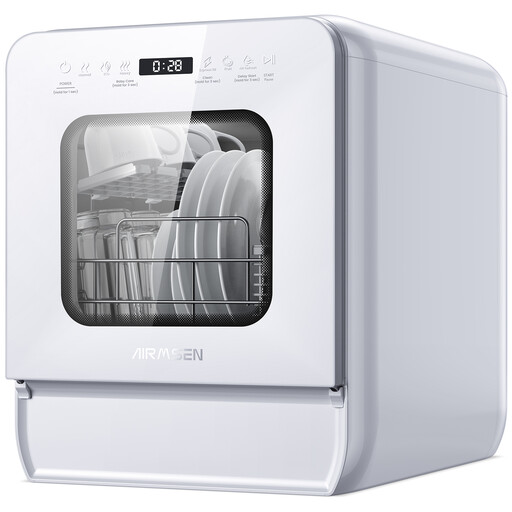 Image unavailable
Worth considering if a tabletop appliance suits your available space and a stated capacity of 4 place settings meets your needs.
The title lists a built-in 5 L tank, 9 programmes, a 1 to 24-hour delay start and a D energy rating.
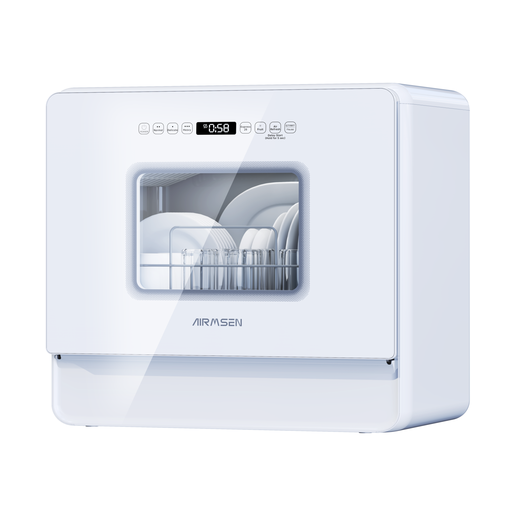 Image unavailable
Worth looking at if you want a worktop appliance with a stated delay start. Check that its capacity suits the dishes you use.
The title lists a built-in 5 L tank, two basket levels, three spray arms and a 12-hour delay start. The product details note that the top basket must be removed to fit plates up to 300 mm.
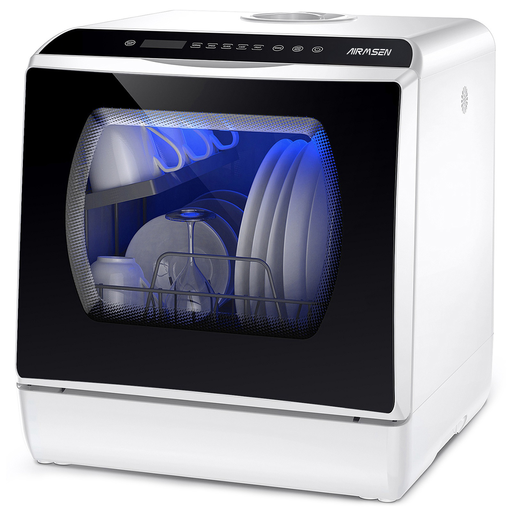 Image unavailable
Consider it for a compact space if its stated capacity of 4 place settings meets your needs; it may be too small for combining dishes from several meals.
The title lists a built-in 5 L tank and a double-glazed tempered glass door.
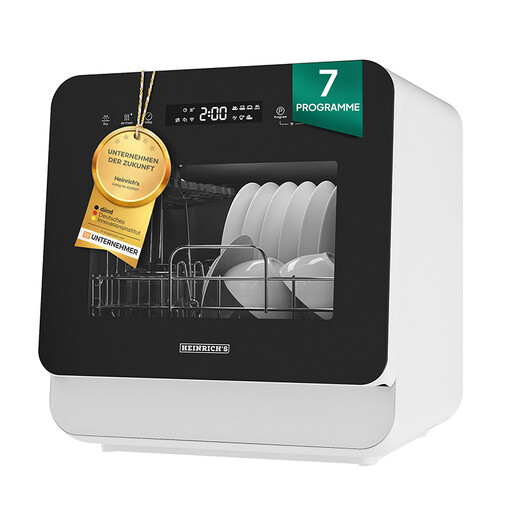 Image unavailable
Worth considering if a tabletop model suits your space and its stated capacity of 3 place settings is enough for your needs.
The title lists 7 programmes, a 24-hour delay start, a water softener, 56,3 dB and a C energy rating.
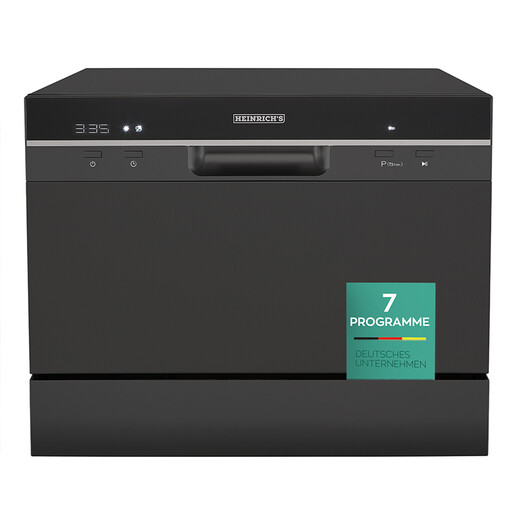 Image unavailable
Worth considering if you want a tabletop appliance with a stated capacity of 6 place settings. Check that the cycle and size fit your routine.
The title lists 7 programmes, a 24-hour delay start, 47 dB and a D energy rating.
The European Commission label includes details such as electricity use per 100 Eco cycles, water use per cycle, Eco programme duration, capacity and noise. These are reference indicators, not figures for every programme.
No. You need to take the delay start and cycle duration into account separately. Electrolux lists a 24-hour delay start and an Eco programme lasting 4:00 for the ESA47210SW. Also check the remaining-time display on the model you’re considering.
A noise rating doesn’t give you blanket permission to run a dishwasher at night. Service Public states that household noise may be penalised if it causes an abnormal disturbance; the Ministry of the Interior notes that there are no uniform permitted hours across France. Local rules and the rules of your block of flats may also apply.
Compact size alone doesn’t tell you how much a dishwasher will use. Bosch lists an F energy rating and 8,0 litres per Eco cycle for the SKS62E32EU. Compare the figures for specific models, and check their availability and loading capacity too.
No. Installation options depend on the exact model. Electrolux states that the ESA47210SW can’t be installed at a raised height. Check the model’s instructions and, if necessary, have the connections assessed.