Households that cook often
If your meals also leave you with bulky dishes and utensils, look at the usable space in the baskets, not just the number of place settings. Que Choisir puts 60 cm models at around 12 to 17 place settings.


Start by choosing a dishwasher that fits your usual loads and your kitchen. According to Que Choisir, 60 cm models generally hold 12 to 17 place settings, 45 cm models 9 to 10, while a compact model suits smaller loads. Next, decide whether a freestanding or integrated model works best for your kitchen, then compare the Eco programme figures, noise level, basket layout and repairability index of the model you’re considering.
If your meals also leave you with bulky dishes and utensils, look at the usable space in the baskets, not just the number of place settings. Que Choisir puts 60 cm models at around 12 to 17 place settings.
When space is tight, you’ll need to balance capacity against the room the appliance takes up. Que Choisir associates 45 cm models with 9 or 10 place settings and lists six-place-setting compact worktop models. However, check each product individually.
The stated noise level matters more if the machine runs close to your living area. For an integrated appliance, also check the housing, door panel and connections before choosing a model.
Start with the amount of washing-up and the space available. Freestanding and integrated models suit different installation requirements. A compact model is mainly for saving space, but check the capacity of each model.
| Criteria | What to check | Who it matters to |
|---|---|---|
| Capacity and loading | Compare the number of place settings, basket heights and space for your dishes. According to Que Choisir, 60 cm models generally hold 12 to 17 place settings, while 45 cm models hold 9 to 10. | After a meal that quickly fills the sink with dishes and utensils, I want to avoid running several cycles. Around 31% of consumers would prioritise this loading capacity. |
| Space and installation | Measure the space and door clearance; check the water inlet, waste outlet and socket. For an integrated model, also check the housing and door panel. | In an already fitted kitchen, the appliance needs to fit without blocking the door or making connections difficult. This would be the main concern for around 31% of consumers. |
| Use and repairability | Compare the Eco programme figures on the labels of similar models and check the repairability index for the model in question. | If the machine runs regularly, I want to know how much it uses and be able to take its repairability into account. Around 23% of consumers would put these questions first. |
| Noise and convenience | Check the stated noise level for the exact model and make sure it has the features you want, such as automatic door opening. | When the kitchen opens onto the living area, the machine could disturb activities nearby. Noise and convenience would come first for around 15% of consumers. |
This figure doesn’t tell you whether your pans, dishes and utensils will fit easily in the baskets.
Picture a typical load after a meal, then check the basket adjustments and available height in the manual or in store.
External dimensions aren’t enough: the housing, door panel and access to the connections all affect installation.
Take measurements and check who supplies and fits the door panel, as well as what’s included in the installation service.
Depending on your kitchen, you may also need a matching door panel or carpentry, plumbing or electrical work.
Water and energy use vary by model and programme, so two figures on their own aren’t an apples-to-apples comparison.
Use the Eco programme figures on the labels of similar models, and avoid running the machine when it’s nearly empty.
Noise levels, automatic door opening and adjustable baskets can vary from one model to another.
Check the product page and manual for the exact model to confirm it has the features that matter in your kitchen.
Bosch offers freestanding and integrated dishwashers, with features that vary by model.
Some freestanding Beko models include features such as SelfDry or CornerIntense.
The range includes freestanding models, with programmes and capacity to check for each individual model.
Miele offers, among other options, integrated appliances and XXL models, with features that vary.
These models suit three of the situations covered here: fitting an integrated appliance, choosing a freestanding model for regular loads, or opting for a compact model for smaller loads. Before choosing, compare their stated specifications with your dishes and available space.
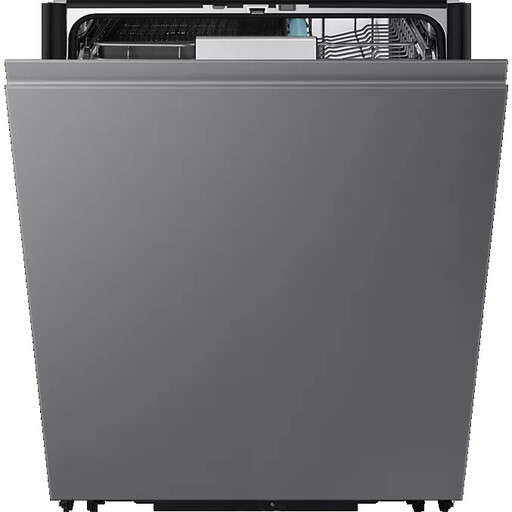 Image unavailable
Worth considering for regular loads in a fitted kitchen. This model is listed as a 60 cm integrated dishwasher with 14 place settings and an A energy rating. Check the housing measurements and door panel compatibility.
 Image unavailable
A freestanding option to consider if your household regularly produces a large load. The model title lists 14 place settings and 7 programmes; check its dimensions, door clearance and required connections.
 Image unavailable
Worth considering for a fitted kitchen used for everyday meals. This 60 cm integrated model is listed with 13 place settings and a C energy rating. Check the housing, door panel and clearance needed in front of the door.
 Image unavailable
Worth comparing for regular loads when you don’t need a kitchen door panel. The model is listed with 14 place settings, a width of 60 cm and an E energy rating. Measure the space and check the connections.
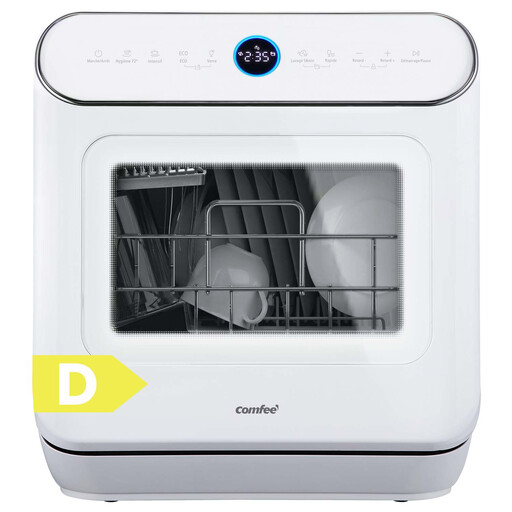 Image unavailable
Worth considering when space and the amount of washing-up are limited. The title lists 7 programmes and a D energy rating; check the stated capacity for this model, the size of your plates and how it’s filled before making your choice.
A smaller model may suit lighter loads better, as long as it can fit your usual dishes. Que Choisir lists six-place-setting compact worktop models and 45 cm models with 9 to 10 place settings. Avoid running nearly empty cycles or packing the dishes in too tightly.
Measure the space and door opening, then check access to the water supply, waste outlet and an electrical supply that meets the model’s instructions. If you use Electrolux’s pre-installation service, it specifies a maximum distance of 1.2 m between the appliance and the water and waste connections. This service-specific guideline doesn’t replace the requirements for your own installation.
Compare the Eco programme figures on the labels of similar-sized models, particularly energy use per 100 cycles and water use per cycle. Actual consumption also depends on the programme and how full the machine is. ADEME advises against pre-rinsing and running the machine with too few dishes.
In France, the repairability index displayed for applicable household dishwashers lets you compare this aspect of different models, but it doesn’t tell you about their capacity or washing performance. The French ministry responsible for ecological transition explains that the label is shown in shops and online; the decree of 22 April 2022 sets out the criteria for household dishwashers.