What should you check before choosing?
First, work out what size your kitchen can accommodate, then check that the capacity suits your mealtime routine. Next, consider the installation type and compare the energy labels.
45 cm model
Worth considering: when there isn’t enough width for a 60 cm model and you need a smaller capacity to suit the amount of washing-up you produce.
Bear in mind: if you have a lot of washing-up, the smaller capacity may mean running cycles more often.
60 cm model
Worth considering: if you have enough space and need a larger capacity. Que Choisir gives a capacity of 12 to 17 place settings for freestanding models of this size.
Bear in mind: you’ll need enough width, as well as room for the appliance’s height, depth and door to open.
| Priority | What to check | What I need |
|---|
| Space and capacity |
Measure the height, width and depth, as well as the clearance needed for the door. Compare the stated place settings with the amount of washing-up you produce between cycles. Que Choisir gives typical capacities of 9–10 place settings for 45 cm freestanding models and 12–17 for 60 cm models. |
My kitchen is narrow, but I also want to be able to wash the dishes I get through at mealtimes. |
| Installation |
Check the water inlet, waste outlet, socket and space for the hoses. Check the requirements in the manual and, if you’re having the appliance installed, the terms of the service you choose. |
I want to know whether the space can accommodate the appliance without any unexpected changes to the connections. |
| Noise and energy use |
Check the energy label for the exact model and compare kWh per 100 cycles, water per cycle and noise information. ADEME notes that electricity consumption is shown per 100 cycles. |
In an open-plan kitchen, the stated noise level matters as much to me as the space the appliance takes up. If I run it often, I’ll also check its stated water and electricity use. |
| Installation type |
For an integrated model, check the recess, door panel, hinges and fixings. For a freestanding model installed under a worktop, check the specifications to confirm whether the top can be removed if needed. |
I need an appliance that suits my kitchen units, whether it’s left visible or fitted with a door panel. |
What do the brands have to offer?
These examples relate to specific models or ranges; they don’t represent every appliance from each brand.
Bosch
Bosch publishes the full dimensions of some 45 cm freestanding dishwashers, making it easier to check whether a particular model will fit in your chosen space.
- Bosch Électroménager France lists dimensions of 845 × 450 × 600 mm for the SPS4EMW61E.
- These dimensions apply to the SPS4EMW61E only. Check the specifications and manual for any other model before installation.
Beko
Beko’s French range includes 45 cm dishwashers. Compare the capacity of each model to find the right one for you.
- Beko states that one model in its 45 cm range can hold up to 10 place settings.
- This stated capacity doesn’t apply to the whole range, so check the specifications of the model you’re considering.
Miele
The G 5790 SCVi SL is an example of a 45 cm fully integrated dishwasher designed for a fitted kitchen.
- Miele lists a width of 45 cm and a stated noise level of 44 dB for this model.
- To fit it, check that your recess and door panel are suitable for the G 5790 SCVi SL.
A tabletop option on Joybuy
This selection features a tabletop dishwasher for spaces where width is particularly limited. Consider its size and capacity separately from those of 45 cm and 60 cm dishwashers.
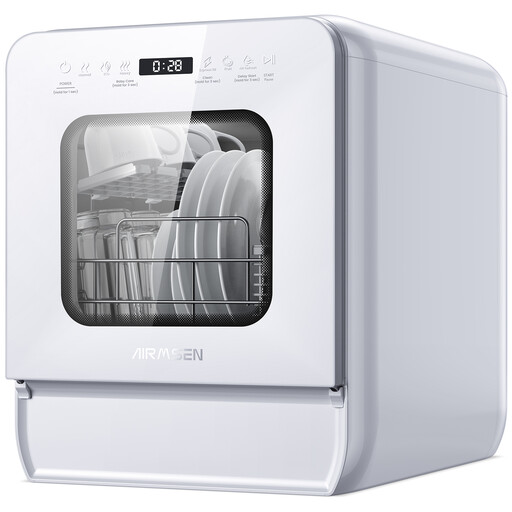 Image unavailable
AIRMSEN tabletop dishwasher, 5 L tank, white
Worth considering if you can’t find room for a 45 cm appliance: this model is listed as 37 cm wide and has an integrated 5 L tank, with the option to connect it to a tap. The product title lists 9 programmes, a delay-start function of 1 to 24 hours and a D energy rating. Before planning its installation, check the required depth and clearance, as well as whether its capacity suits your washing-up.
View on Joybuy
Frequently asked questions
Is a 45 cm dishwasher suitable for a small household?
Yes, provided its capacity suits the amount of washing-up you accumulate between cycles. Que Choisir gives a typical capacity of 9–10 place settings for 45 cm freestanding models. Check the stated capacity of the model you’ve chosen and how often you expect to run it.
What should I measure before ordering?
Measure the available height, width and depth, then check the door clearance and space for the hoses. If a freestanding model needs to fit under a worktop, check the specifications to see whether its top can be removed if necessary.
Which connections should I check?
Check the water inlet, waste outlet and a socket that meets the requirements in the model’s manual. For its own installation service, Electrolux specifies, among other things, a maximum distance of 1.2 m between the appliance and the water inlet and waste outlet. This is a condition of that service, not a rule that applies to every appliance.
How can I compare noise and energy use?
Check the label for each model rather than looking only at its energy rating. ADEME states that electricity consumption is shown in kWh per 100 cycles. Also compare water use per cycle, the Eco programme duration and the noise information, particularly if the appliance will be running near your living space.
Does an integrated dishwasher come with a door panel?
Don’t assume so: check what’s included with the model and whether it’s compatible with your planned kitchen door panel. Also confirm with your installer whether fitting and attaching the panel are included in their service.


