
Livraison le jour même ou le lendemain

Qualité garantie

Débloquez vos offres de bienvenue: Livraison GRATUITE | Jusqu'à -80 % | 30 jours d'essai gratuits à JoyPlus
Téléchargez l'application
A dish drainer can quickly become bulky, unstable or awkward to clean if its dimensions and drainage system are not suited to your kitchen. Whether you live in a studio flat, a shared home or a family house, your choice mainly depends on the space available around the sink, how much crockery you need to dry and how often you use it.
Before you buy, three common mistakes are worth avoiding.
Measure the space available next to the sink, taking cupboard doors and everyday access into account. A 2-tier dish drainer makes use of vertical space, but it needs a sufficiently stable base and enough clear space above it.
For one person or a student, a compact model with plate dividers and a cutlery holder may be perfectly adequate. Families are more likely to benefit from a wider model that can hold different types of crockery. The stated capacity should also be compared with the maximum permitted load: some Curver models specify a limit of 6 to 10 kg, while the model designed for 18 plates states 8 kg evenly distributed.
A stainless-steel dish drainer generally withstands moisture well, provided it is cared for correctly. 304 stainless steel, used on several models, is valued for its resistance to corrosion in a damp household environment. However, deposits should still be rinsed away and surfaces dried, especially after using cleaning products.
Polypropylene, or PP, is lightweight and easy to wash. It is well suited to compact models and drip trays. To prevent unpleasant odours, choose a dish drainer with a tray that can be removed easily and rinsed regularly. Open corners, ventilation slots and removable dividers also make cleaning easier.
A dish drainer with a drip tray protects the worktop, provided you empty the tray before it overflows. If the model has a hose or water outlet, it should be possible to direct it towards the sink without obstruction.
A dish drainer designed for use in the sink, or placed directly over the bowl, helps limit water running onto the worktop. However, check its extension range and the width of your sink. Non-slip feet, a flat base and evenly distributed plates are essential to prevent it from tipping over.
The models recommended below are designed for different uses. The specifications are based on the information available for each product; check the product page before buying to confirm which accessories are included and the maximum permitted load.
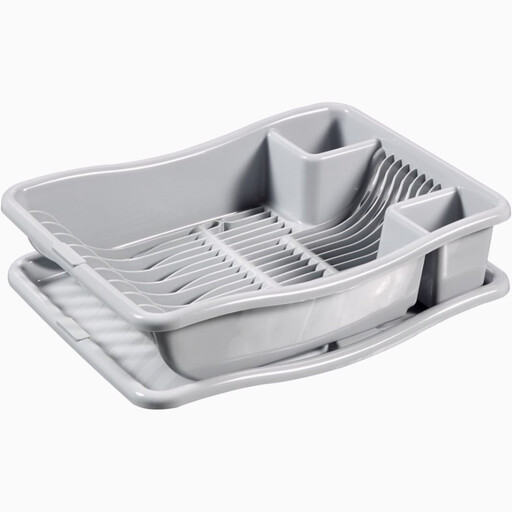
Why this choice suits this profile : This polypropylene model measures 29 × 10.5 × 39 cm and provides slots for 12 plates, along with integrated cutlery holders. It is ideal for a first-time setup with no assembly required, particularly in a small kitchen.
The removable drip tray helps reduce the risk of water ending up on the worktop. Its compact base avoids taking up too much space in a small kitchen.
Compact format, integrated cutlery holders and cleaning stated to be dishwasher-safe.
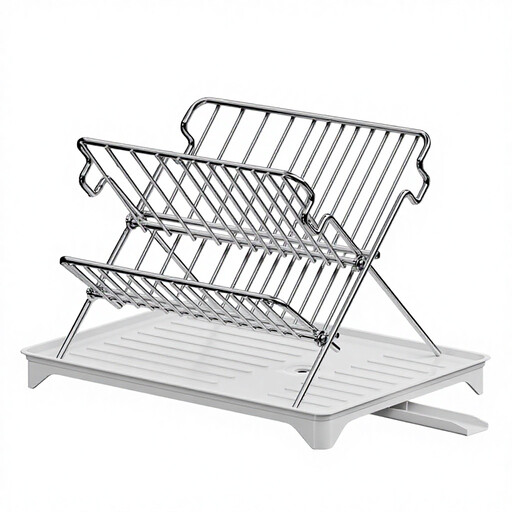
Why this choice suits this profile : Its two-tier stainless-steel and PP design efficiently organises plates, bowls, cups and utensils. Measuring 42 × 32 × 30 cm, it is suited to households that use their dish drainer regularly.
The drainage hose must be directed towards the sink, helping to limit water build-up. Once folded, the dish drainer is easy to store when you need to clear the worktop.
Two tiers, foldable design, multiple compartments and a stainless-steel surface designed for damp environments.
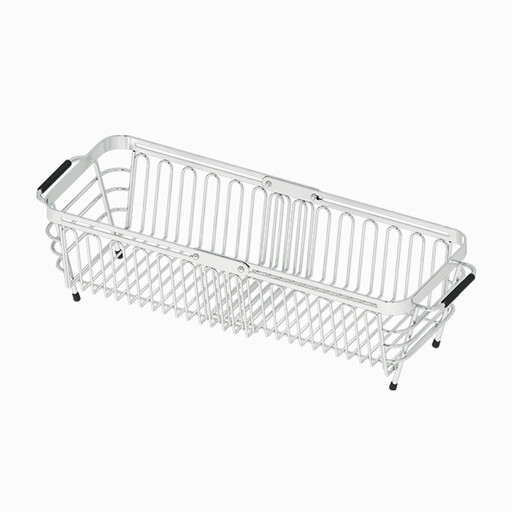
Why this choice suits this profile : This sink dish drainer extends from 29 to 44 cm and can also be used as a basket for draining fruit and vegetables. It is ideal for anyone who wants to combine washing-up and food preparation.
The adjustable length means you do not have to buy a fixed model that is poorly suited to the sink bowl. The openwork base guides water and residue towards the sink.
304 stainless steel, extendable length from 29 to 44 cm and colander function for fruit and vegetables.
We have put together a complete, real-time updated list of products that meet these demanding selection criteria as well as European safety standards.
A separate cutlery holder can be useful when the main dish drainer is full. The Maxcook 304 stainless-steel model measures 10 × 7.5 × 15 cm and has a removable lower tray. For food preparation, a double basket such as the COOKERKING or a PURECOOK 304 steel rice colander can be used to rinse grains, fruit and vegetables. These accessories do not replace a dish drainer, but they help keep your preparation area better organised.
A sink organiser for sponges and washing-up liquid can also help reduce clutter. Before adding several accessories, however, check the available width and how easy it is to empty each tray.
Place it on a level surface, empty the drip tray regularly and direct the water outlet towards the sink when provided. After cleaning, dry the tray and poorly ventilated areas to help limit deposits and unpleasant odours.
Yes, provided its structure remains stable when unfolded and the load is distributed according to the manufacturer’s instructions. Its main advantage is that it can be stored easily in a small kitchen, not that it automatically increases its capacity.
It depends on the quality of the steel, exposure to standing water, the products used and the load it bears. Regular rinsing, thorough drying and using non-abrasive sponges help preserve the surface. Also remember to check the feet, seals and assembly points regularly.