
Livraison le jour même ou le lendemain

Qualité garantie

Débloquez vos offres de bienvenue: Livraison GRATUITE | Jusqu'à -80 % | 30 jours d'essai gratuits à JoyPlus
Téléchargez l'application
Cluttered countertops, poorly dried dishes… it's an all-too-familiar scenario. The dish rack, an accessory often considered trivial, is actually a cornerstone of kitchen organisation. But be warned: a poor choice can quickly turn this valuable ally into a source of daily frustration.
Before you commit, let's break down the classic mistakes that lead to buyer's remorse. All too often, design flaws or low-quality materials only reveal themselves after several weeks of use.
Choosing the right dish rack, therefore, is about finding the perfect balance between capacity, durability, and hygiene, while also considering how it fits with your kitchen's aesthetic.
To make the right choice, a few technical points need close attention. These are what will make all the difference between a gadget and an everyday ally.
The material doesn't just define your dish rack's look. Above all, it determines its durability against moisture and its ease of cleaning.
A good kitchen organiser must manage runoff water perfectly. Two systems compete?:
The size of your dish rack must obviously match your needs and the space you have available.
Here are a few models that stand out for their smart design and practicality, each meeting a specific need.
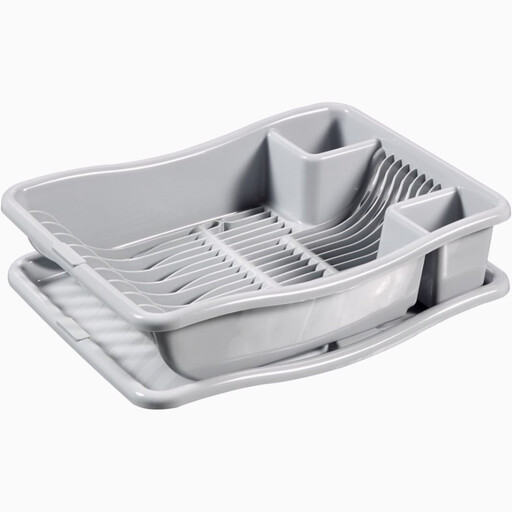
Why it stands out : Perfect for kitchens where every inch counts. Its compact design hides a surprising capacity (up to 18 plates), while also integrating a cutlery holder and a tray. An all-in-one solution designed for everyday life.
Made entirely of plastic, it completely eliminates the risk of rust. Its integrated collection tray puts an end to the problem of water stagnating on the countertop, ensuring a surface that's always clean and dry.
A complete and compact solution with a tray and cutlery holder. Its dishwasher-safe compatibility radically simplifies maintenance.
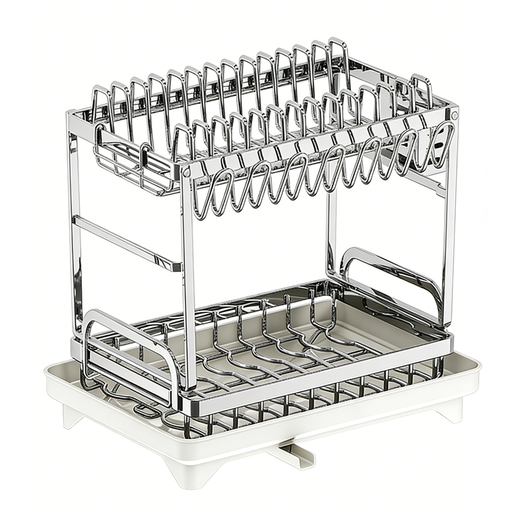
Why it stands out : Its two-tier structure multiplies drying capacity without taking over your countertop. It's designed to handle all the dishes from a family meal, with dedicated spaces for plates, bowls, and cutlery.
The combination of stainless steel and PP plastic effectively protects it from rust. Its reinforced structure ensures excellent stability, even when fully loaded. The integrated drain pipe continuously evacuates water, preventing any stagnation.
Its large vertical capacity and direct drainage system make it a champion of hygiene and space optimisation.

Why it stands out : Designed for those who want to invest in a robust, durable, and well-thought-out product. Its single-piece stainless steel structure is ready to use out of the box and built to withstand heavy use. Its sleek design fits elegantly into contemporary kitchens.
Its high-quality stainless steel construction takes rust out of the equation. The removable collection tray radically simplifies cleaning and prevents mould growth. Its single-piece design ensures rock-solid stability.
An ultra-sturdy single-piece design (no assembly required) and easy maintenance thanks to its removable tray.
Discover our complete and up-to-date selection of products that meet our quality criteria and safety standards.
Weekly cleaning is key. Empty it completely and wash it with hot, soapy water, paying close attention to the collection tray, cutlery basket, and any grooves where water can stagnate. Rinse thoroughly and dry it completely before putting it back into service. For compatible models, a cycle in the dishwasher is the easy solution.
Stainless steel is an alloy that integrates chromium into its very structure, making it naturally rust-resistant. Chrome-plated metal, on the other hand, is simply a base steel covered with a chrome plating. While this coating is aesthetically pleasing, it remains fragile: a single knock or scratch is enough to make it flake, exposing the metal to moisture and therefore to corrosion. Stainless steel is unquestionably the more durable choice for a humid environment like the kitchen.
The stability of a 2-tier dish rack depends entirely on its design. Good models have a wide, weighted base, non-slip feet, and a sturdy frame. The golden rule to ensure balance is to always distribute the weight wisely, placing the heaviest items (large plates, pans) on the bottom tier. Finally, make sure it rests on a perfectly flat surface.