
Livraison le jour même ou le lendemain

Qualité garantie

Débloquez vos offres de bienvenue: Livraison GRATUITE | Jusqu'à -80 % | 30 jours d'essai gratuits à JoyPlus
Téléchargez l'application
A dish drying rack isn't just there to hold a few plates upright. It needs to let water drain away, stay perfectly stable, and fit the space you actually have. Whether you're working with a small kitchen or a family home, a poorly chosen model can quickly clutter your worktop or leave water pooling under your utensils.
Before you place your order, here are the main pitfalls to avoid.
The number of plates listed isn't always enough to judge the real capacity. Also check the space set aside for bowls, glasses, pans and cutlery. A very compact plate rack can turn out to be impractical if its dividers are too close together.
Also think about the external dimensions. A large-capacity drying rack measuring 48 cm in length might suit a family, but it can become particularly bulky on a narrow worktop.
A dish drying rack with a drip tray protects your worktop, but that tray needs emptying regularly. If you don't, stagnant water can leave marks and make cleaning more tiresome.
Models fitted with a swivel outlet or a water drainage hose directed towards the sink reduce this hassle. However, check that the drainage can be positioned correctly and that the stand remains stable once loaded.
Stainless steel generally resists moisture well, but the quality of the finish and assembly matters just as much. A stainless steel rack with hard-to-reach areas can trap residue. Plastic, often lighter and easier to clean, can be vulnerable to heat or knocks.
Whatever material you choose, go for a structure with no sharp edges, a removable drip tray, and dividers that are easy to access.
Measure the available area before comparing models:
A compact drying rack around 29 to 39 cm can suit a single person or a small household. A wider model will be more comfortable after a family meal, provided it doesn't get in the way around the sink.
For a sink-mounted drying rack, also check the adjustable length and the usable width. A telescopic support must sit securely on the rim, without tipping when the plates are in place.
A good dish drying rack separates different items to encourage air circulation:
A 2-tier drying rack uses height rather than width. This can free up space on a small worktop, but its base needs to be stable enough and its drainage system properly designed.
Stainless steel, particularly 304 when mentioned on the product page, is widely used in damp environments. This indication tells you about the material's stated composition – it doesn't replace regular maintenance or careful drying after cleaning.
Always respect the maximum load stated by the manufacturer. For example, some Curver product pages list a distributed load of 6 to 10 kg depending on the model. Place items on a flat, stable surface, away from the edge of the worktop.
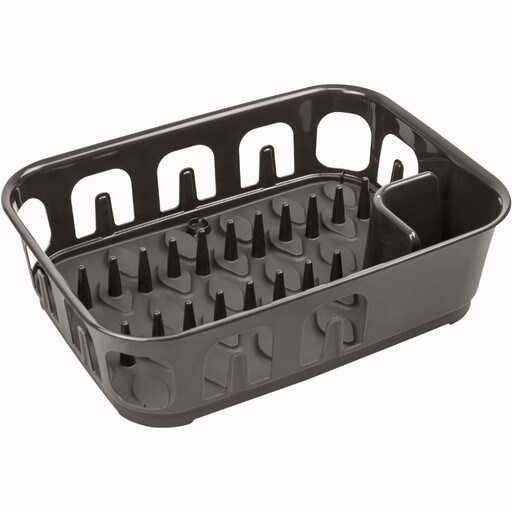
Why this choice suits this profile: Its compact dimensions work well in kitchens where space around the sink is tight, and for moderate everyday use.
The product page mentions slots for plates, mugs and cutlery. Its square shape limits the footprint on your worktop.
Stated capacity of 9 plates, integrated cutlery holder, and dishwasher-safe according to the product page.
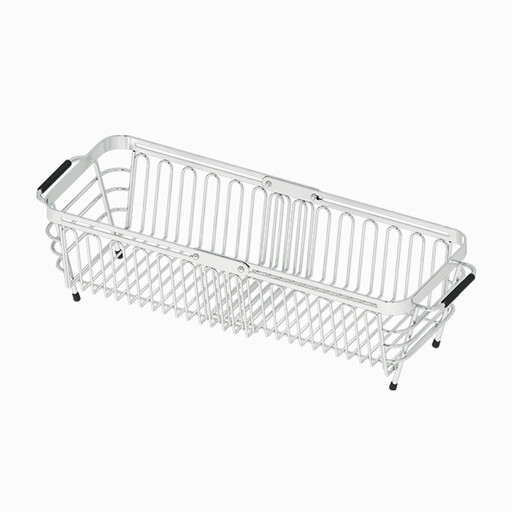
Why this choice suits this profile: Its adjustable format is ideal for those who want to install the drying rack over the sink and adapt its length as needed.
Thanks to its slatted base, water drains directly into the sink, without relying on a tray sitting on the worktop.
Stated 304 stainless steel, adjustable length from 29 to 44 cm, and can be used as a draining basket.
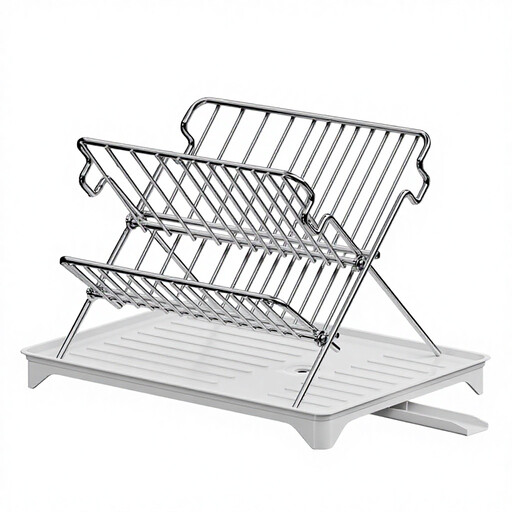
Why this choice suits this profile: Its two tiers and foldable design can suit a family that washes a lot of dishes, while allowing you to store it flat when not in use.
The removable drip tray and integrated hose make water drainage easy, while the folding system means you don't have to leave a large structure on your worktop permanently.
Stated stainless steel and PP, dimensions of 42 × 32 × 30 cm with drip tray, multiple compartments and foldable structure.

Why this choice suits this profile: It's aimed at users who want a fixed, compartmentalised structure with a drainage system on the worktop.
The PP drip tray can be removed for cleaning, and the rotating outlet is designed to direct excess water towards the sink.
Stainless steel and PP structure, no assembly required according to the product page, separate sections for plates, bowls, mugs and utensils.
We've put together a comprehensive, regularly updated list of products that meet these demanding selection criteria and European safety standards.
Place the drying rack on a flat surface, close to the sink, and distribute the weight across the different compartments. Separate the plates to allow air to circulate, and position the water outlet before loading the rack.
To extend its lifespan:
A compact, foldable model or one designed to sit over the sink can reduce the footprint on your worktop. However, measure the available space before buying and check the rack's stability once loaded.
It's a practical solution for reducing standing water on your worktop. However, it does require the outlet to be correctly positioned towards the sink. If that's not possible, a removable drip tray remains simple to use and maintain.
It depends on the material, the weight it supports, the humidity levels and how often you clean it. A rack used within its limits, emptied and dried regularly, can stay functional for a long time. Replace it if the structure becomes unstable, the drip tray leaks, or sharp edges appear.