当日/次日达

品质保障

开启新人专享福利: 全场免邮 | 低至 2 折 | 免费试用 30 天 JoyPlus 会员
下载 Joybuy
In the quiet of a child's room, as the late afternoon light stretches the shadows, miniature worlds come to life. Entire universes are born and fade with the ebb and flow of imagination. And among the heroes of these ephemeral kingdoms, one figure endures through the ages without losing any of its majesty: the dinosaur. This almost primal fascination with these long-lost giants seems etched into our collective memory. It is a gateway to dizzying concepts like the passage of time, evolution, and the fragility of existence. More than just an object, the dinosaur toy is a true cultural artefact, a tool for deciphering the world.
Giving a toy to a child is like giving them a new language. A simple dinosaur figurine becomes the hero of an epic, a vehicle for exploring complex emotions like fear, power, or loneliness. Play becomes an exercise in storytelling. The child doesn't just handle an object; they build a narrative, weave cause-and-effect relationships, and develop their emotional intelligence. A plastic T-Rex can thus become a fearsome predator or a benevolent protector, depending on the day's script.
The world of dinosaurs is rich with this narrative dimension. It awakens scientific curiosity: what was this creature? Where did it live? Why did it disappear? Play transforms into a genuine quest for knowledge. Construction sets, for example, are an excellent introduction to anatomy and mechanics. Assembling a skeleton, brick by brick, is to understand how a body articulates and moves—a subtle lesson in biology and engineering. Franchises like LEGO or Jurassic World have understood this well, blending spectacular adventure with a certain, albeit fantastical, rigour. The toy then becomes a bridge between pure imagination and an initial foray into the natural sciences.
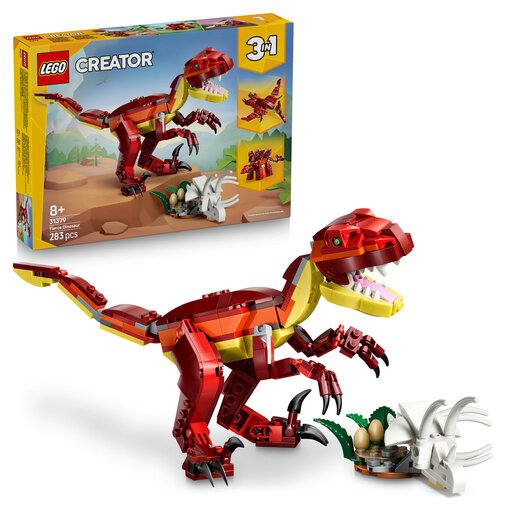
The quality of a toy is measured by its ability to broaden horizons. For the youngest children, blending familiar worlds is often the best entry point. The LEGO DUPLO Marvel 10463 Spidey-Rex vs. Green Goblin set brings together the world of superheroes and prehistoric fascination, creating a playground where the rules are reinvented. The large bricks, designed for little hands, encourage fine motor skills while giving free rein to hybrid stories. For older children, this construction logic evolves into more complex models. The LEGO Creator 31379 Fierce Dinosaur offers the ability to create a Velociraptor, a Stegosaurus, or a Pterodactyl with the same bricks, subtly introducing concepts of modularity and ingenuity.
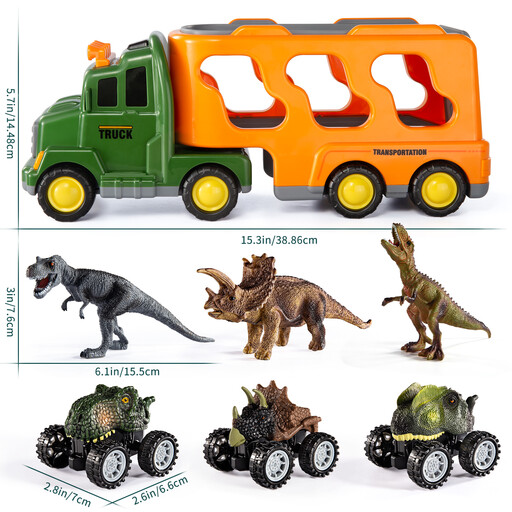
Imagination isn't limited to building; it's also embodied in movement and action. The simple idea of a dinosaur car combines two childhood passions into a single object, promising wild chases. These small pull-back cars, shaped like Triceratops or T-Rexes, transform the living room floor into a Jurassic racetrack. Play becomes physical—an exploration of speed and trajectory. For more elaborate scenarios, a dinosaur transporter truck adds a logistical and narrative dimension: capturing, transporting, and caring for the creatures gently introduces concepts of organisation and responsibility. The adventure can even continue outdoors, with dinosaur-shaped walkie-talkies that turn a simple walk in the woods into a true palaeontological expedition.
Sometimes, a dinosaur toy transcends its simple play function to become an object of contemplation, a tangible link to science. The LEGO Jurassic World 77985 Dinosaur Fossils: Triceratops set, aimed at an older audience, is an exquisitely detailed piece. Once assembled, this skeleton is no longer just a toy; it's a sculpture that will find its place on a shelf or desk. It becomes a reminder of the beauty of anatomy and the immensity of geological time. This more artistic approach is also found in activities like Crayola's dinosaur-themed giant light-up drawing board, which allows children to trace and create prehistoric scenes, linking the creative act with a fascination for this lost world.