
Livraison le jour même ou le lendemain

Qualité garantie

Débloquez vos offres de bienvenue: Livraison GRATUITE | Jusqu'à -80 % | 30 jours d'essai gratuits à JoyPlus
Téléchargez l'application
Under-tightening can leave a part loose, while over-tightening risks damaging a thread, screw or delicate component. For a bike, motorbike, car or maintenance work, the digital torque wrench lets you control the force applied thanks to a clear display and alerts when the target value is reached.
However, not all models are created equal. An ill-suited torque range, an incompatible drive size or a stated accuracy without context can turn a promising purchase into an impractical tool. Here are the criteria to check before choosing an electronic torque wrench.
A 1/4-inch torque wrench is generally suitable for small assemblies and low torque values. The 3/8-inch format covers a wider range, particularly for motorbikes, light automotive work and certain mechanical tasks. The 1/2-inch size is better suited to fixings that require high torque.
However, the square drive size isn't everything. Always check the range in N·m. A wrench covering a very wide range may lack precision on low values, while a model that's too limited will quickly reach its maximum capacity.
A beep is handy, but it can go unnoticed in a noisy workshop. Conversely, a light can be hard to see in a dark compartment. Models combining sound, light and vibration offer an extra reference point, without replacing the need to check the displayed value or follow the manufacturer's instructions.
A digital torque wrench contains a screen and electronic components that require more care than a traditional manual tool. Avoid water, persistent humidity, organic solvents, impacts and high temperatures. After each use, wipe the tool down and store it in a dry place, preferably in its case.
A rating like ±2% means the manufacturer states a tolerance around the measured value, under the specified conditions. Check whether this accuracy applies only to clockwise tightening or to both directions. For the digital torque adapter shown below, the specification states ±2% in the clockwise direction and ±2.5% in the anticlockwise direction.
This data does not replace periodic calibration when a workshop follows strict control procedures. Even for home use, keep the manual and respect the stated operating range.
A practical digital torque wrench usually lets you choose between N·m, lb·ft, lb·in and kgf·cm. 'Track' mode displays the torque reading in real time, while 'Peak' mode holds the maximum value reached. Presets are particularly useful when the same operations are repeated regularly.
The square drive must match your sockets. Some adapters include 1/2, 3/8 and 1/4-inch reductions. However, they must be used with a manual ratchet or suitable bar, and never with an impact wrench if the manual prohibits it.
The models below are categorised according to practical uses, rather than on a general promise of performance.
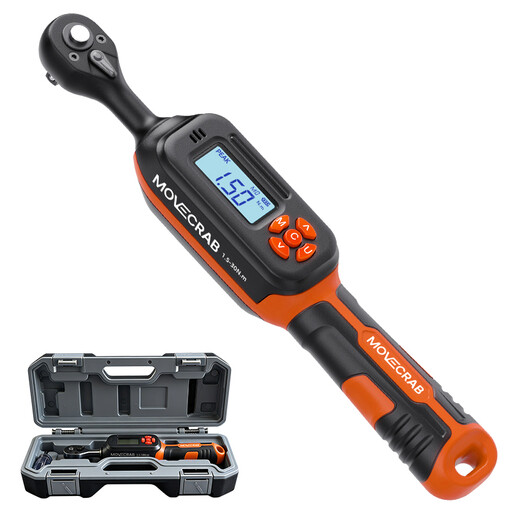
Why this choice suits this profile: Its compact format and range of 0.6 to 12 N·m are suitable for small assemblies, particularly for bicycles, delicate components and low-torque jobs.
Its narrow range reduces the risk of choosing an oversized tool for small screws. The specification also mentions alerts via vibration, sound and light.
1/4-inch square drive, stated accuracy of ±2%, display in four units and 10 preset values.
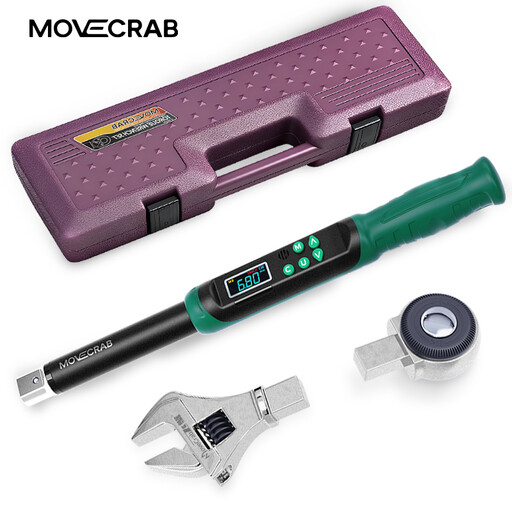
Why this choice suits this profile: Users who switch between nuts, bolts and fittings will appreciate its ratchet heads and adjustable spanner head.
The interchangeable heads avoid relying on a single socket type, but check their dimensions before buying.
Track, Peak and Preset modes, stated storage of 500 measurements and conversion between four units.
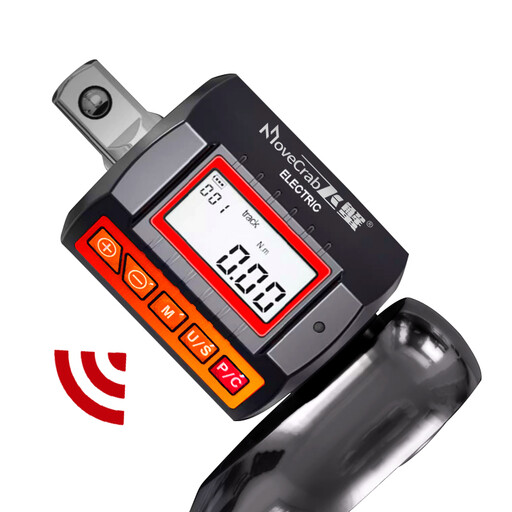
Why this choice suits this profile: This digital torque adapter is aimed at workshops that already own ratchets and want to expand their measurement capabilities.
Its range of 6 to 200 N·m covers many operations. However, the tool must be used with a manual ratchet, never as a striking tool.
3/8 and 1/4-inch adapters, three operating modes, auto-off after 10 minutes and stated memory of 1,000 measurements.
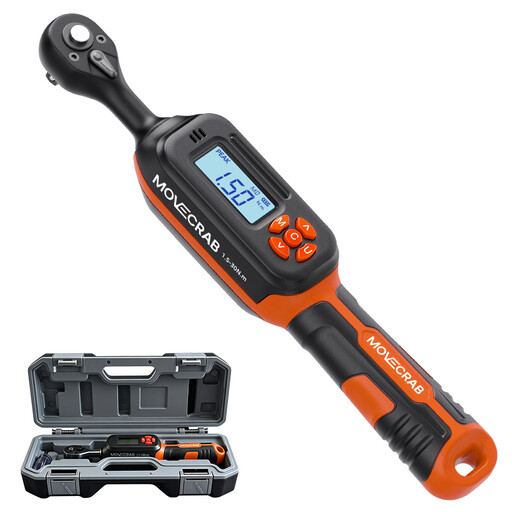
Why this choice suits this profile: Its mid-range can suit regular work on a motorbike, car or mechanical equipment requiring a 3/8-inch square drive.
The screen lets you follow the torque build-up and Peak mode holds the stated maximum value. A real plus for checking your work after a job.
Stated accuracy of ±2%, triple-signal alerts, 10 presets and memory of 500 values according to the product specification.
We've put together a comprehensive, real-time updated selection of products that meet these demanding selection criteria and European safety regulations.
Yes, provided you choose a range suited to low torque values and a square drive compatible with your bits. A precision 1/4-inch wrench is often more practical for bicycle components than a model designed for car nuts.
The frequency depends on how intensively it's used, any impacts it has suffered and the requirements of your activity. In a professional workshop, follow the internal procedure and the manufacturer's recommendations. For occasional use, at least check the general condition of the tool, the screen's operation and that it stays within the stated range.
It can complement an existing set, as it sits between the ratchet and the socket. It doesn't necessarily replace a dedicated wrench, especially if you need a particular ergonomics, a reversible head or frequent use at low torque. Always check the adapters supplied and the usage limits stated in the manual.