
Livraison le jour même ou le lendemain

Qualité garantie

Débloquez vos offres de bienvenue: Livraison GRATUITE | Jusqu'à -80 % | 30 jours d'essai gratuits à JoyPlus
Téléchargez l'application
A bolt that’s overtightened can damage a thread, an aluminium part or a bicycle component. On the other hand, insufficient tightening can lead to play or vibration. Whether you’re working on a car, motorbike, bicycle or carrying out maintenance tasks, a digital torque wrench lets you control the force applied and stop as soon as the manufacturer’s recommended torque is reached.
However, not all models are created equal. A poorly suited torque range, an incompatible drive square or a hard-to-notice alert can turn what seems like a bargain into a frustrating tool to use every day. Here are the criteria to consider before choosing an electronic torque wrench.
A wrench with a very wide range isn’t necessarily right for every job. For small screws on a bicycle component, for example, a 1/4-inch torque wrench covering roughly 1 to 20 N·m will be more suitable than a 1/2-inch model designed for much higher torques.
Always check that the recommended torque for your vehicle or equipment falls in the middle of the tool’s range, rather than at its minimum or maximum limit.
A stated accuracy of ±2% is a good indicator, but it doesn’t excuse you from using the tool correctly. In particular, you should:
For a high-precision ±2% torque wrench, also consult the manual and the measurement conditions. Accuracy can vary depending on the direction of rotation and the portion of the range being used.
In a noisy workshop, a simple beep can easily go unnoticed. A torque wrench with LED alarm, vibration and audible signal gives you multiple cues when the set value is reached. This type of alert is also useful in a poorly lit space, under a car or near an engine.
N·m is the unit to choose when your vehicle or part documentation uses it. Some models also display values in in·lb, ft·lb or kgf·cm. Built-in conversion saves you doing the maths, but always double-check the selected unit before each tightening.
For a torque wrench intended for a car, generally look for a medium to high range. For a motorbike torque wrench, a mid-range will cover most routine jobs. For a bicycle, accuracy at low torques and access to tight spaces are often the priority.
The size of the drive square determines which sockets are compatible:
An adapter can broaden compatibility, but it doesn’t change the tool’s torque range. It should be used with a manual wrench or a suitable breaker bar, never with an impact wrench if the manual prohibits it.
Track mode displays the torque in real time. Peak mode stores the maximum value reached. Some Movecrab models claim a storage capacity of up to 500 measurements for wrenches and 1,000 values for certain adapters.
Presets are handy when you’re repeating the same jobs. However, they don’t replace checking the recommended torque for each part.
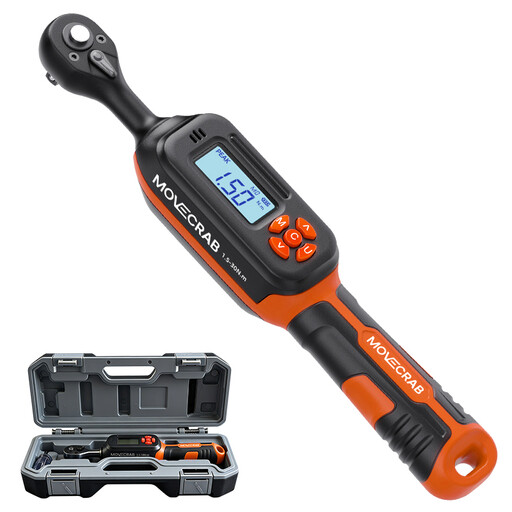
Why this choice suits this profile: Its low range is ideal for precision work on bicycles, motorbikes and small assemblies. The display supports multiple units.
The 1/4-inch square clearly targets the tool at small fasteners, without promising excessive versatility.
Stated accuracy of ±2%, alerts by vibration, sound and light, Track and Peak modes.
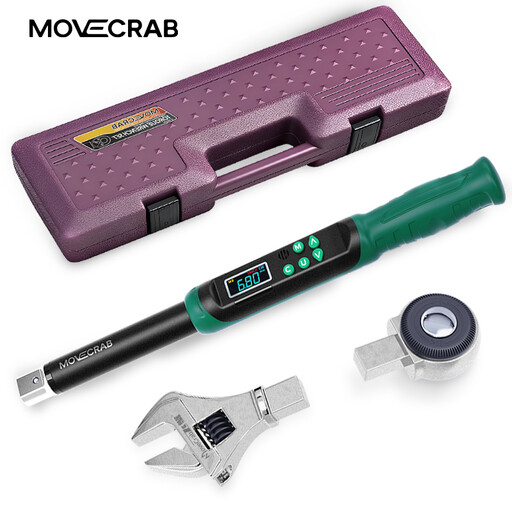
Why this choice suits this profile: Its ratchet and open-end heads adapt to the varied work of a workshop or enthusiast equipped with several types of fasteners.
The interchangeable heads are clearly identified, so you won’t end up with a fitting that’s incompatible with the nuts you need to tighten.
Range of 6.8 to 135 N·m, display of four units, Peak, Track and Preset modes.
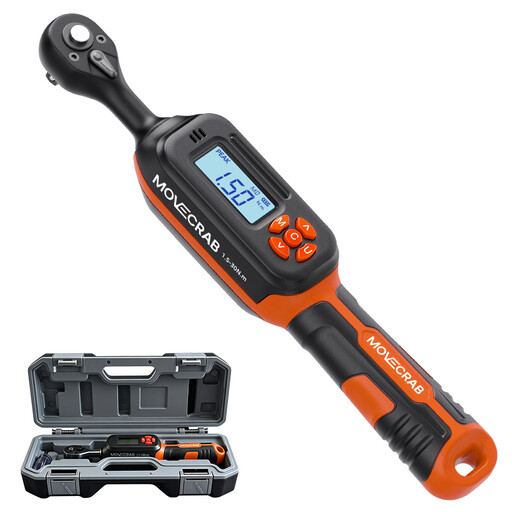
Why this choice suits this profile: Its mid-range format is ideal for regular work on motorbikes, cars and general mechanical tasks.
The range and 3/8-inch square are clearly stated, making it easy to check compatibility with your sockets.
Stated accuracy of ±2%, dual rotation direction, ten presets and claimed memory for 500 measurements.
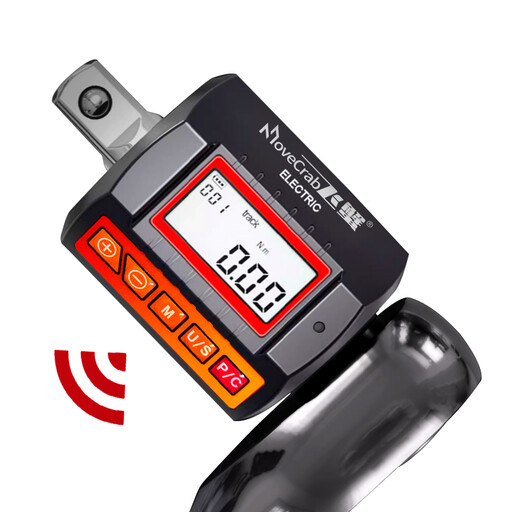
Why this choice suits this profile: The adapter attaches to an existing wrench or breaker bar and includes 3/8 and 1/4-inch adapters.
It saves you replacing your entire toolbox, provided you respect compatibility and don’t use it with an impact wrench.
Audible and visual alerts, automatic shut-off after ten minutes and claimed storage of 1,000 values.
We’ve put together a comprehensive, real-time updated selection of products that meet these strict criteria as well as European safety regulations.
Before your first tightening, select the unit, set the desired torque and check that the socket is properly engaged. Apply steady, gradual pressure without jerking. As soon as the vibration, audible signal or LED indicates the torque has been reached, stop immediately.
After use:
For a digital torque wrench used regularly in a workshop, periodic accuracy checks can be worthwhile. Its lifespan will depend on how often it’s used, storage conditions and whether the torque limit is respected.
Yes, provided you choose the right torque range and drive square. A 1/4-inch model is better suited to the low torques of a bicycle, while a 3/8 or 1/2-inch model will cover more automotive jobs. Always refer to the manufacturer’s recommended values.
The wrench integrates the tightening mechanism and drive square directly. The adapter sits between a manual wrench and the socket. It can be handy for supplementing existing equipment, but you need to check the dimensions and respect its usage limits.
Avoid shocks, overloads and moisture. Stay within the operating range, apply steady pressure and store the tool in a dry environment. For intensive professional use, arrange for checks in line with your workshop’s requirements and the manual’s recommendations.