
Livraison le jour même ou le lendemain

Qualité garantie

Débloquez vos offres de bienvenue: Livraison GRATUITE | Jusqu'à -80 % | 30 jours d'essai gratuits à JoyPlus
Téléchargez l'application
A digital torque wrench lets you apply precise tightening torque thanks to a clear display and alerts that activate when the programmed value is reached. It can be used to maintain a car, motorbike, bicycle or any machine that requires controlled tightening.
The problem is that product listings sometimes highlight the claimed accuracy, versatility or number of accessories without explaining the tool’s actual limitations. To avoid buying the wrong model, focus on three criteria: the torque range, the drive size and how the wrench indicates that the target has been reached.
A wrench capable of reaching high torque levels is not necessarily suitable for delicate screws. For working on a bicycle, motorbike components or small fasteners, a 1/4-inch torque wrench covering low torque values will often be more suitable than a 1/2-inch model designed for heavily tightened nuts.
If the minimum value is too high, the tool loses its usefulness for precision work. Conversely, a wrench used constantly near its maximum limit may be less comfortable to handle and more likely to lose accuracy if overloaded.
The drive size must be compatible with the sockets you already own. The most common sizes are:
An adapter can be useful in a pinch, but it will not turn a small wrench into a tool capable of meeting every mechanical requirement. Also remember to check which tightening direction is supported by the ratchet head.
A screen is convenient, provided it remains easy to read in your working environment. In a noisy workshop, a simple audible alarm can easily go unnoticed. A torque wrench with an audible alarm and vibration, complemented by an LED, provides several signals to confirm that the programmed torque has been reached.
The technical specifications should also state the available units, measurement mode and recommended storage conditions. Electronics exposed to moisture, heat or impact may become less reliable.
Compare the range expressed in N·m with the recommendations from your vehicle manufacturer or component maker. Units such as ft·lb, in·lb or kgf·cm can make conversions easier, but it is best to use the unit stated in the assembly instructions to minimise errors.
Several Movecrab models claim a tolerance of ±2%. This value corresponds to the product specification provided; it does not remove the need to follow the manufacturer’s maintenance, storage and checking instructions.
‘Track’ mode displays the torque in real time during tightening. ‘Peak’ mode retains the maximum value reached. These functions are useful for monitoring an operation or keeping a record of a tightening task, but they do not replace a documented workshop procedure.
Presets save time when you regularly switch between several torque settings. However, check the number of available memory slots, whether the buttons can be locked and how clearly the screen can be read while wearing gloves.
A digital wrench is a torque-controlled tightening tool, not a breaker bar or a hammer. To keep it working properly:
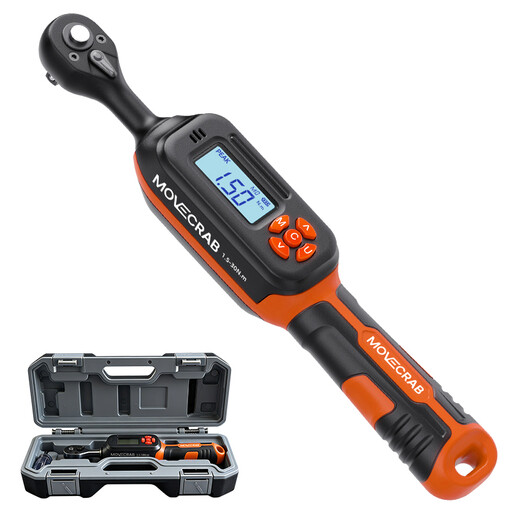
Why this choice suits this profile : Its low range is suitable for small fasteners, bicycles, delicate mechanisms and light assembly work, without requiring you to invest in a format designed for high torque levels.
Its limited maximum torque reduces the risk of choosing an oversized wrench for delicate screws. The listing also specifies vibration, sound and LED alerts.
1/4-inch drive, stated range of 0.6 to 12 N·m, display in multiple units and memory for preset values.
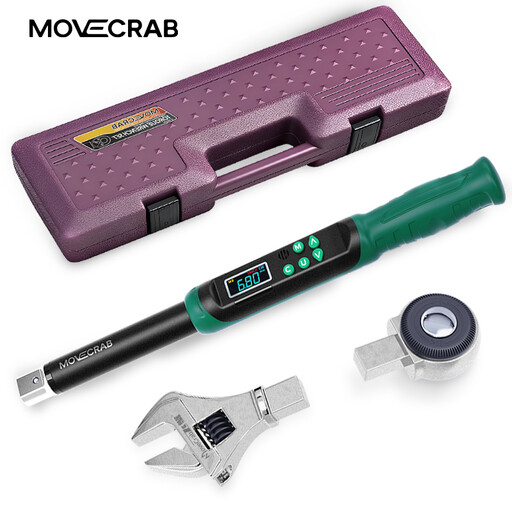
Why this choice suits this profile : Users who prioritise versatility can switch from a ratchet head to an open-ended head depending on the fastener they encounter.
Interchangeable heads eliminate the need to buy several tools for different applications. However, you should check that they are compatible with the dimensions of your nuts and bolts.
Stated range of 6.8 to 135 N·m, four units, Peak, Track and Preset modes, with stated memory for 500 values.
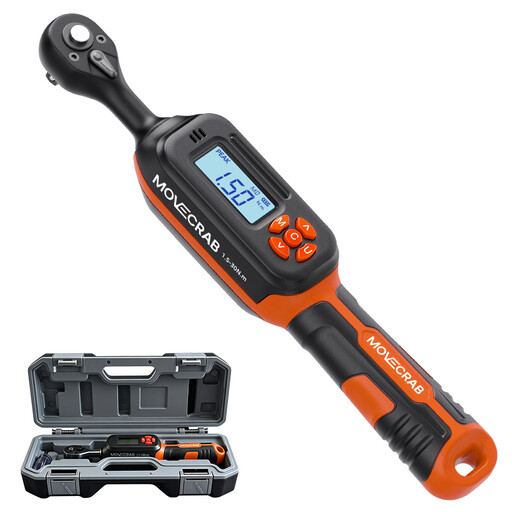
Why this choice suits this profile : Its mid-sized format may suit a workshop that regularly switches from bicycle work to motorbike maintenance and then to certain automotive tasks.
Its range of 4.2 to 85 N·m means you are not restricted to a tool intended for very low torque levels when carrying out varied tasks. The alerts are specified in three forms.
3/8-inch drive, stated accuracy of ±2%, conversion between four units and stated memory for 500 measurements in Peak mode.
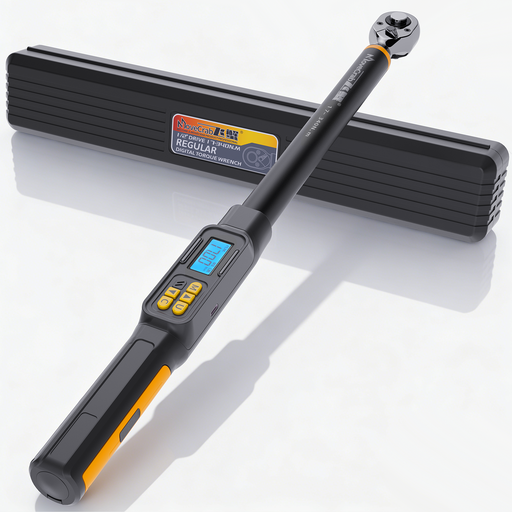
Why this choice suits this profile : This format is designed for tasks requiring substantial torque, particularly on certain automotive and mechanical assemblies.
Its high range prevents you from pushing a small wrench beyond its intended operating range. However, it is not suitable for screws requiring low torque.
1/2-inch drive, stated range of 17 to 340 N·m, display in four units and vibration, sound and light alerts.
We have put together a complete, real-time updated selection of products that meet these demanding selection criteria and European safety requirements.
A bicycle torque wrench is generally chosen with a low range, a 1/4-inch drive or a system compatible with the bits being used. Always check the torque recommended by the manufacturer of the frame, stem, seatpost or components. A range of 0.6 to 12 N·m may be suitable for some precision work, while a model starting at a higher value may not cover the lowest settings.
Protect it from impacts, overloads and moisture. Do not use the wrench to loosen a fastener if the instructions do not allow it. After each use, wipe it with a dry cloth and store it away from heat and magnetic fields. In a professional setting, refer to the manufacturer’s recommendations for periodic accuracy checks.
A 3/8-inch torque wrench may be suitable for many motorbike or car repairs, provided its range covers the recommended torque. For nuts requiring considerably higher torque, a 1/2-inch torque wrench will be more suitable. The head size is therefore not the only consideration: always compare the torque range, compatible sockets and the manufacturer’s instructions.