
Same-day & Next-day Delivery

Quality Guaranteed

Unlock Your Welcome Offers: FREE Delivery | Up to 80% OFF | Free 30-day JoyPlus trial
Download the APP
A digital torque wrench lets you control the torque applied to a nut or bolt, instead of tightening it by feel. It can be used to refit a wheel, maintain a motorbike, adjust a bicycle or carry out certain industrial maintenance tasks.
Technical specifications can sometimes cause confusion between loosening torque, rotational speed and measurement accuracy. Before placing your order, it is therefore worth distinguishing between impact wrenches, controlled tightening wrenches and electronic adapters.
A 1,000 N·m impact wrench is primarily designed to quickly loosen seized nuts. The quoted figure generally refers to the maximum loosening torque, achieved under very specific conditions. It does not mean that the tool should be used to permanently tighten a wheel to 1,000 N·m.
For final tightening, use a torque wrench set to the value specified by the manufacturer. A 21 V cordless impact wrench can speed up the removal and initial fitting of a nut, but it does not automatically replace a torque wrench.
An accuracy rating of ±2 % is not enough to assess a tool. You also need to examine its measurement range. A wrench covering 6.8 to 135 N·m will suit many jobs on a car, motorbike or bicycle, but it will not cover either the very low torque settings needed for small assemblies or the higher values required for a commercial vehicle.
A precision torque wrench should therefore be chosen first according to the torque settings you actually need, rather than solely by the percentage shown on the product page.
A digital display does not make a tool indestructible. For some models, the instructions recommend avoiding water, high humidity, solvents, high temperatures and impacts. An adapter should be stored in its case and reset to zero in accordance with the manufacturer’s instructions.
Also check that the device is suitable for manual use. Some digital torque adapters must not be used with an impact wrench, as the impacts could damage their sensor.
The 1/2 inch square drive is a common size for automotive sockets and wheel nuts. For spark plugs, small bolts or bicycle components, a 3/8 inch drive can be easier to handle. Adapters with 1/4 and 3/8 inch reducers offer greater versatility, provided you use the appropriate socket.
A 1/2 inch, 60 cm breaker bar provides substantial leverage for loosening a nut, but it does not measure the torque applied. It complements a torque wrench; it does not replace one.
Check the stated figures in both directions of rotation. Some products specify ±2 % clockwise and ±2.5 % anticlockwise. This difference can matter when carrying out a task requiring loosening or reverse-direction tightening.
Audible, visual and vibration alerts are particularly useful in a noisy or poorly lit garage. The “track”, “peak” and “preset” modes are designed for different uses: real-time readings, recording the maximum torque or recalling regularly used values.
An electronic wrench generally runs on batteries, while a cordless impact wrench uses a rechargeable battery. Compare the battery life, charging time, number of batteries included and how easy it is to find a replacement battery.
If you regularly work on car or lorry wheels, a non-slip handle, storage case and suitable sockets make the job more comfortable. For a torque wrench intended for motorbikes and bicycles, weight, a slim head and a low torque range often matter more than maximum torque.
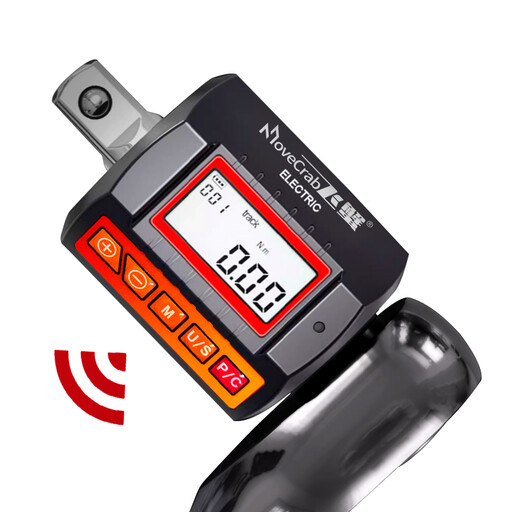
Why this product suits this profile : it turns a manual ratchet or breaker bar into a torque-control tool, without requiring you to buy a complete wrench.
The product details specify that it is used with a manual tool and advise against using it with an impact wrench. This clearly eliminates the risk of errors caused by impacts.
4.05 to 135 N·m range, multiple unit display, audible and visual alarms, and memory for up to 1,000 values.
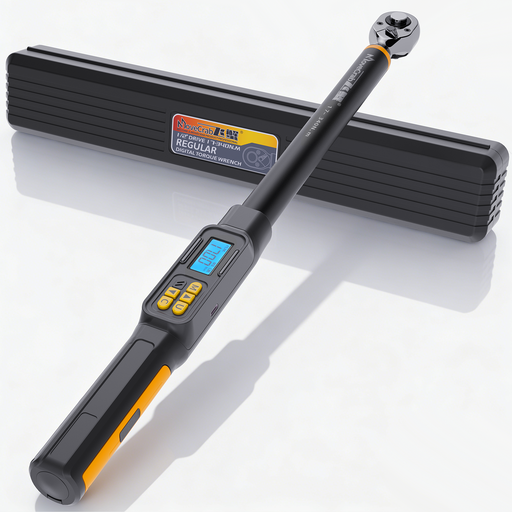
Why this product suits this profile : its wide range is suitable for repeated work on cars, motorbikes, bicycles and various workshop equipment requiring different tightening settings.
The preset values, along with the tracking and peak modes, help distinguish the selected target from the actual reading obtained after tightening.
17 to 340 N·m range, stated accuracy of ±2 %, reversible head and vibration, audible and visual alerts.
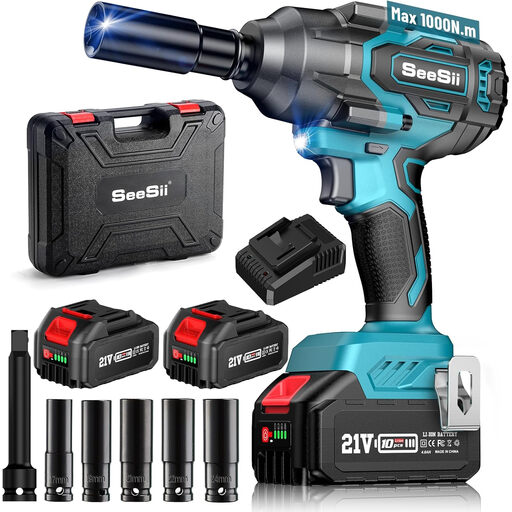
Why this product suits this profile : this tool is designed for garages, building sites and removal tasks that require substantial torque capacity, while offering the freedom of cordless operation.
Its three speed settings let you adjust the initial fitting of the nut, while the supplied sockets indicate the supported sizes. Final tightening must nevertheless be checked separately.
Stated loosening torque of 1,000 N·m, two 21 V 4.0 Ah batteries, 1/2 inch square drive and five sockets.
We have put together a comprehensive selection, updated in real time, of products that meet these demanding criteria and European safety standards.
For regular professional use, keep the inspection details, instructions and any calibration records. Periodic testing can be useful when tightening accuracy plays a critical role in your work.
Yes, provided its range covers the value recommended by the manufacturer and its drive size is compatible with the sockets being used. A car impact wrench can speed up removal, but final tightening must be carried out with a tool capable of accurately controlling torque.
For small assemblies, choose a low range and an easy-to-handle head. A wrench covering 4.05 to 135 N·m will cover many tasks, but always check the torque settings specified for your model. For particularly sensitive components, a narrower range may make readings and adjustments more precise.
The budget is not limited to the purchase price. You also need to allow for batteries, the possible replacement of accessories and calibration checks if the tool is used frequently. A rechargeable model supplied with two batteries will minimise interruptions, while a battery-powered adapter will often be simpler for occasional use.