
Livraison le jour même ou le lendemain

Qualité garantie

Débloquez vos offres de bienvenue: Livraison GRATUITE | Jusqu'à -80 % | 30 jours d'essai gratuits à JoyPlus
Téléchargez l'application
In mechanics, tightening to the correct torque isn't an option—it's a necessity. Whether for a cylinder head, alloy wheels, or a carbon fibre bike frame, incorrect tightening can lead to costly, or even dangerous, failures. The digital torque wrench promises superior accuracy, but the market is flooded with models offering widely inconsistent performance. Before you invest, it's crucial to know how to avoid the pitfalls that can render a seemingly sophisticated tool completely ineffective in the field.
As a product expert at Joybuy, my mission is to help you navigate this landscape. Let's review the warning signs and the criteria to look for to select a reliable tool that's truly suited to your needs.
The appeal of a digital display can sometimes mask major design flaws. Here are the two most common issues that could make you regret your purchase.
To ensure you're buying a reliable, professional mechanical tool, focus on these three fundamental parameters.
These are the two characteristics that dictate everything else. A wrench is only useful if its operating range matches your applications.
Always check the torque specifications recommended by your vehicle or equipment manufacturer before choosing your wrench.
A modern precision torque wrench must confirm that the target torque has been reached in a foolproof way. The most effective models combine three types of alerts:
A triple-alert alarm torque wrench is a safety guarantee that you'll never miss the set point.
A good wrench should be simple and quick to use. A clear, backlit digital display is the bare minimum. Other features greatly enhance the experience:
Rather than an exhaustive list, here are targeted options for distinct user profiles, ensuring they meet the reliability criteria we've just discussed.
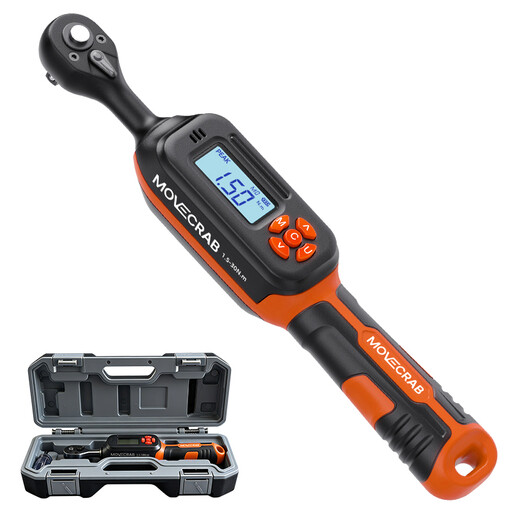
Why it's a match: Its very low torque range is specifically designed for delicate components like carbon bike stems, engine covers, or sensors, where over-tightening by just a few Newton-metres can cause irreversible damage.
The triple-alert system (sound, light, vibration) is particularly effective at low torque, where the applied force is minimal. The vibration in the handle confirms the torque has been reached without a shadow of a doubt.
±2% accuracy in a very low torque range, where many wrenches are imprecise. Ideal for meticulous work.
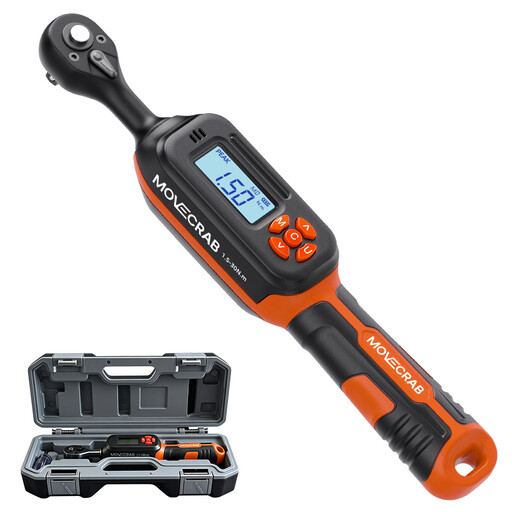
Why it's a match: With its 3/8" drive and 4.2 to 85 N.m range, this wrench covers the vast majority of common car and motorcycle maintenance needs. It's the quintessential all-rounder for regular servicing.
It includes a preset mode that lets you save 10 torque values. No more input errors when switching from tightening spark plugs to the oil pan drain plug. The interface is designed to be fast and intuitive.
The preset memory function and its wide torque range make it an extremely practical and cost-effective tool for varied use.
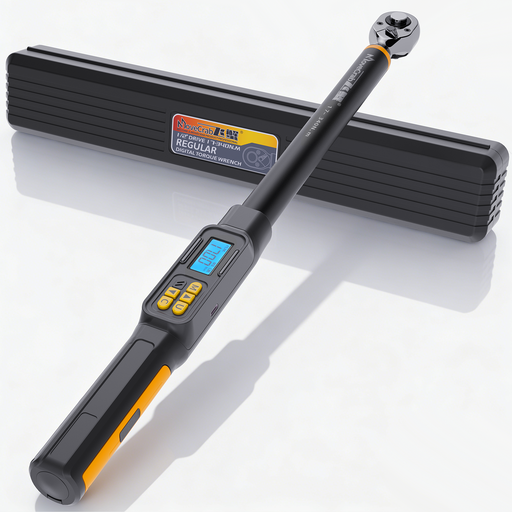
Why it's a match: Designed for high torque, this wrench is the tool of choice for work on chassis, suspension, hubs, and lug nuts. Its robust construction is suited for the significant force required for these tasks.
In a garage where the sounds of impacts and air tools are constant, the triple-alert system ensures you'll never miss the signal, even while wearing hearing protection. The vibration is a major asset here.
A very high torque capacity (up to 340 N.m) combined with an ergonomic handle designed for applying significant force comfortably and safely.
We have compiled a complete, up-to-date list of products that meet these strict selection criteria and safety standards.
No, and this is a golden rule. It is strongly advised not to use a torque wrench, whether digital or mechanical, to loosen bolts or nuts. These are precision measuring instruments calibrated to apply tightening torque. Using them for loosening, especially on seized fasteners, can exert excessive force on the internal mechanism and permanently throw off its calibration. For loosening, always use an impact wrench or a standard breaker bar.
Accuracy is this tool's entire purpose. For heavy professional use, annual recalibration by a specialised service is good practice. For a hobbyist, a check every 2 to 3 years or after approximately 5,000 cycles is generally sufficient. In the meantime, protect your wrench from impacts, moisture, and extreme temperatures, and most importantly, always set it to its lowest value before storing it to relieve stress on the sensor.
In terms of factory calibration, both types can achieve similar levels of accuracy (often ±2% to ±4%). The real advantage of a digital wrench lies in reducing human error. The digital display eliminates the ambiguity of reading a vernier scale, and the multiple alerts (light, sound, vibration) make over-shooting the target torque much less likely than with a mechanical 'click' wrench, where it's easy to miss the click in a noisy environment.