
Livraison le jour même ou le lendemain

Qualité garantie

Débloquez vos offres de bienvenue: Livraison GRATUITE | Jusqu'à -80 % | 30 jours d'essai gratuits à JoyPlus
Téléchargez l'application
Whether you're working on cars, motorcycles, or industrial maintenance, precision isn't an option—it's a requirement. An improperly tightened bolt can lead to vibrations, leaks, or even mechanical failure. Conversely, over-tightening can strip a thread or warp a critical component. This is precisely where the digital torque wrench becomes indispensable: a precision tool designed to ensure every fastener meets the manufacturer's recommended torque specifications.
This guide is designed to walk you through the essential criteria for finding the electronic torque wrench that best suits your needs. We'll break down the key technical features to consider and present our selection of the top models for 2026. The goal? To help you make the right investment for your workshop.
Choosing a precision tool isn't something to be taken lightly. Here are the key points to evaluate before you buy to ensure your new wrench is perfectly suited for your work.
The first question to ask is simple: what jobs will this wrench be used for? The required tightening torque varies dramatically between the bolts on a motorcycle crankcase and the lug nuts on a heavy-duty truck.
The main advantage of an electronic torque wrench lies in its accuracy and advanced features. An accuracy of ±2% is the current quality standard for professional use. Beyond mere accuracy, certain features can be a game-changer in the workshop:
A tool is good. A complete kit is better. A torque wrench set often provides much better value by including essential accessories like sockets, an extension bar, or a universal joint. Ensure the materials, such as Chrome-Vanadium (Cr-V) steel, are robust and built to last.
To help you make an informed choice, we've reviewed several options on the market. Here is a selection of models that stand out for their features and suitability for specific applications.
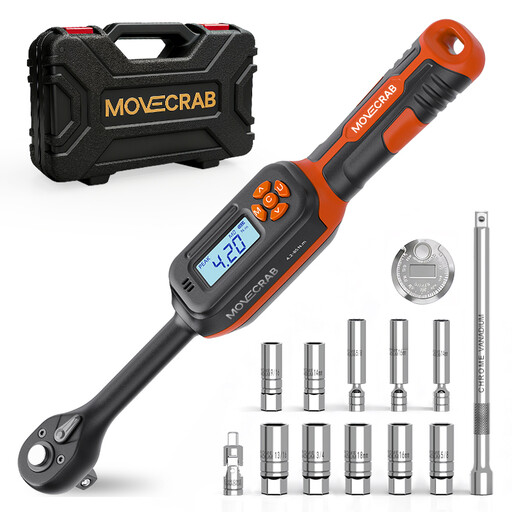
What sets it apart: More than just a wrench, this is a complete 14-piece torque wrench set. It is particularly well-suited for car and motorcycle maintenance, especially for replacing spark plugs, thanks to its dedicated magnetic sockets.
Key Features:
Who is it for? Mechanics and experienced DIYers looking for a versatile, all-in-one solution for routine car or motorcycle maintenance. The 4.2 to 85 N.m torque range covers the vast majority of needs for engines and their peripherals.
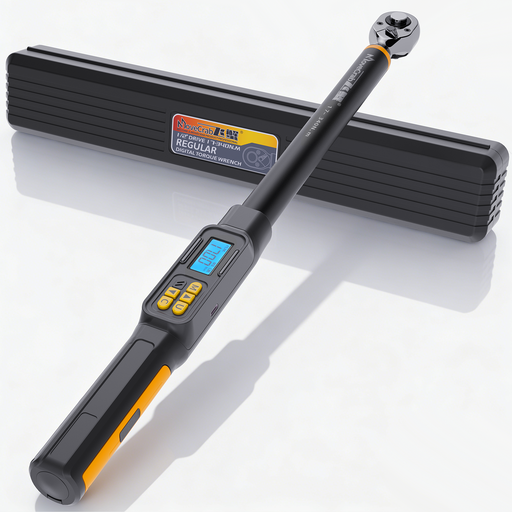
What sets it apart: Built for heavy-duty jobs, this 1/2" drive wrench offers a high torque range and a triple alert system (vibration, sound, light) that ensures you never miss the target setting, even in a noisy workshop.
Key Features:
Who is it for? Professional auto mechanics who regularly work on drivetrains and other components requiring significant tightening torque.

What sets it apart: This model is the tool of choice for finesse and precision on the most delicate assemblies. Its very low torque range and compact form factor make it the perfect ally for tight spaces and fragile components.
Key Features:
Who is it for? Maintenance technicians, bicycle mechanics, and model-making or precision-mechanics enthusiasts who work on assemblies where excessive torque is simply not an option.
Our selection highlights tools that meet well-defined needs. If your projects require different torque ranges, other drive sizes, or specific features, many other solutions are available.
? Explore our full range of motorcycle repair tools and find the equipment that perfectly matches your requirements.
1. What is the difference between a digital torque wrench and a mechanical click-type wrench? The main difference lies in the feedback. A mechanical wrench produces an audible "click" when the torque is reached, a signal that can be hard to perceive in a noisy workshop. A digital torque wrench, on the other hand, displays the value in real-time on an LCD screen and uses visual, audible, and/or vibrating alerts for much more reliable notification. It also typically offers memory and preset functions.
2. How should I maintain my electronic torque wrench to ensure its longevity? To preserve your tool's accuracy, a few golden rules apply. Avoid dropping it or using it as a hammer. After each use, set it to the lowest value in its range to release tension on the internal mechanism. Store it in its case, away from moisture and extreme temperatures. Finally, and this is an absolute rule, never exceed the maximum torque supported by the wrench.
3. Does a digital torque wrench need to be calibrated? Yes, periodic calibration is highly recommended, especially in a professional setting. The frequency depends on the intensity of use. For heavy daily use, annual calibration is good practice to ensure that the ±2% accuracy is maintained over time.