
Livraison le jour même ou le lendemain

Qualité garantie

Débloquez vos offres de bienvenue: Livraison GRATUITE | Jusqu'à -80 % | 30 jours d'essai gratuits à JoyPlus
Téléchargez l'application
On a bike, motorbike, car or any mechanical equipment, torque shouldn't be set "by feel". Under-tightening can create play, while over-tightening risks damaging a thread, an aluminium part or a delicate screw. A digital torque adapter lets you precisely control the force applied with a manual ratchet wrench.
The trouble is, product specs don't always make comparison easy. Here are the common mistakes to avoid and the criteria to check before placing your order.
A wide measurement range doesn't mean the tool will suit every job. On a bike, torque values are generally low, whereas a car or industrial machine may demand much more. A device rated from 6 to 200 N·m won't necessarily replace a model designed for very low torque.
Always check:
A claim like accuracy ±2% needs to be put in context. The spec sheet should state the direction of rotation, the range involved and the measurement conditions. For the MoveCrab adapter, the published data indicates an error of ±2% in the clockwise direction and ±2.5% in the anticlockwise direction.
This accuracy doesn't guarantee consistent measurement if the adapter is used with an impact wrench, subjected to overload or stored poorly. Battery condition, the device's position and following the instructions also affect the result.
A digital device left in a damp drawer or stored with its batteries for several months can lose reliability. To limit unpleasant surprises:
For a bike, a torque wrench for bike and motorbike covering roughly 2 to 20 N·m works for many lightweight components. For a motorbike or car, a wider range is usually needed. 1/2-inch adapters supplied with reductions to 3/8 and 1/4 inch make it easier to use different sockets, but these accessories don't change the device's measurement range.
For a torque wrench for car use, check the manufacturer's recommended torque values and choose a model where your target value sits in the middle of the range, rather than at its limit.
An audible and visual alarm is especially handy in a noisy or poorly lit garage. Some models add vibration, a real bonus when the screen isn't easy to watch during tightening.
The different modes may include:
The built-in memory can help track a series of jobs, but it doesn't replace a professional record or a properly documented maintenance procedure.
Check the battery type, how accessible it is and whether there's an auto-off function. The MoveCrab adapter featured here claims to switch off after 10 minutes of inactivity and has a memory capable of storing 1,000 values. For the battery type and replacement procedure, the manual is the reference source.
Before ordering, also check for a clear manual, contact details for the responsible party established in the European Union, and battery disposal instructions. This information is far more useful than a vague marketing promise.
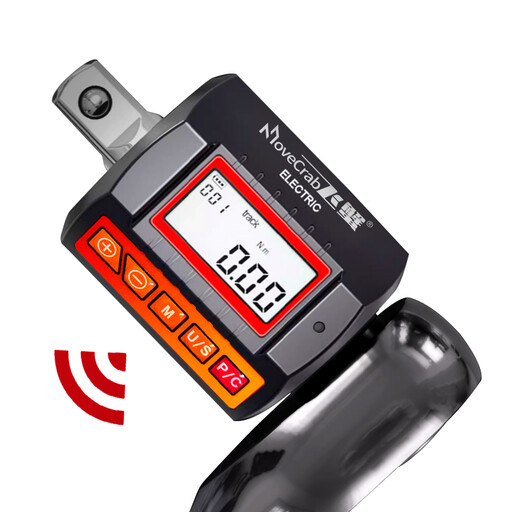
Why this choice suits this profile: This adapter fits onto a manual ratchet wrench and covers common jobs on a bike, motorbike or car. The 3/8 and 1/4 inch reductions let you reuse sockets you already own.
Its range of 4.05 to 135 N·m and three adapter sizes stop you ending up with a tool limited to just one type of job.
Audible and visual display, real-time, peak and preset modes, with a claimed memory of 1,000 values.
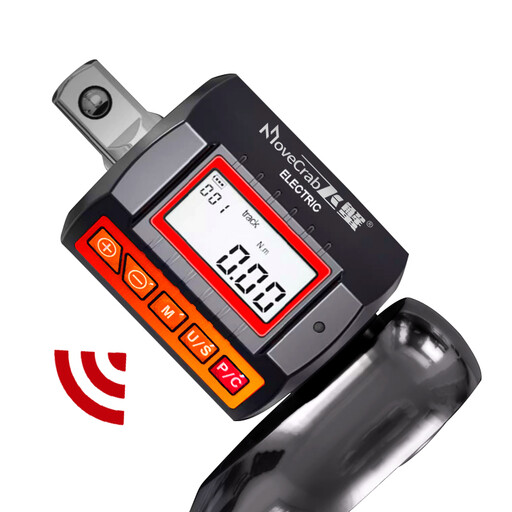
Why this choice suits this profile: Its wider range suits users who move between car and motorbike maintenance and more varied mechanical work.
Its range of 6 to 200 N·m reduces the risk of choosing an adapter that's too limited for common automotive nuts.
Four units available — N·m, kgf·cm, lbf·ft and lbf·in — with audible and visual alert.
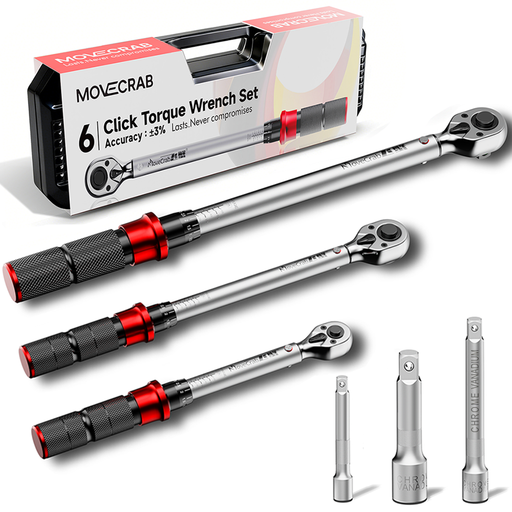
Why this choice suits this profile: This mechanical kit is aimed at workshops that prefer having several dedicated wrenches, covering torques from 5 to 220 N·m.
The three wrenches and 1/4, 3/8 and 1/2 inch extensions stop you pushing a single tool beyond its ideal range.
Claimed Cr-V steel construction, distinct ranges and calibration certificates mentioned in the product listing.
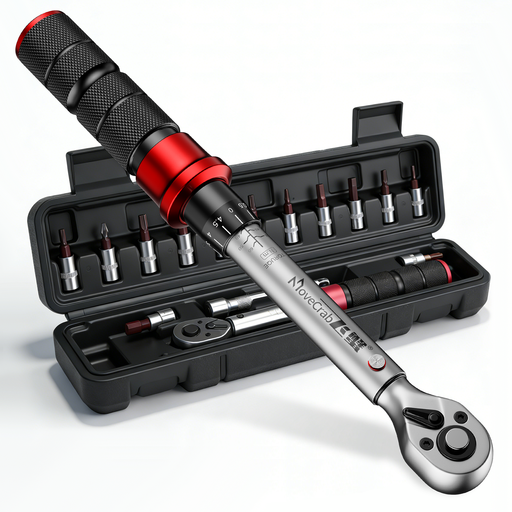
Why this choice suits this profile: Its range of 2 to 20 N·m and hex, Phillips and Torx bits are especially suited to adjusting bike components.
Its low range stops you using an automotive tool on bike screws that are particularly sensitive to over-tightening.
Adjustment via thumbwheel, reversible head and 15-piece kit for everyday jobs.
We've put together a full, up-to-date selection of products that meet these demanding criteria as well as European safety regulations.
No. The vibrations and shocks from an impact wrench can damage the sensor and throw off measurements. Use a manual ratchet wrench or a breaker bar compatible with the adapter's drive.
A digital torque wrench has the tightening mechanism and handle built in. The adapter sits between a manual wrench and the socket. It can be more economical if you already own several wrenches, but requires more care during setup.
It depends on how often you use it, any overloads, humidity and storage conditions. Stick to the stated limit, protect the screen and connectors, and check regularly that the device is working properly. For professional use, periodic calibration checks may be necessary, depending on workshop requirements.