Fans of plain Digestives
You’re after the taste of cereals and the crunch of a Digestive to go with tea or coffee, rather than a flavoured shortbread or chocolate biscuit.


For a Valentine’s Day treat, choose a plain Digestive if you’re looking for a cereal biscuit to enjoy with tea or coffee; its name doesn’t prove that it aids digestion. A chocolate version is for a different craving, while traditional shortbread may be a better choice if the recipe or presentation matters more to you. Whichever you choose, check the variety, ingredients, allergens and pack size.
You’re after the taste of cereals and the crunch of a Digestive to go with tea or coffee, rather than a flavoured shortbread or chocolate biscuit.
The way the pack looks and whether the biscuits can be served for two or with a dessert matter to you. Individually wrapped portions may also influence your choice.
Before giving the pack as a gift, you want to check its recipe, allergens and nutritional information, especially if the recipient needs to avoid certain ingredients.
For Valentine’s Day, start with the biscuit you’d like to give, then check that its recipe and packaging suit the person receiving it.
Choose these if: you’re looking for the cereal-rich character of the original Digestive to enjoy with a hot drink.
Bear in mind: the original recipe listed by Carrefour France and Auchan France contains wheat and palm oil, and may contain milk.
Choose this if: you’d rather give a chocolate biscuit than a plain Digestive.
Bear in mind: Carrefour France lists its chocolate McVitie’s products separately; don’t assume they have the same ingredients or nutritional values as the original Digestive.
Choose this if: a different recipe, such as Sablé de Retz with coconut, feels more suited to your gift.
Bear in mind: this shortbread doesn’t have the cereal profile of a Digestive; St Michel lists gluten, milk and soya in its recipe.
| What to consider | What to check | Who is it for? |
|---|---|---|
| Digestive style | The biscuit’s name, its ingredients and whether it’s plain or chocolate-coated. | I want a cereal biscuit to enjoy with a hot drink, without mistaking its name for a digestive health claim. The cereal profile is the main consideration for around 42% of consumers. |
| Gift-friendly pack | The net weight and whether the chosen pack includes individual portions. | For a little treat to share, I’d like to know whether I can serve a few biscuits or will need to open a whole pack. Around 25% of consumers prioritise pack size and sharing. |
| Ingredients | The ingredients, allergens and possible traces listed on the exact pack, as well as the nutritional values per 100 g. | If the recipient needs to avoid an ingredient, I check that the recipe is suitable before choosing between these options. Ingredients and allergens come first for around 33% of consumers. |
Carrefour France describes the original McVitie’s Digestive as a cereal biscuit. Its name doesn’t prove that it aids digestion.
Choose it for the recipe and taste you’re looking for, and check the label to see what it contains.
Plain and chocolate varieties are different products. The ingredients and nutritional values for the original Digestive don’t automatically apply to a coated biscuit.
Check the product details and packaging for the specific variety you’re planning to give.
The original Digestive listed by Auchan France contains wheat and may contain milk. St Michel lists gluten, milk and soya for Sablé de Retz, along with possible traces of other allergens.
If the recipient has an allergy or needs to avoid certain ingredients, read the information on the exact pack before giving it as a gift.
The original Digestive is a useful reference point when comparing cereal biscuits with traditional shortbread or chocolate varieties.
The 120 g Sablé de Retz has a coconut recipe that’s different from a plain Digestive. St Michel packages it in four sachets of five biscuits.
The retailer has separate product listings for the original Digestive and chocolate McVitie’s biscuits.
The product listing for the original McVitie’s Digestive is another useful reference when checking this biscuit before you buy.
The Sablé de Retz featured here is a traditional shortbread option to give as a gift or share, rather than a plain Digestive.
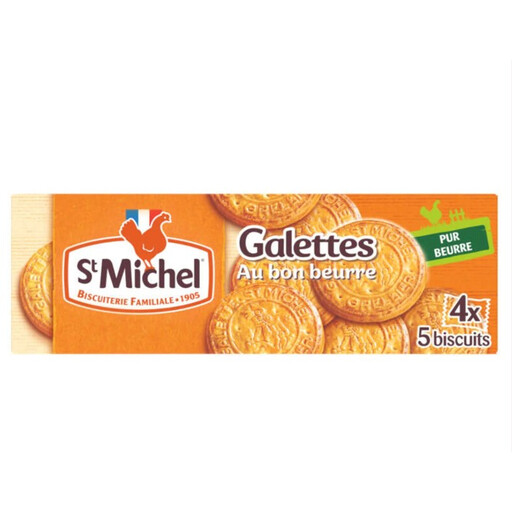 Image unavailable
Consider this if you’d rather give traditional shortbread than a cereal Digestive. The pack on offer is 120 g; St Michel describes Sablé de Retz as a coconut biscuit containing gluten, milk and soya. If individual portions matter to you, check the packaging of the pack on offer before buying.
No: the name of the original McVitie’s Digestive doesn’t prove that it aids digestion. Carrefour France describes it as a cereal biscuit; choose it for the recipe and taste you’re looking for, without assuming it offers digestive benefits.
Read the information on the exact pack. Auchan France lists wheat and possible milk in the original Digestive; St Michel lists gluten, milk and soya for Sablé de Retz, with possible traces of nuts, sesame and egg.
No. The French Ministry of the Economy describes Nutri-Score as an optional, supplementary label. When comparing the packs you’re interested in, also check their ingredients, allergens, nutritional values per 100 g and net weight.
Follow the instructions on the pack and check its best-before date. Auchan France recommends storing the original Digestive away from heat and moisture; for Sablé de Retz, St Michel recommends a dry place away from heat and light.