People looking to reduce their sugar intake
You want to tell the difference between juice with no added sugars and juice labelled “reduced sugar”, rather than relying on the word “diet”.


For an afternoon snack, don’t choose orange juice labelled “no added sugars” assuming it contains no sugar: naturally occurring sugars still count. If you’re looking to reduce your sugar intake, check for the description “reduced sugar” and the nutritional information for the exact product. If you’d rather eat a piece of fruit, Manger Bouger recommends choosing whole fruit and limiting juice.
You want to tell the difference between juice with no added sugars and juice labelled “reduced sugar”, rather than relying on the word “diet”.
You’d like to enjoy orange juice as an afternoon snack and compare the sugar listed per 100 ml with the amount you plan to drink.
You’re choosing between juice with or without pulp, not-from-concentrate juice or juice made from concentrate, and then between a small bottle and a sharing size.
Worth considering: if you want to drink orange juice while avoiding added sugars.
Bear in mind: this label doesn’t remove the sugars naturally present in the fruit.
Look for this: if reducing sugars, rather than simply avoiding added sugars, is your main priority.
Check: the product description and nutritional information for the exact product you’re buying.
Choose this: if you’d rather eat a piece of fruit than drink juice as an afternoon snack, in line with Manger Bouger’s advice to choose whole fruit.
The trade-off: this won’t give you the taste or convenience of a ready-to-drink juice.
| What to consider | What to check | Who is it for? |
|---|---|---|
| Sugars | Compare the juice description with the “of which sugars” line in the nutritional information, per 100 ml and then for the portion you plan to drink. | I’m looking to reduce the sugars in my afternoon snack and don’t want to confuse no added sugars with an actual reduction; around 45% of consumers put this need first. |
| Portion | Check the container size and how much you actually pour. For a large bottle, also check the instructions for use after opening. | When I have juice in the afternoon, I’d rather decide how much to drink than pour without thinking; around 36% of consumers put portion control first. |
| Recipe and texture | Check the ingredients, whether it contains pulp, and whether it’s described as “not from concentrate” or “made from concentrated juice”. | I mainly want a texture and format that suit me, without assuming this tells me how much sugar it contains; around 19% of consumers put these preferences first. |
The sugars naturally present in the fruit remain in the juice. The product information for a 20 cl Auchan bottle lists 17 g of sugars per bottle, despite the “no added sugars” label.
Check the “of which sugars” line and the amount for your portion. If you’re looking to reduce your sugar intake, check the description of the exact product.
A 2 L bottle can provide several servings, but its size doesn’t determine how much you pour into a glass. Manger Bouger recommends limiting fruit juice and having no more than one glass a day.
Decide how much to pour before drinking, and check the storage instructions for after opening.
Manger Bouger recommends choosing whole fruit and limiting all kinds of juice.
If you’d like to eat a piece of fruit as an afternoon snack, have it with water rather than automatically treating juice as a substitute.
Carrefour lists a 1 L Joker product with no pulp, labelled “no added sugars” and made from concentrated juice.
Carrefour’s product information describes 50 cl and 2 L products with no pulp, labelled “no added sugars”.
Auchan lists a 20 cl bottle of not-from-concentrate orange juice, labelled “no added sugars”.
A Carrefour product listing describes a 1.5 L Tropicana product with no pulp, labelled “no added sugars”.
This 1 L product with pulp is for people who’d like to enjoy orange juice as an afternoon snack. If reducing sugar is your priority, check its product description and nutritional information.
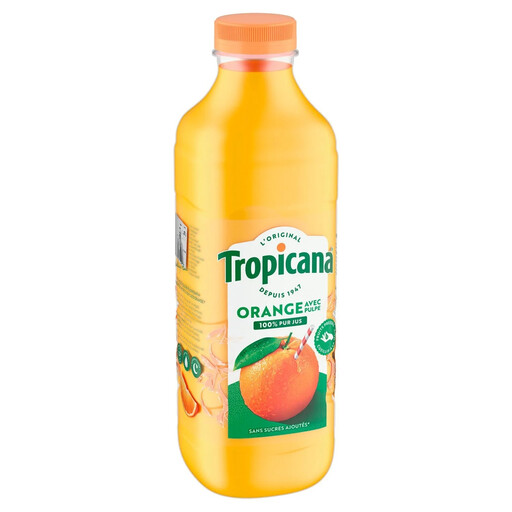 Image unavailable
For an afternoon snack with orange juice and pulp, check how much you pour from this 1 L pack.
The title indicates that the product is close to its best-before date. Check the exact date before buying, along with the product description and nutritional information on the packaging.
No. Juice with no added sugars can still contain the sugars naturally present in oranges. To compare products, check the “of which sugars” line in the nutritional information and consider how much you’ll drink.
Manger Bouger recommends limiting fruit juice as much as possible, having no more than one glass a day and choosing whole fruit. If you have juice in the afternoon, count that glass as part of your intake for the day.
No. A small pack makes the amount clear, but it doesn’t determine how much sugar the juice contains. The product information for the 20 cl Auchan bottle lists 17 g of sugars per bottle.
Follow the instructions for the product you buy. For its 20 cl bottle, Auchan recommends keeping it refrigerated and consuming it within five days of opening. Check the packaging if you choose a different juice.