What should you check before choosing?
Assurance Maladie recommends relating nutritional information to the amount you eat. To compare two packets, start with the values per 100 g, then check them against the portion you plan to serve.
| Criteria |
What to check |
Who is it for? |
| Carbohydrates, sugars and portion size |
Compare the carbohydrate and sugar values per 100 g, then relate them to the amount you serve. |
If I’m keeping an eye on what’s in my breakfast, I want to know what’s in my bowl, not just what’s in the portion size stated on the packet. Around 36% of consumers prioritise this. |
| Fibre and cereals |
Check the fibre content and read the cereal ingredients. Under European Regulation (EC) No 1924/2006, the claim ‘high in fibre’ requires at least 6 g per 100 g or 3 g per 100 kcal. |
When comparing recipes that seem similar, I look for a clear fibre content without overlooking the rest of the label. This is the top priority for around 29% of consumers. |
| Ingredients and allergens |
Read the ingredients, declared allergens and any ‘may contain’ statements on the exact packet. |
If an ingredient doesn’t suit my needs, I need to be able to rule out the recipe before comparing its nutritional values. Around 21% of consumers check this first. |
| Product availability |
Check the name and format of the product sold by your retailer before using the values from another recipe. |
If I shop at my usual store, I want to find the recipe whose label I’ve read, not a different version from the same range. This is the main priority for around 14% of consumers. |
A muesli option on Joybuy
This selection features a BJORG muesli to consider if you’re looking for a recipe labelled high in fibre and with no added sugars. Compare the information on its packaging with the amount you plan to serve.
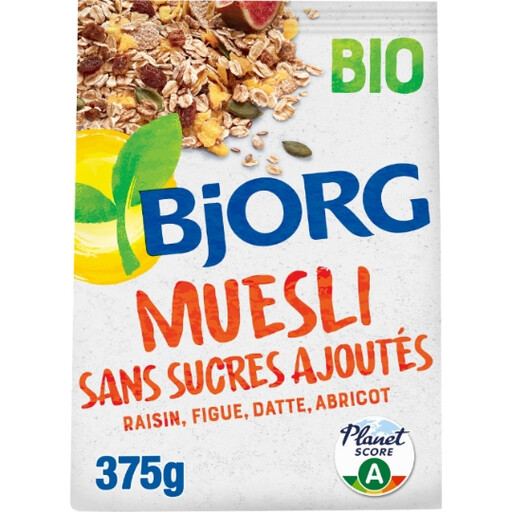 Image unavailable
BJORG Organic Muesli 375 g
Worth considering if you’re looking for a muesli with a stated fibre content and a recipe labelled ‘no added sugars’.
The BJORG product page published by Joybuy lists 10 g of fibre per 100 g and 23% fruit, including raisins, figs, dates and apricots. The presence of fruit doesn’t mean the muesli is sugar-free: check the carbohydrate and sugar values on the packaging and relate them to the amount you serve. Also check the allergens on the exact packet.
View on Joybuy
Frequently asked questions
What does ‘high in fibre’ mean on muesli sold in France?
European Regulation (EC) No 1924/2006 allows this claim if a product contains at least 6 g of fibre per 100 g or at least 3 g per 100 kcal. This threshold does not tell you how much carbohydrate or sugar the muesli contains.
Is muesli with no added sugars also sugar-free?
No. A recipe with no added sugars can still contain naturally occurring sugars, particularly in dried fruit. Check the carbohydrate and sugar values per 100 g, then take the amount you serve into account.
How should you use the portion size shown on the packet?
Use it as a guide when reading the label, but don’t assume it matches the amount you’ll eat. Assurance Maladie recommends relating nutritional information to the amount actually consumed.
Which allergens should you check in muesli?
Check the allergens listed in the ingredients and any ‘may contain’ statements on the exact packet. Depending on the recipe, the Jordans, Carrefour and Auchan product pages mentioned here flag cereals containing gluten, nuts and other ingredients to check.
Is the Nutri-Score enough to choose between two mueslis?
No. It gives you an overall indication, but it doesn’t replace checking the full label. To compare two recipes in this context, also look at the fibre, carbohydrate and sugar content, the ingredients and the amount you plan to serve.


