
Livraison le jour même ou le lendemain

Qualité garantie

Débloquez vos offres de bienvenue: Livraison GRATUITE | Jusqu'à -80 % | 30 jours d'essai gratuits à JoyPlus
Téléchargez l'application
As a product expert and editor, my mission is to sift through the market to help you make the right choices. Today, we're putting the detachable ceramic cookware set under the microscope: a solution that's winning over more and more people looking to optimise their space and cook healthier. But be warned, not all sets are created equal. We'll explain how to avoid the common pitfalls and recognise a set that will truly stand the test of time.
Marketing for kitchen utensils can be particularly misleading. There's often a world of difference between enticing promises and real-world performance. Here are three red flags to keep in mind before you pull out your credit card.
To ensure your investment goes the distance and meets your expectations, focus on these three key points.
What's the number one advantage of ceramic? It offers a perfect non-stick surface without resorting to the notorious per- and polyfluoroalkyl substances (PFAS), which include PFOA. A quality ceramic coating is made from mineral-based materials, making it perfectly stable, even at high temperatures.
The real advantage of a space-saving cookware set lies in the intelligence of its detachable and stackable system.
A modern cookware set must be a true workhorse. Compatibility with all hobs, including induction, is now an essential prerequisite.
Here are a few options that check all the boxes for quality, safety, and practicality.
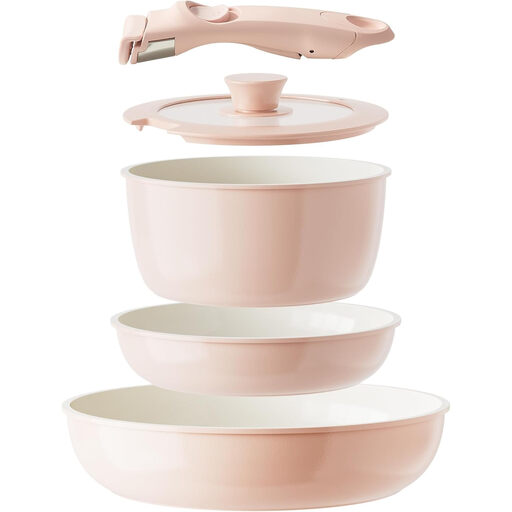
Why we recommend it: This set is tailor-made for modern kitchens where every square inch counts. It combines a stylish aesthetic (we love this pink cookware set) with a design focused on health and practicality, perfect for daily use.
The technical sheet guarantees it is free of PFAS, PTFE, and PFOA. The stackable design promises up to 75% space savings, and the patented coating is engineered for enhanced durability.
Total versatility: compatible with all hobs including induction, oven-safe up to 230°C, and a detachable handle that lets you move seamlessly from the hob to the oven and to the table in a snap.
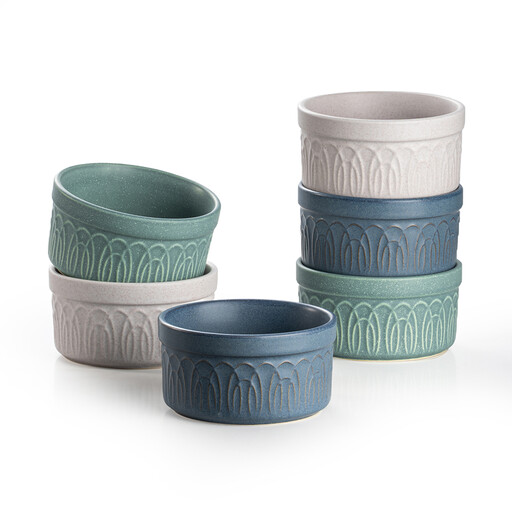
Why we recommend it: As a complement to a main cookware set, these ramekins are perfect for individual desserts, soufflés, crème br?lées, or sauces. Their compact size is a real bonus for busy kitchens.
Made from high-quality ceramic, they are guaranteed to be lead-free and non-toxic. Their function is clear, specialised, and free of empty promises. They are built to last and resist scratches.
Ultimate versatility: they are oven, microwave, freezer, and dishwasher safe. Their simple, elegant design allows them to go straight from the kitchen to the table.
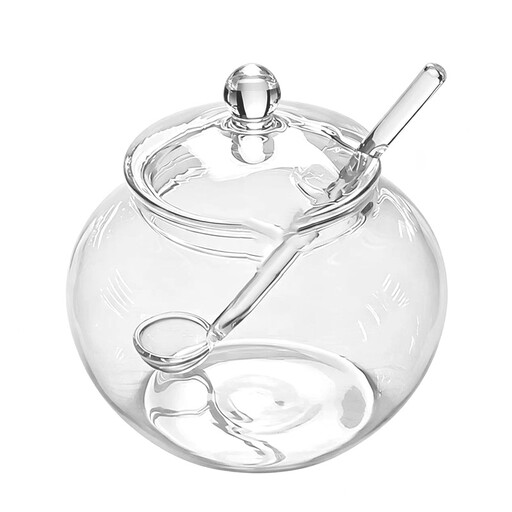
Why we recommend it: For those who like everything to be spotless and within easy reach, this jar is the perfect accessory. It keeps salt, sugar, or spices protected from moisture while adding a touch of elegance to the countertop.
This is a simple, honest product. Its mission? To store. And it does it well, thanks to an airtight lid and healthy materials (glass and BPA-free plastic). No gimmicky features that are likely to disappoint.
Its design is ultra-practical: the jar is transparent to identify the contents at a glance, and the spoon integrated into the lid means you don't have to search for one every time. Clever.
Explore our full selection of products that meet our quality criteria and safety standards.
The longevity of a ceramic coating primarily depends on its care. To preserve its properties, avoid metal utensils, thermal shock (going from very hot to very cold suddenly), and abrasive sponges. With minimal care, a well-made coating can remain effective for several years.
Removable handle systems have improved immensely. Quality models feature robust, often patented, locking mechanisms that ensure a firm, wobble-free attachment. Before buying, check the manufacturer's details on the handle's design and the materials used, such as reinforced Bakelite, which provides a good grip and excellent heat insulation.
No, the use of metal utensils on a ceramic coating should be avoided. To prevent scratching the surface and destroying its non-stick properties, always use utensils made of wood, silicone, or nylon. It's a small habit that significantly extends the life of your cookware.