
Livraison le jour même ou le lendemain

Qualité garantie

Débloquez vos offres de bienvenue: Livraison GRATUITE | Jusqu'à -80 % | 30 jours d'essai gratuits à JoyPlus
Téléchargez l'application
A cluttered desk is often a sign that your workspace no longer meets your needs. Piles of documents, scattered supplies, and a lack of organization can undermine your focus and productivity. Getting a desk organizer seems like the perfect solution, but the market is flooded with products whose alluring marketing promises don't always deliver.
Before you buy, it's crucial to learn how to spot the design flaws that turn a good intention into a purchase you'll regret. Here are the most common traps to avoid:
To make the right choice, focus on a few key criteria that guarantee the durability and practicality of your future desk storage solution.
The material is the first indicator of your organizer's longevity.
Before any purchase, measure the available space on your desk. An organizer that's too bulky can quickly become counterproductive. Think vertically: a wall-mounted file sorter or a multi-tiered model can free up valuable work surface.
Check the internal dimensions of the compartments. For effective paper storage, make sure each section can comfortably hold stacks of A4-sized paper (21 x 29.7 cm), including when they are in folders or sleeves. Models like a stackable letter tray or a vertical desktop file holder are designed specifically for this purpose.
Your choice will depend on what you need to store.
We have selected a few models that check all the boxes, for different profiles and budgets.
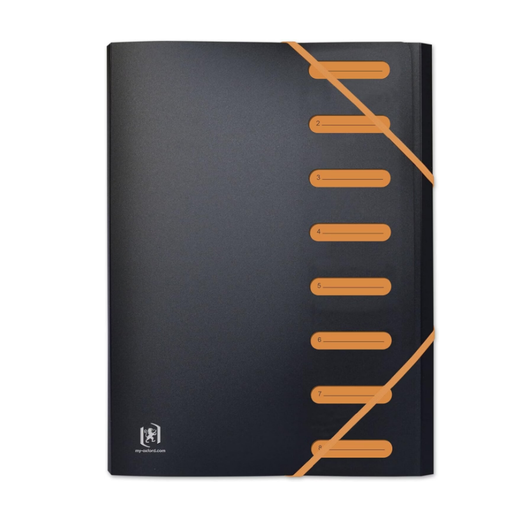
Why we chose it: Perfect for students or those who juggle between the office and home. It combines filing and transport for small supplies in a single, lightweight, and durable unit.
Its expandable spine adapts to the number of sheets, avoiding the trap of a rigid, ill-fitting format. The sturdy polypropylene cover protects A4 documents without bending them.
Includes 8 compartments, a zippered pouch for pens, and a flap closure to secure the contents. The ideal companion for organized, on-the-go filing.
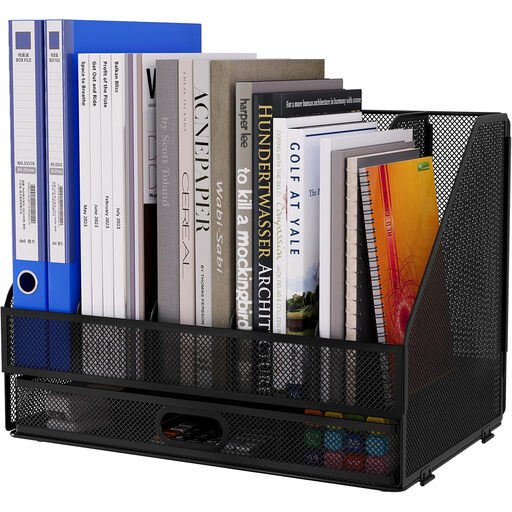
Why we chose it: A true storage station for those who juggle numerous files and supplies. Its design centralizes everything in one place for a consistently clean and functional desk.
Its powder-coated metal construction guarantees rock-solid stability, unlike flimsy plastic models. It won't bend under the weight of binders and books.
Combines 5 vertical compartments for A4 files and a bottom drawer for small supplies. An all-in-one that maximizes efficiency in a small footprint.
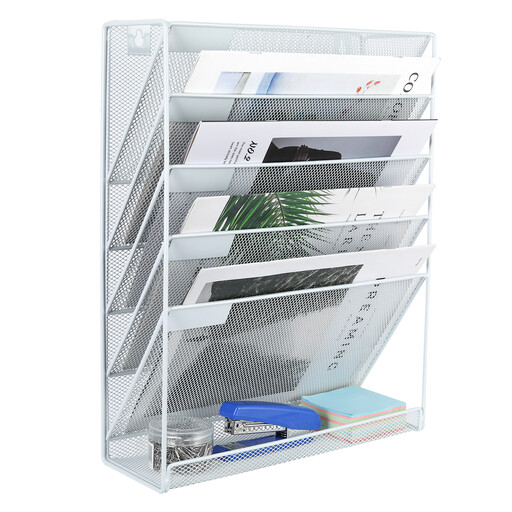
Why we chose it: The ideal solution for home offices or tight workspaces. By utilizing vertical wall space, it completely frees up your desk surface for your daily tasks.
It bypasses the problem of bulky desktop organizers. Its dual-use design allows it to be mounted on the wall (screws included) or placed on a desk for maximum flexibility.
Offers 6 compartments with label holders to find what you need at a glance, plus a bottom tray for small items. Its metal structure is a guarantee of longevity.
We have compiled a complete selection of products that meet our strict criteria for quality and practicality.
Most quality metal organizers feature a powder coating that protects them from rust. For maintenance, regular dusting with a dry cloth is sufficient. For stains, use a slightly damp cloth and dry immediately. Avoid placing it in a very humid environment and do not use abrasive cleaners that could damage the protective coating.
A letter tray (or filing tray) is typically a single, often stackable, tray intended to hold pending documents (incoming mail, papers to be filed). A document sorter is a more complex structure with multiple compartments (vertical or horizontal) designed to sort and classify different types of papers or files simultaneously.
Yes, provided it is installed correctly. The load capacity of a wall-mounted file sorter depends on two factors: the sturdiness of the product itself and the quality of the wall mounting. Always use screws and anchors appropriate for your wall type (drywall, brick, etc.). A well-secured metal model can easily support the weight of several magazines and thick files without any issue. Always check the manufacturer's recommendations for the maximum load.