
Livraison le jour même ou le lendemain

Qualité garantie

Débloquez vos offres de bienvenue: Livraison GRATUITE | Jusqu'à -80 % | 30 jours d'essai gratuits à JoyPlus
Téléchargez l'application
A cluttered desk makes it harder to find documents, reduces your available space, and quickly creates a sense of chaos. However, buying a desk organiser at random isn't always a good idea. Some models take up more room than expected, others don't accommodate A4 formats well, or they become impractical once their compartments are full.
Before comparing desk storage solutions, it's best to identify the most common pitfalls and check a few concrete features.
A compact organiser is fine for a few pens and accessories, but it won't replace an A4 document holder. Commercial photos can also give a misleading impression of volume. Always check the width, depth and height, then compare them to the space available on your desk or in a drawer.
A tray that's too narrow risks bending folders, ring binders or magazines. For letters, administrative files and professional documents, look for an explicit mention of A4 compatibility. Vertical or stacked trays should also remain easy to access once loaded.
A letter tray that's too light can slide when you pull out a shelf. Conversely, a poorly protected metal model might scratch your desk. Non-slip feet, rounded edges and the quality of the assembly all deserve your attention. For plastic, cardboard or woven paper, also consider moisture resistance and the maximum weight capacity.
Start by distinguishing your needs:
Measure the space before buying and allow a few extra centimetres to open a drawer or remove a tray. A model measuring 35.5 × 29.5 cm won't be used the same way on a small student desk as on a large home-office workstation.
Metal generally offers a rigid structure, suitable for documents and ring binders. A metal document organiser with a protective finish can also find its place in a professional environment, provided you avoid excessive humidity and abrasive products.
Plastic is easy to clean and works well for everyday accessories. Cardboard is suitable for light filing and items not exposed to moisture. Baskets combining a metal frame with woven paper add a more decorative touch, but should neither be overloaded nor placed in a damp room.
A system with drawers or sliding trays makes it easier to organise by priority: 'to do', 'pending' and 'archived'. However, check for protective feet, stability on a flat surface, and whether assembly is required.
For models that need putting together, tighten the screws properly without forcing them. Respect the recommended weight limit and avoid pulling out several loaded compartments at once – the structure could lose its balance.
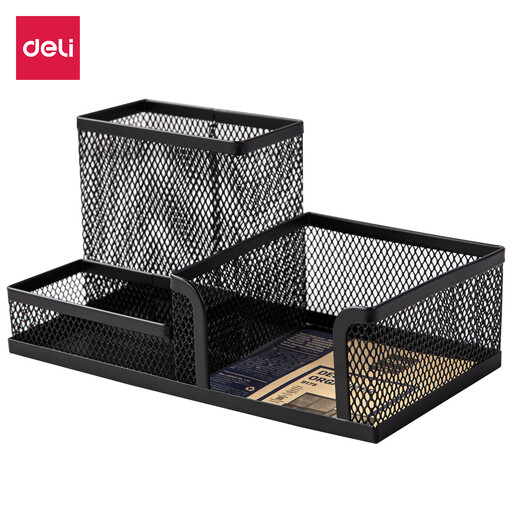
Why this choice suits this profile: Its many compartments hold pens, scissors, rulers, sticky notes and paperclips in a single storage unit, with no assembly required.
The open compartments prevent loose accumulation and let you see at a glance whether each accessory is in its place.
A black plastic structure, multiple storage zones and easy cleaning with a slightly damp soft cloth.
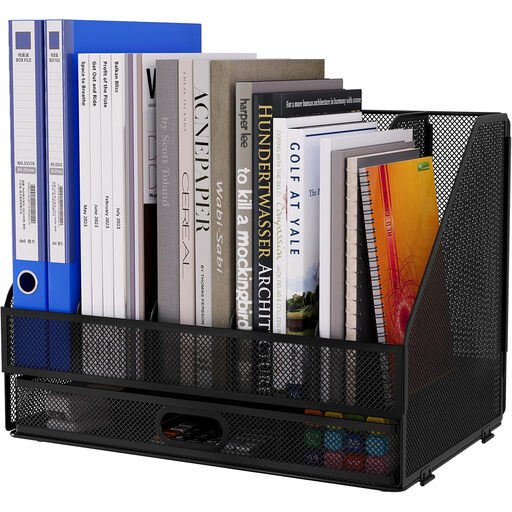
Why this choice suits this profile: Its black metal aesthetic complements a professional desk or home-office space where you want to keep documents visible and well organised.
The stated dimensions of 40 × 26 × 30 cm and A4 compatibility let you accurately assess the footprint before ordering.
Five vertical compartments and a lower drawer, all in a metal structure with a powder-coated finish.
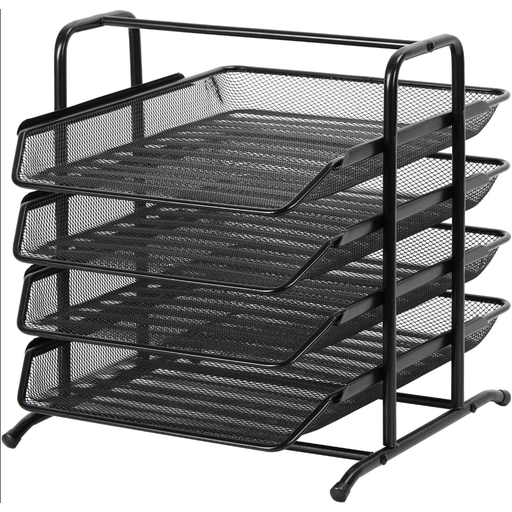
Why this choice suits this profile: Its four sliding tiers are ideal for workstations where several folders, letters or magazines need to stay separate and easily accessible.
Each tray is easily identifiable, which reduces the risk of mixing incoming documents, current files and everyday archives.
A metal structure, four sliding A4 trays, four rubber feet and dimensions of 35.5 × 29.5 × 32 cm.
We've put together a comprehensive selection, updated in real time, of products that meet these demanding criteria as well as European safety standards.
A simple method is to assign a specific function to each area:
This approach avoids duplicate purchases and helps you choose an accessory suited to a specific use, rather than a multi-purpose model where half the functions will go unused.
Check that the product clearly states its compatibility with A4 format, then compare its external dimensions to those of your folders. Also allow a little extra room for thick files, ring binders and handling documents.
A dry or slightly damp cloth is usually sufficient. Dry the surface quickly and avoid abrasive products. Keep the storage away from sources of moisture to preserve its coating and reduce the risk of oxidation.
Its lifespan depends on the material, the weight stored and the frequency of use. Don't overload the trays, follow the assembly instructions and choose a structure suited to the intended load. Regular maintenance and use on a flat surface will also help maintain its stability.