
Livraison le jour même ou le lendemain

Qualité garantie

Débloquez vos offres de bienvenue: Livraison GRATUITE | Jusqu'à -80 % | 30 jours d'essai gratuits à JoyPlus
Téléchargez l'application
A table lamp is much more than a simple light source. It's a true decorative object that punctuates a space, sculpts an atmosphere, and asserts your style. However, choosing the right designer table lamp can quickly become a headache. Between the flattering photos on online shops and marketing descriptions that seem too good to be true, it's easy to make a mistake. As the head of product selection at Joybuy, my role is to help you see things more clearly and avoid the most common pitfalls.
Before you dive in, here are the three classic mistakes that too often turn a promising purchase into a real disappointment.
To make the right choice, focus on a few objective technical criteria. These are the true guarantors of a successful long-term purchase.
Not all lamps are created equal, nor do they serve the same purpose. An ambient lamp for the living room will diffuse a soft, warm light, while a modern desk lamp must provide more direct and precise illumination. The shape and opacity of the lampshade are crucial here.
Also, remember to check the socket type. The most common in Europe are:
Opting for a standard socket ensures you can find replacement bulbs anywhere and can vary the intensity or colour temperature as you wish.
The materials set the tone and define your lamp's style. An industrial bedside lamp will readily combine metal and raw wood, while a Scandinavian table lamp will favour light wood and natural fabrics.
Beyond aesthetics, pay close attention to the lamp's base. A heavy base made of metal or solid wood guarantees good stability, which is essential to prevent disasters, especially on a bedside table or a cluttered desk. For a small decorative lamp, aim for a minimum weight of 0.5 kg: it's a good benchmark.
Take the time to measure the space where you plan to place your lamp. A lamp that's too high on a bedside table can be dazzling when you're in bed. A lamp that's too low on a desk won't sufficiently light your work surface.
Also, consider the practical aspects, like the cable length. A standard 150 cm cable offers decent flexibility, but 180 cm or more will be a game-changer. Finally, check that the switch is easy to reach.
To move from theory to practice, here are a few models that tick all the boxes, each in its own style.
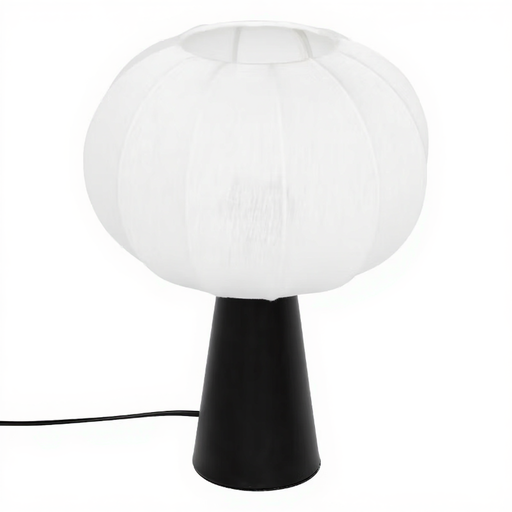
Why we love it: Because it embodies a minimalist and timeless aesthetic. With its two-tone design and pure lines, it fits perfectly on a bedside table or an entryway console, in a contemporary or Scandinavian decor.
This model combines elegant design with foolproof functionality: a standard E27 socket and a reliable mechanical switch. The combination of metal and cotton is a classic that inspires confidence and avoids the "cheap" trap.
Its compact size (H 33 cm) and light weight (0.5 kg) make it a nomadic lamp, easy to move around as your mood strikes.
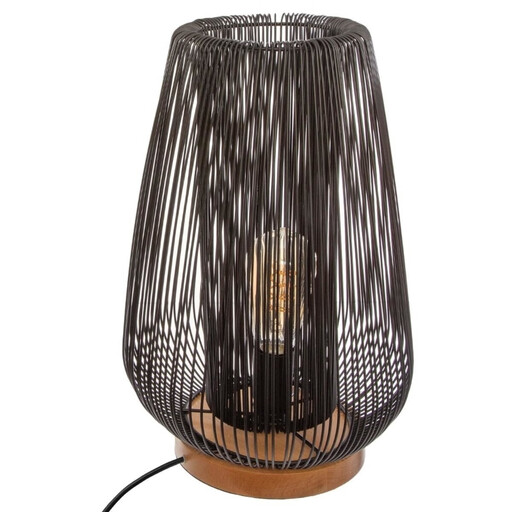
Why we love it: Because it has character! For those who want a raw, authentic touch. The combination of black wireframe metal and wood makes it a true sculptural piece, ideal as a statement living room light or an industrial bedside lamp that won't go unnoticed.
No more risk of instability: its weighted base (18 cm diameter) and substantial weight (2.83 kg) anchor it securely. In terms of ergonomics, its long 180 cm cable offers maximum placement freedom.
Its wireframe structure creates unique plays of light and shadow, turning simple lighting into a true visual animation.
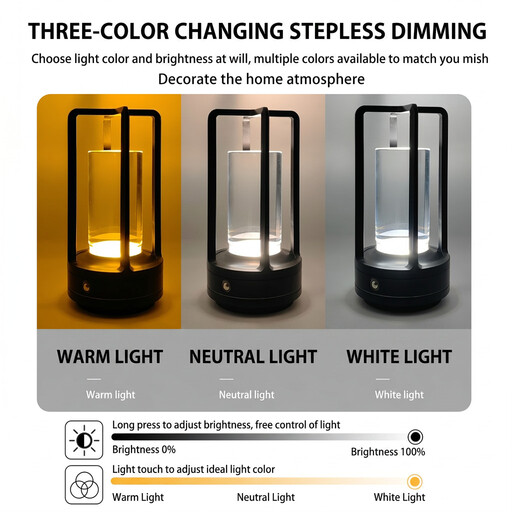
Why we love it: Because it's the epitome of flexibility. Ideal as a bedside lamp, perfect on the dinner table, and even a companion for your summer evenings on the balcony. Its masterstroke? Being cordless, freeing you from the tyranny of electrical outlets.
It shatters the "bad light" trap by offering 3 colour temperatures (warm, neutral, cool) and adjustable brightness. As for the short cable… the problem is solved at the source: it's 100% cordless.
Up to 18 hours of battery life, universal USB-C charging, and an ultra-intuitive touch control. Versatility at its peak.
Explore our full selection of lighting fixtures that meet our demanding standards for design, quality, and safety.
The difference lies in the size of the screw base. The E27 (27 mm diameter) is the large standard, found on most table lamps, pendant lights, and floor lamps. The E14 (14 mm diameter) is its smaller sibling, typical for accent lamps, chandeliers, or compact bedside models. The choice depends on the size of the fixture and the desired light output.
For a bedside lamp, the ideal is for the bottom of the lampshade to be at chin level when you are sitting up in bed. This illuminates your book without dazzling you. For a desk lamp, it should be tall enough to light your entire work area without creating annoying shadows from your hand or head. A height between 35 and 50 cm is often a good compromise.
Consumption doesn't depend on the lamp itself, but on the bulb. Good news: almost all current models are compatible with LED bulbs. These use up to 85% less electricity than a classic incandescent bulb for the same brightness, while having an incomparably longer lifespan. Choosing LED is therefore a smart move for both your wallet and the planet.