
Livraison le jour même ou le lendemain

Qualité garantie

Débloquez vos offres de bienvenue: Livraison GRATUITE | Jusqu'à -80 % | 30 jours d'essai gratuits à JoyPlus
Téléchargez l'application
A designer pendant light can transform a kitchen, dining room or living room. But an attractive light fitting is not necessarily the right choice. If it is too large, it may obstruct movement. If the light is poorly diffused, it can cause glare. And with an uncommon lamp base, replacing the bulb can quickly become complicated.
Before placing your order, three common mistakes are particularly easy to avoid:
To illuminate a kitchen island, a linear pendant light will generally distribute light more effectively along the entire length of the worktop. With its seven light sources, the Homary model measures 120 cm wide and has adjustable cables up to 150 cm, according to the manufacturer’s information. It will therefore be better suited above an island or large table than in a small dining area.
Above a table, allow sufficient space between the tabletop and the bottom of the light fitting. This will ensure good visibility between diners and help prevent you from bumping into the pendant in everyday use. In an entrance hall or walkway, also check the ceiling height and the risk of contact.
A ceiling pendant light or a shallow light fitting will often be better suited to rooms with low ceilings. Conversely, in a room with a high ceiling, an adjustable cable or rod offers greater flexibility.
The lamp base determines which type of bulb is compatible:
Also check the maximum permitted wattage per bulb. The Tinto pendant light, for example, accepts one E27 bulb of up to 15 W and can be used with a dimmable bulb. The Contina uses three G9 bulbs of up to 5 W, which are not included. The Homary model comes with seven 5 W G9 LED bulbs in warm white, but its brightness cannot be adjusted.
To keep energy consumption under control, choose an LED bulb suited to the intended use. Warm white creates a welcoming atmosphere in a dining room or bedroom. A more neutral shade will often be more practical for working at a kitchen worktop or desk.
The lampshade material directly affects the lighting atmosphere, as well as maintenance requirements:
Light fittings with an IP20 rating are designed for indoor use in dry spaces. They are not suitable for a bathroom exposed to splashes of water or for outdoor installation.
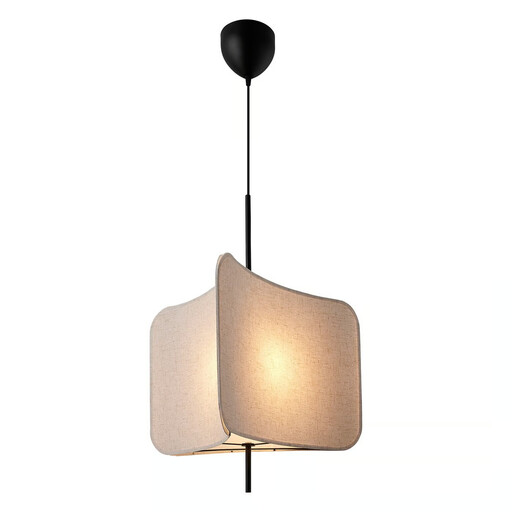
Why this choice suits this profile : Measuring 50 cm and featuring an E27 base, it fits easily into a living room, bedroom or above a small table.
The description specifies the maximum wattage of 15 W, compatibility with a ceiling hook and the fact that no bulb is included. You therefore know immediately what you need to provide.
A triangular fabric lampshade, diffused light, dimensions of 50 cm in both height and width, and adjustable brightness when used with a compatible bulb.
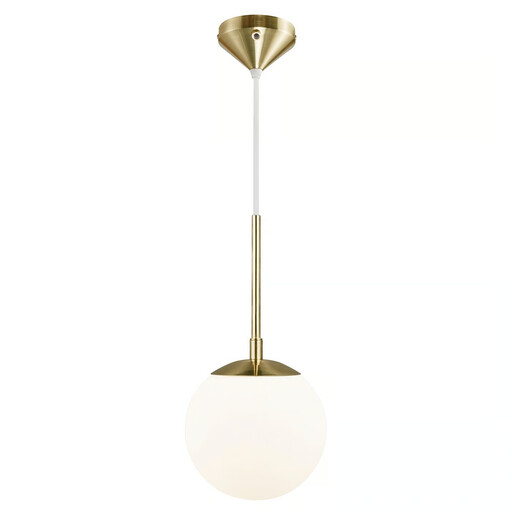
Why this choice suits this profile : Its mouth-blown opal glass and brass-colour finish add character to a dining room, living room or entrance hall.
The product details specify the E14 base, a maximum wattage of 10 W, the fact that no bulb is included and the need to use suitable mounting equipment.
Opal glass, brass-colour metal, a diameter of 15 cm and the option to create a cluster with several pendant lights.
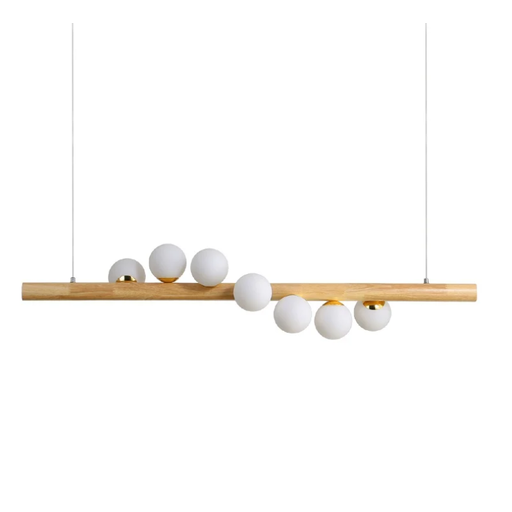
Why this choice suits this profile : Measuring 120 cm wide and featuring seven glass globes, it is designed for large kitchen islands, long tables and open-plan rooms.
The product details mention a voltage of 220–240 V, a fixed connection, adjustable height and the absence of a dimmer.
Seven included 5 W G9 LED bulbs, white glass globes, a wooden beam and gold-finish metal details.
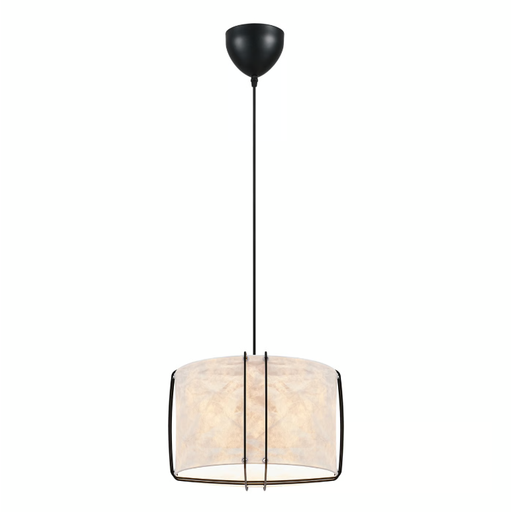
Why this choice suits this profile : Its white lampshade with delicate pleats works effortlessly in a bedroom, reading nook or living room with clean lines.
The material should be dry-cleaned and protected from moisture. You should also use an LED bulb that produces little heat.
A distinctive Japandi style, soft and diffused light, a combination of paper and metal, and a format suited to spaces designed for relaxation.
We have brought together a complete, real-time updated selection of products that meet these demanding criteria as well as European safety standards.
A modern pendant light must be secured to a support capable of bearing its weight. Before carrying out any work, switch off the power at the circuit breaker and check compatibility with a 220–240 V supply where specified. In the case of a fixed connection, it is best to call on a qualified electrician.
Handle glass globes with care. For fabric, paper and metal, use a dry cloth suitable for the material. Always observe the maximum wattage recommended by the manufacturer and replace a bulb with one featuring the same base.
This depends on the room, the light fitting’s dimensions and the desired level of visibility. Measure the distance between the tabletop and the bottom of the pendant light, then make sure it does not interfere with conversations or everyday movements. An adjustable cable makes it easy to fine-tune the height after installation.
Running costs depend primarily on the bulb’s wattage and how long it is switched on, not on the base itself. Compare the wattage, the number of light sources and the technology used. A pendant light with several bulbs may use more energy if they are all left on for long periods.
A pendant light’s lifespan depends on the quality of its installation, its maintenance, the weight it supports and bulb replacement. Models with replaceable bulbs, such as certain E27, G9 or E14 pendant lights, allow you to change the light source without replacing the entire fitting.