
Livraison le jour même ou le lendemain

Qualité garantie

Débloquez vos offres de bienvenue: Livraison GRATUITE | Jusqu'à -80 % | 30 jours d'essai gratuits à JoyPlus
Téléchargez l'application
A designer pendant light is much more than just a bulb on a wire. It's the centrepiece that sets the tone for a room, whether it's your dining room, kitchen, or living room. But with a multitude of models available, making the right choice can quickly become a daunting task. A poor purchase guarantees either ghastly, lifeless lighting or a fixture that clashes with your decor. To help you see things more clearly, we've broken down the common pitfalls to avoid and the essential criteria for choosing your pendant light wisely.
Before you fall in love with a design, think practically! Here are the most common mistakes that could ruin your purchase.
To ensure you make the right call, focus on a few technical points that determine both visual comfort and style.
How the light is distributed is the number one criterion. There are three main categories:
To avoid any missteps, follow these simple guidelines:
The material directly influences the style and durability of your light fixture.
To put theory into practice, here are a few models that tick all the right boxes, tailored to specific needs and lifestyles.
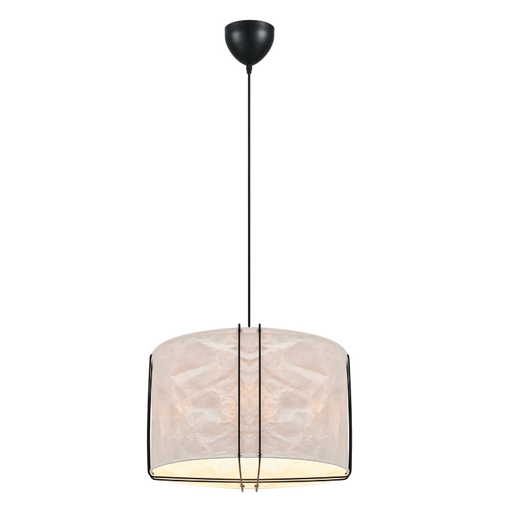
Why this choice : This profile seeks harmony, natural textures, and soothing light. The Japandi style, a fusion of Nordic minimalism and Japanese aesthetics, perfectly meets this desire for serenity and purity.
The slightly crumpled paper-like shade ensures a diffuse and warm light, eliminating any risk of glare. Its large size (50 cm) gives it character without weighing down the space, thanks to its visual lightness.
Creates a soft, poetic ambiance, perfect for a living room or bedroom. The suspension by thin metal wires enhances its minimalist expression.
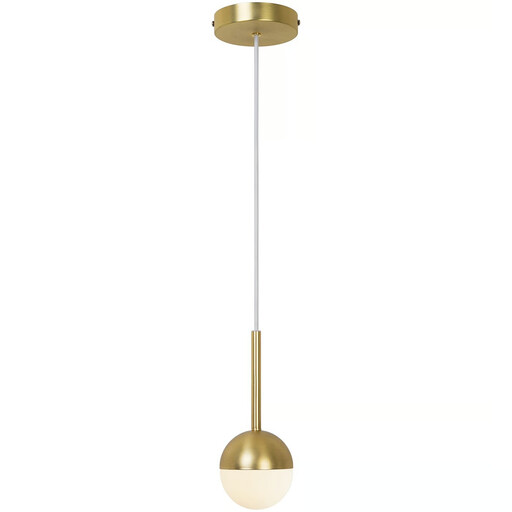
Why this choice : Drawn to glamour and noble materials, this profile wants a strong statement piece that combines modernity with a touch of sophistication. The pairing of brass and opal glass is a signature of the modern Art Deco style.
The white opal glass sphere conceals the bulb and diffuses a soft, uniform light, preventing any glare. The quality of the materials (brass-finish metal and blown glass) ensures a refined and lasting aesthetic.
Its elegant and compact design (10 cm diameter) is perfect to be installed alone, in a series above a bar, or in a cluster for a modern chandelier effect.
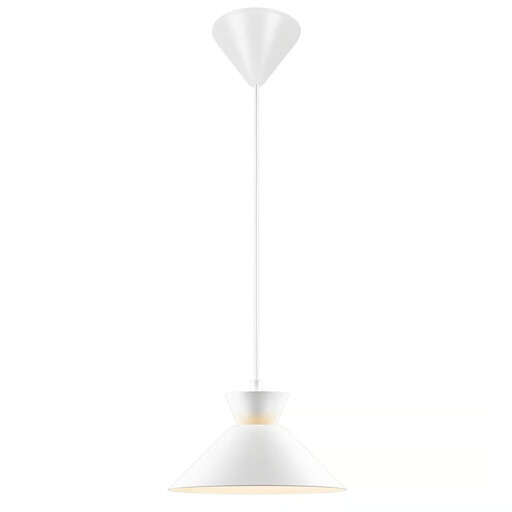
Why this choice : This profile values functionality, clean lines, and a timeless design. Inspired by the 1950s, this Nordic pendant embodies a geometric simplicity that transcends trends.
Its open shape creates decorative uplighting while directing the main light downwards. This dual function creates ambiance without neglecting functional lighting, thus avoiding flat or harsh light.
The metal construction ensures durability and easy maintenance. Its clean design makes it a versatile **white pendant light**, suitable for a kitchen, office, or entryway.
We have curated a complete range of light fixtures that meet our quality criteria and current safety standards.
As a general rule, leave a space of 75 to 90?cm between the lowest point of the pendant and the tabletop. This illuminates the surface without blocking the line of sight of those seated. Feel free to adjust this height based on the bulb's brightness and your ceiling height.
The size should be proportional to the room and the furniture it hangs over. For a rectangular table, you can opt for a single large pendant or an alignment of several smaller models. For a living room, here's a decorator's tip: add the length and width of the room (in metres), then multiply the result by 8. This will give you an approximate ideal diameter for your pendant light in centimetres.
Their maintenance is simpler than it seems. For daily care, a simple dry microfibre cloth is enough to remove dust. For a deeper clean, use a damp cloth with a little glass cleaner, after, of course, turning off the power and waiting for the bulb to cool down. Note that opal or frosted glass finishes are less prone to fingerprints than clear glass.