Households preparing several bowls
For back-to-school dinners, the stated number of portions and the volume of soup prepared can help you work out whether a sachet will be enough for your planned meal.


For back-to-school meals, start by considering how many bowls you need to serve and what equipment you have. A sachet prepared in a pan is suitable for sharing, while individual instant portions are ideal when you’re eating alone. Then compare the stated yield with the amount you’ll actually serve, and check the ingredients, allergens, salt content and preparation instructions for the product you choose.
For back-to-school dinners, the stated number of portions and the volume of soup prepared can help you work out whether a sachet will be enough for your planned meal.
An individual sachet can be a good choice when only one person wants soup. Auchan, for example, lists Royco soups in boxes of four sachets, each making 20 cl.
If the ingredients matter to your choice, check the nutritional information and ingredients list for each recipe. Always check the allergens for the exact product, even within the same brand.
First, work out how many people you’ll be serving and how you’ll prepare the soup. Then compare the quantity and ingredient information for recipes that suit your needs.
| What to consider | What to check | Who it’s for |
|---|---|---|
| Amount served | Compare the net weight, prepared volume and stated number of portions with the number of bowls you plan to serve. | When several people are having dinner together, I want to know whether one sachet will make enough soup for the meal; around 33% of consumers would put the amount served first. |
| Format and preparation | Check whether it’s an individual portion or a sachet to cook, as well as the water and equipment needed. | If I’m making just one bowl between activities, I look for a format that suits the time and equipment I have; speed would be a priority for around 27% of consumers. |
| Salt and nutritional information | Compare the “salt” figure on a like-for-like basis, for example per 100 ml of prepared soup. Check the Nutri-Score if it appears on the products you’re comparing. | For meals eaten regularly, I want to compare the stated salt content without confusing the amount per portion with the amount per 100 ml; around 20% of consumers would make this their main consideration. |
| Ingredients and allergens | Check the ingredients list, highlighted allergens and any “may contain” statements for the specific recipe. | If I need to avoid an ingredient, the soup’s name alone isn’t enough to confirm what’s in it; around 20% of consumers would put this check first. |
Nutri-Score is a voluntary label, as Santé publique France explains. When shown, it can help you compare similar products, but it doesn’t replace the nutritional information or ingredients list.
Sachets of different weights won’t necessarily make the same number of bowls. The amount of water specified in the instructions also affects the volume you’ll serve.
Check the number of portions and the preparation instructions, then compare them with the amount you plan to serve at home.
A vegetable soup may contain wheat or celery. Some Maggi recipes listed by Auchan include allergenic ingredients and, depending on the product, warnings that other allergens may be present.
Check the label for the flavour and format you’ve chosen. The French Directorate-General for Competition Policy, Consumer Affairs and Fraud Control states that allergenic ingredients must be highlighted in the ingredients list.
This logo doesn’t tell you how much salt is in the bowl you’ll serve or which ingredients you may need to avoid. Its absence doesn’t tell you what a soup contains, either.
When comparing recipes, also read the nutritional values on a like-for-like basis and check the ingredients and allergens separately.
These ranges provide examples of formats and recipes to compare. Their features depend on the specific product you choose.
Auchan lists several dehydrated Maggi soups, including vegetable and vermicelli, tomato and vermicelli, onion and harira-style recipes. Some product listings state that they make four portions.
Auchan lists instant Royco soups in boxes of four 20 cl sachets, with a choice of recipes.
The Carrefour range includes dehydrated soups under the Carrefour and Carrefour Classic’ brands, with family-size sachets and individual portions.
E.Leclerc lists sachet soups from its Régal Soupe and ECO+ ranges, including minestrone and tomato and vermicelli recipes.
This selection of Joybuy soups includes instant portions and sachets for making several bowls. Choose the preparation method that suits you, then check the details for your chosen variant before use.
 Image unavailable
This pack of three portions is a good choice if you want to make one bowl at a time with hot water.
Check the ingredients and allergens on the packaging for this recipe before serving.
 Image unavailable
This noodle soup is made with water and is suitable for a meal at home when you have a pan to hand.
The title states 69 g and 0,70 l; follow the instructions for the variant you receive to measure the water and check the ingredients.
 Image unavailable
This sachet may suit anyone who’d rather make soup in a pan than prepare an instant cup.
For this 85 g format, check the packaging for the amount of water, number of portions and allergens before preparing.
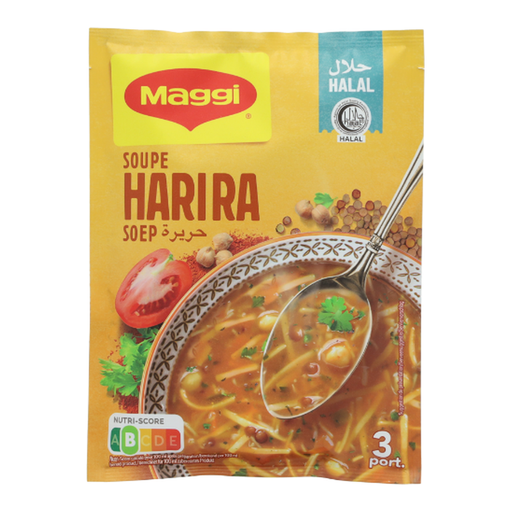 Image unavailable
This sachet soup is for anyone who prepares their meal in a pan.
The sachet is listed as 90 g. Check the packaging for the amount of water, number of portions, salt content and allergens for this recipe.
 Image unavailable
The individual portions are ideal if you want to make miso soup for one with hot water.
Check the ingredients and allergens on the packaging for the Enjuku Tofu variant, along with the instructions for each portion.
As well as the sachet weight, check the number of portions and the volume of soup once prepared. Also check how much water is needed: products of the same weight aren’t necessarily prepared in the same way.
No. When displayed, the Nutri-Score can help you compare similar products, but it doesn’t replace the nutritional values or ingredients list. Santé publique France explains that displaying it is voluntary. If it matters to you, compare the “salt” figure on a like-for-like basis too.
Read the ingredients list, highlighted allergens, nutritional information, net quantity and preparation instructions. For prepacked food sold in France, the French Directorate-General for Competition Policy, Consumer Affairs and Fraud Control also states that the label must include an appropriate use-by or best-before date.
No. A best-before date is not the same as a use-by date. According to the French Directorate-General for Competition Policy, Consumer Affairs and Fraud Control, the product may still be safe to eat if its packaging is intact, although some aspects of its taste may have deteriorated. Check the storage instructions too.
Follow the instructions for the soup you’ve chosen rather than adding salt automatically. Some Maggi recipes listed by Auchan say there’s no need to add salt, but check the instructions for each specific product.