Choose a dehydrated soup as a convenient part of a meal, without assuming that one serving alone will meet an older person’s nutritional needs. Check the nutritional information for the portion actually eaten, particularly energy, protein and salt, as well as allergens. If their appetite is reduced, plan the rest of the meal accordingly. If they have been diagnosed with malnutrition, have a prescribed diet or experience swallowing difficulties, ask their healthcare professional to approve the choice and texture.
Who might these soups be suitable for?
Older people with a poor appetite or who eat incomplete meals
A small bowl of hot soup can be part of a meal, but it shouldn’t automatically replace other foods. Manger Bouger points out that a reduced appetite in people over 75 can contribute to malnutrition.
Older people who need to watch their salt intake
Compare the salt content against the amount of soup actually eaten, not just the sachet of powder. If a specific diet has been prescribed, check that the exact recipe is suitable with the person’s healthcare professional.
Carers preparing suitable portions
Choosing between a single-serving sachet and a product for several people depends on appetite, independence and how much will be eaten. You’ll also need to check the texture and allergens for each recipe.
What should you check before choosing?
For an older person, start with the portion you’ll serve and any dietary restrictions. Then choose a format that’s easy to prepare and has a suitable texture for their needs.
| What to consider |
What to check |
Who this matters to |
| Part of the meal |
Check the energy and protein in the reconstituted portion, then decide what other foods to include in the meal. |
When my appetite is reduced, I want to know what the soup provides before making it the main course. This would be a priority for around 36% of consumers in this group. |
| Salt and dietary restrictions |
Compare the salt per portion eaten and check the ingredients, allergens and possible traces listed for the exact recipe. |
If I need to follow a diet or avoid an allergen, a convenient recipe isn’t enough: it must be suitable for the person. Around 29% of consumers would put this check first. |
| Preparation and texture |
Check the amount of water, preparation instructions and whether the soup contains noodles or pieces; follow any prescribed texture requirements. |
If preparation needs to be simple or certain pieces are difficult to eat, I choose a format that works for everyday use. This would be a priority for around 21% of consumers. |
| Format and portions |
Check how many portions will actually be prepared and eaten, as well as the storage instructions. |
If only one small portion is needed, I want to avoid preparing a sachet when the rest will go unused. This would be the main selection criterion for around 14% of consumers. |
Mistakes to avoid
-
Relying on the Nutri-Score alone to plan a meal
A Nutri-Score doesn’t tell you whether the portion served will meet the person’s needs on its own. Anses notes that older people have specific dietary needs.
Check the energy and protein in the nutritional information for the exact product, then consider how the soup fits into the whole meal.
-
Comparing salt without considering how much soup is consumed
A value per 100 g of powder and one per 200 ml of prepared soup don’t describe the same amount consumed. Manger Bouger recommends that adults have no more than 5 g of salt a day, taking all foods into account.
Convert the information to the portion actually served before comparing two recipes, and avoid adding salt out of habit.
-
Assuming a smooth soup has a prescribed texture
A recipe may contain noodles or pieces even if it looks smooth. Its appearance alone can’t tell you whether it’s suitable for someone with swallowing difficulties.
Check the ingredients and follow the texture advice from the care team. Don’t change a prescription without professional guidance.
-
Assuming every recipe from a brand contains the same allergens
Ingredients and ‘may contain’ information vary between soups and can change over time.
Check the packaging of the product you buy, even if the person has already eaten another recipe from the same brand.
Brands and retailers to know
These brands and retailers offer a range of formats and recipes to compare. Their inclusion here doesn’t mean that every soup is nutritionally suitable.
Royco
Royco offers instant soups in single servings, which may be worth considering when you need to prepare a small amount with little effort.
- Royco says to prepare its instant sachets with 200 ml of boiling water and leave for two minutes. Follow the instructions for the product you choose.
- Joybuy’s listing for the carrot and mushroom noodle soup gives 1.82 g of salt and 1.8 g of protein per prepared 200 ml portion. So a single-serving format doesn’t, by itself, guarantee the nutritional intake you’re looking for.
Maggi
Some Maggi dehydrated soups come in sachets that are cooked to make several portions.
- Auchan lists Maggi tomato and vermicelli soup as a recipe for four, ready in five minutes according to its product information.
- Ingredients and nutritional values vary by recipe. Check the prepared portion and allergens listed on the specific sachet.
Carrefour
Carrefour sells dehydrated soups under its Carrefour and Carrefour Classic’ brands, alongside other brands.
- The range makes it easy to compare recipes, sachet sizes and the number of portions.
- Choose based on the label for the recipe you’re considering: a retailer or brand name doesn’t determine its nutritional content.
E.Leclerc / Regal Soupe
E.Leclerc stocks Regal Soupe vegetable, pasta and pulse soups, which can be considered as part of a meal.
- The Regal Soupe minestrone listed by E.Leclerc contains vegetables, pasta and beans, among other ingredients.
- The presence of these ingredients isn’t enough to establish the nutritional content of the portion eaten. Check the salt content and whether it contains wheat, too.
Auchan
Auchan’s range distinguishes between family-sized dehydrated soups and individual instant preparations.
- This makes it easier to choose between preparing a small amount and using a sachet intended for several portions.
- The format doesn’t tell you about allergens or nutritional values, so check the exact product.
Dehydrated soups available on Joybuy
This selection includes two Maggi soups in sachets to be cooked and one Royco soup in individual servings. For the Maggi sachets, compare the preparation instructions with the values listed per portion before deciding what’s in the bowl you serve.
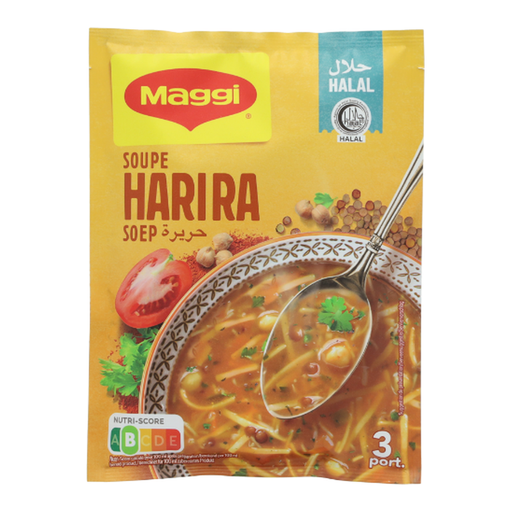 Image unavailable
Maggi Harira Soep 90 gr
To include this soup in an older person’s meal, first decide how much you’ll prepare and serve.
Check that the nutritional values given per portion match the preparation instructions you follow. Pay particular attention to the different amounts of water listed for preparation and for the portion.
View on Joybuy
 Image unavailable
Maggi Chorba Soep 85 gr
This sachet, which needs to be cooked, may be suitable when the soup will be divided into several portions.
Before comparing its nutritional content with another soup, check how much the recipe makes when prepared as instructed and what quantity the per-portion nutritional values refer to.
View on Joybuy
 Image unavailable
Royco carrot and mushroom noodle soup 3 × 20 cl
Individual servings are handy when you’re preparing a small amount at a time, but you’ll still need to consider how the soup fits into the meal.
Joybuy’s listing gives 1.82 g of salt and 1.8 g of protein per prepared 200 ml portion. Check the allergens on the packaging of the product you buy and take the rest of the meal into account.
View on Joybuy
Frequently asked questions
Can a dehydrated soup make up an older person’s entire meal?
Not necessarily: its nutritional content depends on the recipe and the portion eaten. Check the energy and protein in particular, then plan the rest of the meal to suit their needs. If they have been diagnosed with malnutrition or have a prescribed diet, ask their healthcare professional for advice.
How can you compare the salt content of two dehydrated soups?
Compare equivalent quantities of prepared soup, ideally the portions the person will actually drink. Manger Bouger recommends that adults have no more than 5 g of salt a day from all foods combined, so you can’t judge a soup by its name or the weight of the powder alone.
Which allergens should you look for on the sachet?
Check the ingredients, declared allergens and ‘may contain’ information for the exact recipe. Depending on the product, the soups in the listings consulted contain wheat or gluten, celery or milk. Don’t assume the label for one recipe applies to another.
How should you prepare and store dehydrated soup?
Follow the sachet’s instructions for water, preparation and storage, then check how much soup you’ve made before referring to the values per portion. For its instant sachets, Royco specifies 200 ml of boiling water and a two-minute wait. Instructions may differ for soups that need to be cooked.


