People stocking up
You’d like to keep a few sachets in the cupboard. The number of portions and the quantity you’ll need to prepare can help you choose a format you’ll actually use.


When stocking your cupboard, choose a format based on how many bowls you’ll actually make: a multi-portion sachet for sharing, or individual portions for the occasional bowl. Then compare the prepared quantity and ingredients for each recipe, particularly allergens and salt, and follow the storage instructions on the packaging.
You’d like to keep a few sachets in the cupboard. The number of portions and the quantity you’ll need to prepare can help you choose a format you’ll actually use.
For an occasional bowl with no leftovers, individual sachets serve a different purpose from a soup designed to make several portions.
If you’re watching your salt intake or need to avoid an ingredient, compare the nutritional information and ingredients for each recipe, even within the same brand.
Start by thinking about how many bowls you’ll need, then check how to prepare the soup and read the label for your chosen recipe.
| What to consider | What to check | Who it matters to |
|---|---|---|
| Usable quantity | Number of portions stated and amount of water needed. | I want to keep sachets that match the number of bowls I make, without preparing more than I need. Around 33% of consumers would make this usable quantity their priority. |
| Format and leftovers | Individual sachets or a preparation for several bowls; instructions for after preparation. | If I only want the occasional bowl, I’d rather not make a whole family-sized soup. This flexibility would be a priority for around 27% of consumers. |
| Ingredients and salt | Ingredients, declared allergens and salt per 100 ml or per prepared portion. | I need to be able to spot ingredients to avoid or compare the salt content of different recipes on a like-for-like basis. Around 27% of consumers would put checking the label first. |
| Recipe type | Ingredients actually included, particularly pasta or pulses, and the number of portions. | To add variety to my cupboard soups, I check what’s in each recipe rather than relying on its name alone. Around 13% of consumers would put their choice of recipe first. |
A vermicelli soup, a creamy soup and a minestrone won’t necessarily have the same ingredients or allergens.
Read the ingredients list and allergen information for the specific product you’re choosing.
The recipe may already contain salt. The “salt” line in the nutritional information lets you compare soups prepared on the same basis.
Check this information before buying, and taste the prepared soup before adding more salt.
The date shown applies to the product when stored as directed on its packaging. It doesn’t replace the instructions to follow once the soup has been prepared or the sachet opened.
Check the date and the storage instructions for the specific product separately.
Carrefour’s range includes instant soups and soups to cook under these names.
E.Leclerc stocks several ECO+ dehydrated soups, including different recipes.
Products listed by retailers include a 90 g Harira and vegetable and vermicelli soups.
Auchan stocks Royco instant soups in individual sachets, among other options.
Products checked at Auchan include a tomato and vermicelli soup and a minestrone, both stated to make four bowls.
The retailer’s range includes family-sized soups to cook and individual instant formats.
These sachets suit two different cupboard needs: making a noodle soup or a sachet of Harira or Chorba, or choosing individual portions. Check the quantity to prepare and the label for each product before choosing.
 Image unavailable
Keep a mushroom noodle soup in the cupboard for when you fancy one. The product name states 69 g and 0.70 L; check the pack for preparation instructions, the number of portions and allergens.
 Image unavailable
Make a bowl without opening a family-sized sachet. The product name states that it contains three 20 cl portions; check the packaging for preparation instructions, ingredients and allergens.
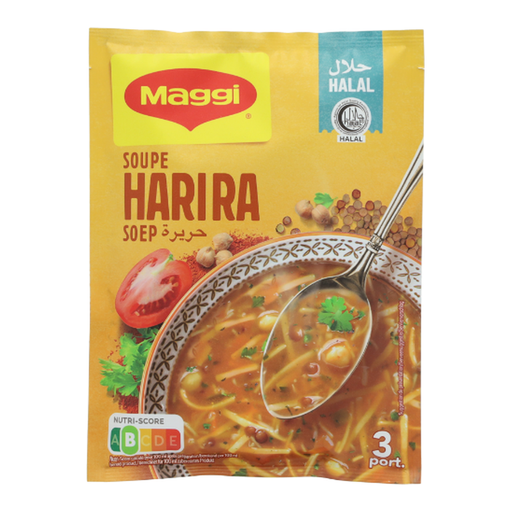 Image unavailable
Add a sachet of Harira to your cupboard for a change of recipe. Before preparing it, check the packaging for the amount of water, number of portions and allergens.
 Image unavailable
Keep a sachet of Chorba handy when you fancy trying a different recipe. Before preparing it, check the pack for the amount of water to add, the number of portions and allergens.
Yes, if you’ll use the amount you prepare in line with the instructions on the pack. Some soups sold by Auchan are stated to make four bowls; if you only want the occasional bowl, compare them with an individual format.
Read the ingredients list and allergen information for the specific product, as allergens vary between recipes. In France, the Directorate-General for Competition, Consumer Affairs and Fraud Control states that allergens in prepacked foods must be highlighted in the ingredients list.
Compare the “salt” line in the nutritional information on a like-for-like basis, such as per 100 ml of prepared soup, rather than comparing a sachet directly with a bowl. Manger Bouger recommends that adults have no more than 5 g of salt a day.
Follow the storage instructions on each pack and check the date before use. After opening or preparing the soup, follow the instructions for that particular product rather than relying on the sachet’s date alone.