Households planning several quick backup meals
If you want to have something on hand for unexpected Easter meals, check how many bowls each pack is stated to make and how much water you’ll need to prepare it.


To top up your Easter shopping, choose a family-size pack if you’re planning to serve several bowls at the same meal, or individual sachets if you want to prepare smaller amounts. Before stocking the cupboard, check the best-before date, storage instructions, stated portion sizes and allergens for each recipe. An organic label or a name that suggests it contains vegetables is no substitute for reading the label.
If you want to have something on hand for unexpected Easter meals, check how many bowls each pack is stated to make and how much water you’ll need to prepare it.
Individual sachets let you make a smaller amount without opening a large pack for a single meal.
If certain ingredients or allergens affect your choice, check the exact recipe and any warnings about traces. Compare salt content on a like-for-like basis, such as per 100 ml of prepared soup where this information is given.
First decide how many bowls you’ll prepare at a time. Then check that you can store the pack as directed and that its ingredients are suitable for the people who’ll be eating it.
| What to consider | What to check | Who this matters to |
|---|---|---|
| Storage and planned meals | Check the best-before date, the condition of the pack and the storage instructions for the specific recipe. | I want to keep soups to make up several meals over the holidays, without keeping them beyond the period planned for my stock; around 42% of consumers put this planning first. |
| Ingredients, allergens and salt | Read the highlighted allergens and any warnings about traces; compare salt content for the same amount of prepared soup. | If someone at the table needs to avoid an ingredient, I first choose a recipe that suits them; this is the deciding factor for around 33% of consumers. |
| Portions and preparation | Compare the stated number of bowls, whether the pack has individual sachets, the amount of water needed and the preparation time. | For a meal on my own or with one other person, I’d rather prepare just the amount I need than store soup that’s already been made; around 25% of consumers prioritise this flexibility. |
A product past its best-before date is not the same as one past its use-by date. According to the DGCCRF, a product with a best-before date may still be safe to eat if its packaging is intact, although some of its qualities may have deteriorated. A use-by date must be followed.
Read the exact wording on the pack and check that the packaging is intact before use.
A vegetable soup or one labelled organic may contain wheat, milk or celery, depending on the recipe. The DGCCRF states that allergens must be highlighted in the ingredients list on prepacked foods.
Check the ingredients and any warnings about traces on the specific product you buy, even if you already know the brand.
Anses lists soups and broths among the foods that contribute to salt intake. The amount varies depending on the recipe and how much soup you make.
Follow the pack instructions, then taste the soup before adding salt. Also check the ‘salt’ line in the nutritional information.
Among its dehydrated soups, the Bio Poule Vermicelles Carotte recipe comes in a 65 g box and is stated to take five minutes to prepare on Carrefour’s product page.
The Moroccan-style soup listed by Carrefour comes in three 18.5 g sachets, a format worth considering if you want to prepare individual portions.
Carrefour’s 9 Vegetable dehydrated soup comes in a 105 g sachet. Compare it with smaller packs, depending on how many bowls you want to make.
This sachet range includes minestrone, chicken and vegetable soup, vegetable soup and cream of asparagus, among other recipes. Choose according to the ingredients and pack size of each product.
E.Leclerc lists a 66 g sachet of dehydrated tomato and vermicelli soup.
These smaller packs and individual sachets can help stock your cupboard with quick options for Easter. When deciding how much to make, distinguish between the stated portions and the pack’s weight, and check the instructions for the recipe you choose.
 Image unavailable
A smaller pack to consider if you want to make a few bowls rather than use a large family-size sachet.
The title mentions “2 Assorted” and 0.70 L. Check the variant, pack contents and instructions before deciding how many portions it makes. Also check the allergens listed on the packaging.
 Image unavailable
The three sachets are a good option if you want to prepare individual bowls.
Joybuy’s product page says to store in a dry place at room temperature. If you need to avoid gluten, celery, milk or chicken, check the ingredients and any warnings about traces on the pack. Also check the salt content per prepared portion.
 Image unavailable
This 66 g pack may suit you if you’re looking for a soup to make in a smaller quantity.
Check the number of portions on the pack if you’re planning to serve several bowls. Check the ingredients if you need to avoid gluten, soya or sesame.
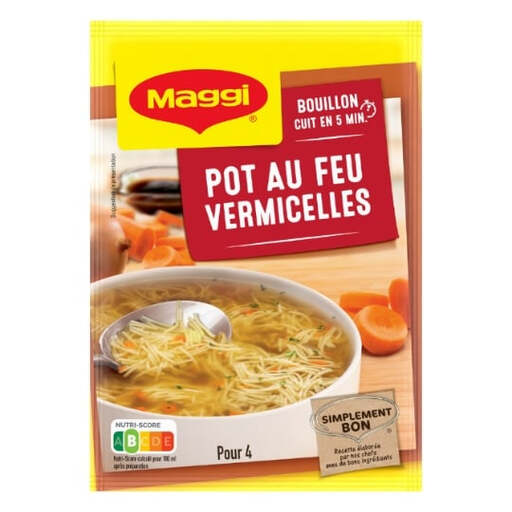 Image unavailable
The 57 g sachet offers a beef recipe to consider for a quick backup meal.
Joybuy’s product page says it takes five minutes to prepare. To work out how many bowls it makes, check the amount of water and the portions stated on the pack. The recipe lists celery and may contain traces of other allergens.
 Image unavailable
This 85 gr sachet could be a handy addition to your cupboard if you fancy a chorba-style soup.
Check the amount of water and the number of portions on the pack before planning your meal. The ingredients list includes gluten and celery, and the product may contain traces of other allergens.
A product is not automatically unsafe to eat once its best-before date has passed. The DGCCRF says it may still be safe to eat if the packaging is intact, although some of its qualities may have deteriorated. Don’t confuse a best-before date with a use-by date.
No. The recipe name and an organic label don’t mean a product is free from allergens. The MAGGI Bio Poule Vermicelles Carotte soup listed by Carrefour contains wheat and may contain celery, eggs and milk. Check the information on the specific product you buy.
Start with the date, storage instructions, ingredients, allergens and nutritional information. The DGCCRF notes, in particular, that allergens must be highlighted in the ingredients list. To choose the right pack size, also check the portions and preparation instructions.
Not automatically. Follow the instructions for your chosen soup and taste it before adding anything. Anses lists soups and broths among the foods that contribute to salt intake. If you’re comparing two recipes, use figures based on the same volume of prepared soup.