Anyone comparing sugars
You want to read the “of which sugars” line without confusing a value per 100 ml with a “reduced in sugars” claim. When comparing two recipes, check the salt content too, using the same amount of prepared soup as your basis.


To choose a dehydrated soup for a weekday dinner, compare the sugars and salt per 100 ml of reconstituted soup, then check how many bowls it makes and how to prepare it. If a “reduced in sugars” claim is essential for you, a low nutritional value alone isn’t enough: according to the National Consumer Institute, this claim requires at least 30% less sugars than a similar product. A single-serving sachet and a sachet made for several people won’t suit the same portion needs.
You want to read the “of which sugars” line without confusing a value per 100 ml with a “reduced in sugars” claim. When comparing two recipes, check the salt content too, using the same amount of prepared soup as your basis.
You’re looking for a number of bowls that suits your meal and preparation steps that fit your evening. Check how much soup it makes: single-serving sachets and preparations for several portions need to be measured differently.
Check the exact recipe if certain ingredients or allergens affect your decision to buy. The Directorate-General for Competition Policy, Consumer Affairs and Fraud Control reminds shoppers that allergens must be emphasised in the ingredients list; they vary from one soup to another.
For a quick dinner, start with anything that could rule out a recipe—such as a required claim or an ingredient to avoid—then compare the nutritional values and the number of portions it actually makes.
| What to check | Look for | Who it matters to |
|---|---|---|
| Sugars and salt | Compare “of which sugars” and “salt” per 100 ml of reconstituted soup. If you need a “reduced in sugars” claim, check that it appears on the specific recipe. | I want to compare sugars without mistaking a low figure on the label for a “reduced in sugars” claim. Around 42% of consumers put this distinction first. |
| Preparation time and portions | Check how many bowls it makes, how much water to add and the preparation steps, including whether it needs to be cooked in a saucepan. | After a busy day, I mainly want a format that suits the number of people eating and the time I have; this is the top priority for around 33% of consumers. |
| Ingredients and allergens | Read the ingredients list and check the allergen and “may contain” information for the exact variant. | If I need to avoid certain ingredients, I should be able to rule out a recipe before buying. Ingredient suitability is the top priority for around 25% of consumers. |
A sugar quantity listed per 100 ml doesn’t, by itself, prove that the product contains less than a similar one. According to the National Consumer Institute, a “reduced in sugars” claim requires a reduction of at least 30%.
If this claim is essential to your choice, look for it on the recipe in question; then compare the sugars and salt listed for the reconstituted soup.
A single-serving sachet and a preparation made for several bowls don’t represent the same quantity consumed. Values per sachet, per portion and per 100 ml therefore answer different questions.
First compare the recipes per 100 ml of prepared soup, then check the size of the bowl you plan to serve.
Two soups can have different salt values, even if you’re mainly looking for lower sugars. The “of which sugars” line doesn’t tell you everything about the nutritional information.
Check the “salt” line too, and take into account how much soup you’re preparing.
The ingredients vary between recipes and variants; a brand name or an image of a bowl is no substitute for the ingredients list.
Check the allergens highlighted in the list and any “may contain” statements on the specific product you want to buy.
The formats and nutritional information mentioned below apply to specific recipes, not every soup from a brand.
The range includes sachets for several people and recipes with vermicelli.
Single-serving sachets let you prepare each bowl separately.
The recipes mentioned include a minestrone to make several bowls and a mushroom noodle soup.
Carrefour offers dehydrated 9 Vegetables and Minestrone with Olive Oil soups under this brand, among others.
These four soups let you explore different formats for a weekday dinner: individually prepared bowls and mixes that need cooking. Compare each recipe with your portion needs, its instructions and its label; its inclusion here doesn’t mean it carries a “reduced in sugars” claim.
 Image unavailable
Worth considering if you’d like to cook a noodle soup in a saucepan for a small number of people.
Joybuy’s product listing states that it makes 0,70 L of reconstituted soup and takes five minutes to simmer. It lists 1,6 g of sugars and 0,78 g of salt per 100 ml of reconstituted soup. Check the allergens for the exact recipe before buying.
 Image unavailable
The individual sachets are handy if you only want to make one bowl at a time with hot water.
Joybuy’s product listing shows 1,3 g of sugars and 0,91 g of salt per 100 ml. Check the ingredients and allergens for this recipe if they affect your choice.
 Image unavailable
If this recipe appeals for a weekday meal, check the cooking instructions and how much soup it makes before choosing the sachet.
Also check how many bowls the pack says it makes: you can’t work this out from the weight of the dry mix alone.
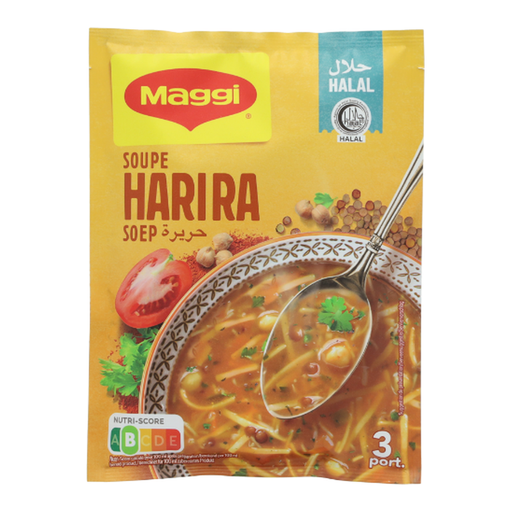 Image unavailable
This recipe is worth considering if a soup that needs cooking suits your dinner plans.
Before relying on this sachet to make several bowls, check the water quantity, portions and cooking instructions on the pack.
According to the National Consumer Institute, this claim means at least 30% less sugars than a similar product. It describes a relative reduction: on its own, it doesn’t mean that the soup is low in sugars or salt.
To compare soups as you’ll eat them, use values given on the same basis for reconstituted soup, such as per 100 ml, then check the size of your bowl. The Directorate-General for Competition Policy, Consumer Affairs and Fraud Control says that nutritional declarations are given per 100 g or 100 ml to make comparisons easier.
No. If you’re specifically comparing sugars, read the “of which sugars” line in the nutritional information, using a comparable basis. Check the salt and the amount prepared too, and don’t assume that one indicator means a recipe meets all your criteria.
Read the ingredients list for the exact variant and check for any “may contain” statements. For pre-packed foods, the Directorate-General for Competition Policy, Consumer Affairs and Fraud Control says that allergens must be emphasised in the ingredients list.