Before buying, check that your air vents and ventilation system are working properly, and have persistent damp marks on the walls assessed. A dehumidifier can complement these steps by managing the air humidity in a particular room. Compare the treated volume, test conditions, noise level and water management.
Who could benefit from a dehumidifier?
Recurring condensation after showering or cooking
If condensation or a damp feeling returns in utility rooms despite airing them, first check whether the moisture is occasional or linked to the ventilation. Your choice of appliance should also take account of water management that fits your routine. ADEME recommends airing rooms after showering and cooking.
Frequently drying laundry indoors
An appliance can help manage the moisture released when drying laundry, but it does not replace airing the room. A laundry mode, noise level, tank capacity and the option of continuous drainage are practical criteria for this situation.
Visible damp marks on the walls
In this situation, buying an appliance should not be the starting point. France Rénov’ states that damp marks should be assessed to identify their cause, which may relate to the building structure, water ingress, insulation or ventilation.
Priorities for choosing without masking the problem
Ventilation and the source of the moisture
Prioritise this: before buying anything if marks, mould or damage persist, or if humidity remains high despite airing the room.
Good to know: this approach does not provide the immediate effect of a portable appliance, but it prevents you from confusing air humidity with water ingress or inadequate ventilation.
Targeted airing
Prioritise this: when the moisture mainly comes from showering, cooking or drying laundry.
Limitation: these actions renew the air, but they will not correct faulty ventilation or a structural cause.
Electric dehumidifier
Consider this: after checking the ventilation, for a room where condensation keeps returning or where laundry is difficult to dry.
Considerations: you need to account for noise, emptying the tank or arranging suitable drainage, and interpret the stated capacity alongside its test conditions.
| Priority |
What to check |
Your needs |
| Do not mask a property-related cause |
Check the air vents and ventilation system. A hygrometer or automatic setting can monitor the room air, but it cannot diagnose water ingress or structural defects. |
I am looking for help with air humidity, without treating the appliance as a solution to persistent marks on the walls. |
| Size the appliance to the room |
Compare the actual volume, including ceiling height, with the stated coverage. Read the L/day figure alongside the temperature and relative humidity used in the test. |
The room being treated should match the stated volume, rather than relying on the extraction capacity alone. |
| Noise and water collection |
Compare dB(A) levels in the same mode where this information is available. Check the tank size, full-tank shut-off and whether continuous drainage is suitable for the intended location. |
In a bedroom or living room, I want to use the appliance without noise or emptying the tank becoming a daily inconvenience. |
| Drying laundry |
Look for a laundry mode if you intend to use it for this purpose, as well as a humidity setting, timer or automatic shut-off. Keep airing the room as part of your strategy. |
I want to limit occasional humidity caused by drying laundry indoors, without leaving the appliance running unchecked. |
Mistakes to avoid before buying
-
Buying an appliance to treat persistent marks on the walls
France Rénov’ recommends having the marks assessed to identify their cause. A portable appliance can reduce air humidity without resolving an issue linked to the walls, water ingress, insulation or ventilation.
Check the ventilation and request an appropriate assessment if marks, mould or damage persist. Do not treat the dehumidifier as proof that the problem has been solved.
-
Choosing solely by the L/day figure
Extraction capacity is stated under specific conditions. For example, De’Longhi gives 14 L/24 h at 30 °C and 80% relative humidity for its DEXD214RF. This figure does not automatically describe the results in every room.
Compare the test conditions, room volume, noise level and water collection, rather than ranking appliances solely by the number of litres extracted per day.
-
Overlooking emptying the tank and the drainage position
A full tank may stop the appliance, depending on the model, while continuous drainage requires a suitable location. For the DH5260F0, Rowenta states that it has a 3 L tank and a 1 m hose; De’Longhi states that the DEXD214RF supports continuous drainage.
Decide whether you can empty a tank regularly or whether you have drainage that is compatible with the instructions for the model.
-
Ignoring noise in a bedroom or living room
Noise and settings often determine whether the appliance will remain practical in an occupied room. Manufacturer figures should only be compared with care when operating modes differ.
Look for a dB(A) figure and the mode it applies to, then check for a humidity setting, timer or full-tank shut-off.
Brands highlighted as useful reference points
Rowenta
In France, Rowenta offers domestic dehumidifiers and identifiable spare parts. The manufacturer positions its Extrême Dry Compact+ DH5260F0 for spaces of up to 40 m² or 100 m³.
- For the DH5260F0, Rowenta states 16 L/day, less than 40.5 dB(A), a 3 L tank, a full-tank alert and a 1 m hose for continuous drainage.
- These specifications relate to one specific model and do not replace checking the ventilation or having marks on the walls assessed.
De’Longhi
The Tasciugo AriaDry Multi range includes the DEXD214RF, with an electronic hygrometer, continuous drainage and a laundry-drying function, according to the manufacturer.
- For the DEXD214RF, De’Longhi states an extraction rate of 14 L/24 h at 30 °C and 80% relative humidity, a maximum airflow of 125 m³/h and 40 dB(A).
- The high test conditions mean that the 14 L/day figure cannot be directly applied to every room or season.
Meaco
Meaco offers compact 12 L dehumidifiers, among other products, aimed at flats and smaller houses according to its product descriptions.
- For the MeacoDry ABC 12L, the brand states 36 dB, a humidity setting adjustable in 5% increments, a laundry mode, full-tank shut-off and automatic defrosting.
- Check availability, the exact version and the terms of sale applicable in France before buying.
Dehumidifier options on Joybuy
These Joybuy options are electric dehumidifiers for recurring humidity in a room or for drying laundry, alongside checking the ventilation.
 Image unavailable
VINO connected 20 L dehumidifier
For a room of up to 40 m² or frequent laundry drying, after checking the ventilation.
Stated capacity of 20 L/day at 30 °C and 80% RH, laundry mode, 2.5 L tank and continuous drainage. Sleep mode is stated at 35 dB; the general stated level is 40 dB(A).
Check that the location allows gravity drainage in accordance with the instructions.
Joybuy
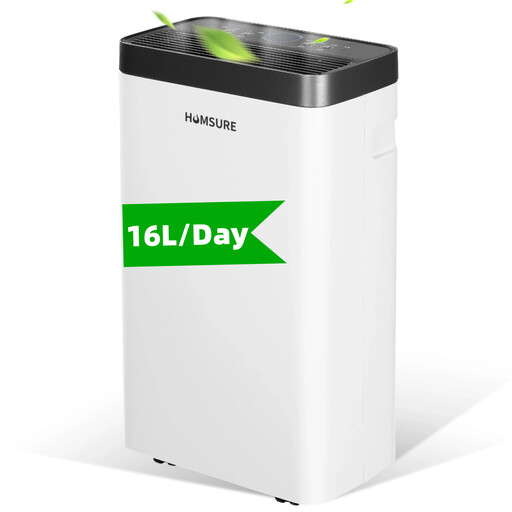 Image unavailable
HUMSURE 16 L/day dehumidifier
For a room of up to 25 m², with a drying mode and stated humidity control.
Stated capacity of 16 L/day at 95 °F and 90% RH, 1.4 L tank, 24-hour timer, automatic defrosting and hose for continuous drainage.
The noise level is stated as below 50 dB in sleep mode; check whether this is suitable for an occupied bedroom.
Joybuy
 Image unavailable
TRULIVA AP10-2012EE dehumidifier
For a flat or room of approximately 32 m², particularly when drying laundry.
Up to 16 L/day stated at 95 °F and 90% RH, 40% to 80% humidity setting, drying mode, 1.35 L tank, 24-hour timer and continuous drainage.
No specific noise level is given: check this before using it in a bedroom or living room.
Joybuy
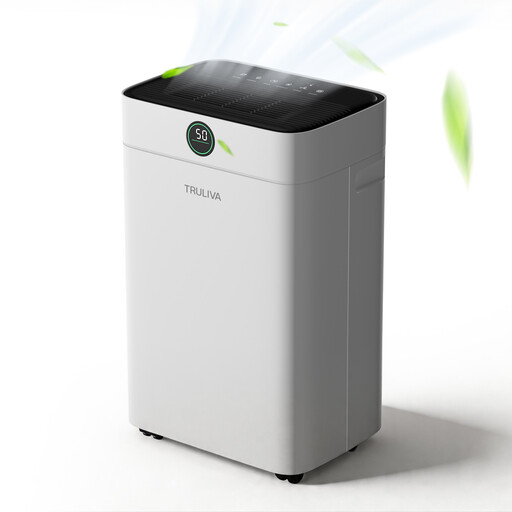 Image unavailable
TRULIVA 25 L/day dehumidifier
For frequent laundry drying or extended use in a room where drainage is possible.
Up to 25 L/day stated at 95 °F and 90% RH, laundry mode, 2.8 L tank, full-tank shut-off, automatic defrosting and continuous drainage hose.
Check the maximum coverage and noise level before buying.
Joybuy
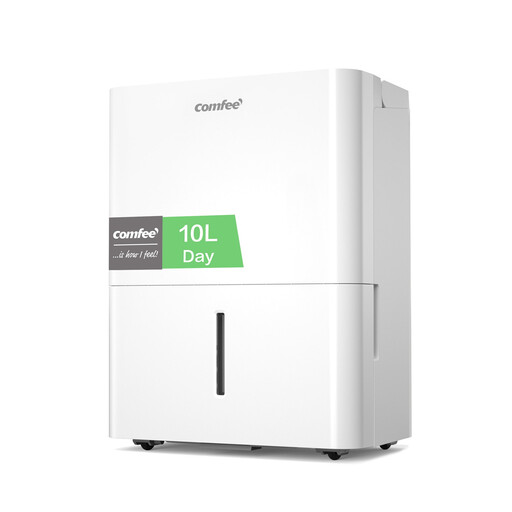 Image unavailable
Comfee MDDN-10DEN7 10 L dehumidifier
For a small room stated as up to approximately 40 m³ or 16 m², where continuous drainage is possible.
Stated capacity of 10 L/24 h, humidity setting from 35% to 85%, 2.1 L tank, normal and continuous modes, defrosting and automatic restart.
The capacity test conditions and coverage information should be checked in the model’s instructions.
Joybuy
Frequently asked questions
Can a dehumidifier replace checking the mechanical ventilation system or air vents?
No. ADEME recommends airing rooms daily and, if the property remains too humid, checking the air vents and ventilation system, then using a dehumidifier where appropriate. The appliance is therefore a supplement, not a replacement for these checks.
How should I compare the stated litres per day?
Always compare this figure with the test conditions, the room volume and your actual usage. For example, De’Longhi states 14 L/24 h for the DEXD214RF at 30 °C and 80% relative humidity. This does not guarantee the same extraction in every household situation.
Should I choose a tank or continuous drainage?
A tank is suitable if you can empty it regularly. Continuous drainage is better suited to extended use if the model supports it and the hose is installed in accordance with its instructions. Rowenta states that the DH5260F0 has a 3 L tank and a 1 m hose, while De’Longhi states that the DEXD214RF supports continuous drainage.
What should I do with the appliance at the end of its life in France?
An electric dehumidifier falls under the waste electrical and electronic equipment stream. The French ministry responsible for ecological transition states that the collection and treatment of household WEEE have been organised in France since 2006: do not dispose of it with ordinary household waste.


