A dehumidifier can help manage the humidity in a room, but it is no substitute for effective ventilation or fixing a problem with the property. For a heated room, consider compressor models; if the space stays cold, look at desiccant models. If drying laundry indoors is the main source of moisture, reducing how much you dry inside may be more effective than dehumidifying the whole room.
Who is this advice for?
The room in question and the likely source of the moisture matter more than an appliance’s stated capacity alone.
Renters dealing with persistent condensation
If condensation keeps coming back or is accompanied by damp patches, check that air inlets and extractor vents are unobstructed. If you suspect a problem with the ventilation or insulation, report it to your landlord or letting agent rather than relying solely on an appliance.
Households that dry laundry indoors
Drying laundry adds moisture to a room, as noted by ADEME. Depending on the space available, consider ventilating the room, using a dehumidifier suited to a utility room or using a tumble dryer.
People using a basement or an unheated space
The usual temperature of the space is crucial: performance figures for a compressor model in a heated room do not necessarily reflect how it will perform in a cold garage or basement.
Which criteria should you check first?
First identify what is causing the moisture, then check the room temperature before comparing water collection and noise levels.
Compressor dehumidifier
Consider this: for a room that is usually heated, where you want to collect moisture from the air.
Bear in mind: Meaco says compressor models are more efficient above 15 °C. A stated capacity does not guarantee the same results in a colder room.
Desiccant dehumidifier
Consider this: for a basement, garage or utility room that often stays below 15 °C, according to Meaco’s guidance for its range.
Bear in mind: check the operating range of the specific model; the appliance will not fix a leak or poor ventilation.
Tumble dryer
Consider this: if drying laundry indoors is the main recurring source of moisture and you have room to install an appliance.
Bear in mind: consider its size, noise, electricity use and maintenance. It will not directly dehumidify another room.
| Priority | What to check | Your needs |
|---|
| Source of the moisture |
Note where and when condensation returns. Keep air inlets and extractor vents unobstructed, in line with advice from the Institut national de la consommation and ADEME; have any suspected property defect investigated. |
If the damp patches persist despite normal use of the ventilation, I want to understand the cause before buying an additional appliance. |
| Room temperature |
Check the usual temperature, particularly in a poorly heated basement. Compare it with the model’s operating range: for its ranges, Meaco differentiates between compressor and desiccant models around 15 °C. |
My garage stays cool for much of the time, so I need an appliance that is documented as suitable for use at that temperature. |
| Water collection |
Compare the tank capacity and whether a hose can be connected. For continuous drainage, check the route to the drain; if the water needs to be pumped upwards, look at models with a pump. |
I won’t be able to empty the utility room’s tank often, so access to a drain is an important factor in my choice. |
| Noise and capacity |
Check the stated noise level for the mode you plan to use. For capacity in litres per day, also check the temperature and humidity conditions specified by the manufacturer. |
In a bedroom or occupied room, I want to assess the noise without relying on the name of a night mode alone. |
| Drying laundry indoors |
Identify where the laundry is dried and how well the room can be ventilated. If you are considering a tumble dryer, check the space it needs, its capacity, noise level, maintenance requirements and energy label. |
Condensation is worst on laundry days, so I’d rather address how the laundry is dried before choosing an appliance for the whole room. |
Which buying pitfalls should you avoid?
-
Choosing based only on litres per day
Stated capacity depends on the test conditions. For example, De’Longhi lists 16 l/24 h at 30 °C and 80% relative humidity for the DEXD216RF. This figure may not reflect how much it will collect in a cooler room.
Also compare the room temperature, noise, tank and drainage options.
-
Installing a compressor model in a cold space without checking the model
Duux says that Bora’s performance decreases as the room gets colder. Meaco, meanwhile, distinguishes between compressor models intended for heated spaces and its desiccant models for cooler spaces.
Check the usual temperature in your basement or garage, then consult the operating range of the model you are considering.
-
Expecting the appliance to fix a problem with the property
A dehumidifier will not fix poor ventilation, a leak or inadequate insulation. The Institut national de la consommation advises keeping mechanical ventilation extractor vents clean and unobstructed.
Do not block them. If you rent and suspect a problem with the ventilation or insulation, report what you have noticed to your landlord or letting agent.
-
Underestimating emptying and noise
A tank needs to be emptied if it is not connected to a drain. The presence of a night mode alone does not tell you how noisy the appliance will be in the mode you use.
Check the tank capacity, whether a hose can reach a drain and the stated noise level for the mode you plan to use.
Which brands offer useful points of comparison?
These examples of ranges and models can help you identify features to compare; they do not describe every appliance from each brand.
De’Longhi
The Tasciugo AriaDry Multi range includes compressor dehumidifiers for heated rooms.
- De’Longhi lists 14 l/24 h for the DEXD214RF and 16 l/24 h for the DEXD216RF, with a stated noise level of 40 dB(A) for each.
- The DEXD216RF’s capacity is specified at 30 °C and 80% relative humidity. Check the test conditions before applying it to your room.
Wood’s
Wood’s offers models designed for utility rooms and heated spaces, among others.
- The MDX20P’s specifications state that it can be connected to a drainage hose and has a stated noise level of 41 dB.
- Check the drainage setup and the operating conditions of your chosen model rather than assuming these features apply across the range.
Duux
The Bora range includes dehumidifiers with a tank and the option of continuous drainage.
- Duux lists a 4 l tank and the option to connect a hose for the Bora 20/30L.
- According to Duux, Bora’s performance decreases as the room gets colder. Check that it is suitable before buying one for a cold basement.
Meaco
Meaco distinguishes its compressor dehumidifiers from its DD8L desiccant range for cooler spaces.
- Meaco says its compressor models are more efficient above 15 °C; the brand presents desiccant models for unheated spaces.
- Check the operating range and specifications of the specific model for your space.
Bosch
Bosch tumble dryers are worth considering if your main aim is to stop drying laundry indoors.
- Bosch lists a 9 kg capacity and a noise level of 64 dB(A) for its WQG2450SFR heat-pump tumble dryer.
- A tumble dryer dries laundry; it will not fix a leak or faulty mechanical ventilation. Also check how much space you need to install it.
Dehumidifiers available on Joybuy
These models are relevant if you are looking for a dehumidifier for a specific room, particularly if condensation or drying laundry indoors is a concern. Compare their operating conditions with the temperature of your room; this selection is no substitute for investigating any potential ventilation problem.
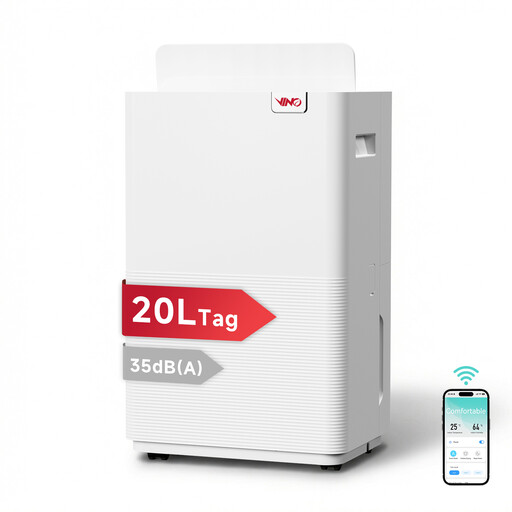 Image unavailable
VINO 20L Smart WiFi, 2.5 l tank
Worth considering for a specific room where laundry is dried indoors. The model name indicates Auto, Dry and Sleep modes, as well as a 2.5 l tank. Check the noise level of the mode you plan to use, as the noise information associated with this product varies.
View on Joybuy
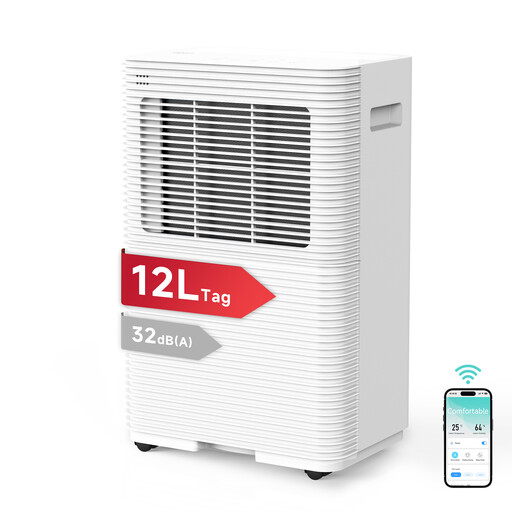 Image unavailable
VINO 12L Smart WiFi, 1.8 l tank
Worth considering for a smaller room where you can manage water collection. The model name indicates Auto, Dry and Sleep modes and a 1.8 l tank. Before using it in a bedroom, check the noise level of your chosen mode, as the noise information associated with this product varies.
View on Joybuy
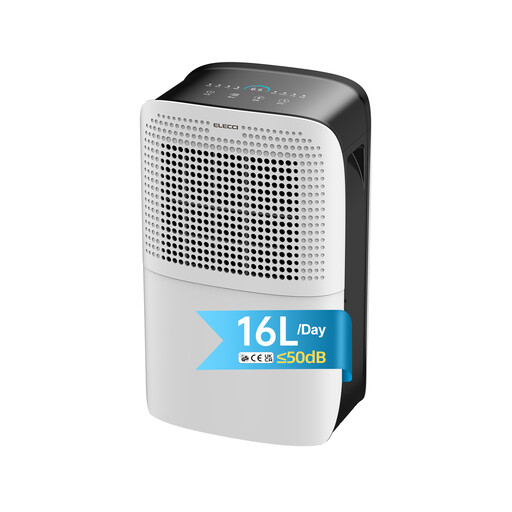 Image unavailable
ELECCI 16L/D with hose, 3.1 l tank
The stated hose connection is worth considering if you have a suitable drain. The product name lists four modes, a 3.1 l tank and a stated coverage area of 32 m². Check the noise level if you plan to use it in a bedroom, and the operating temperature range if the space is cool.
View on Joybuy
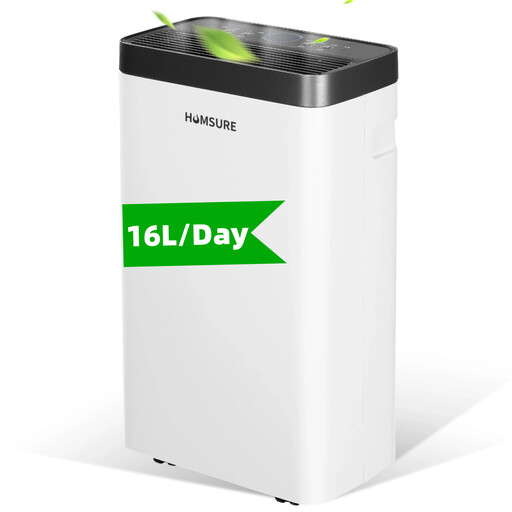 Image unavailable
HUMSURE 16L/Day, 1.4 l tank
If you can empty the tank, bear in mind its stated 1.4 l capacity. The product name lists three modes and a stated coverage area of 25 m². Check the operating temperature and the noise level of the mode you plan to use before placing it in a cold or occupied space.
View on Joybuy
 Image unavailable
Comfee' MDDN-10DEN7, 10 l/24 h
Worth considering for a specific small room, provided you confirm the recommended coverage area: the coverage information for this model varies. Its name refers to around 40 m³ (16 m²) and automatic dehumidification. Also check its operating temperature range if the room stays cold.
View on Joybuy
Frequently asked questions
Can a dehumidifier replace ventilation or mechanical ventilation?
No. ADEME says mechanical ventilation continuously removes moisture from the home, and the Institut national de la consommation advises keeping its extractor vents clean and unobstructed. A dehumidifier can provide extra help in a specific room, but it cannot replace this ventilation.
Which type should I consider for a cold basement or garage?
Consider desiccant models if the space often drops below 15 °C: Meaco positions its desiccant range for these cooler spaces and its compressor models for temperatures above this threshold. Then check the operating range of the specific model.
Tank, hose or pump: which should I choose?
A tank is suitable if you can empty it regularly. Continuous drainage with a hose requires a suitable drain and route; if the water needs to be pumped upwards, look for a model with a pump and check its installation requirements.
Can drying laundry indoors contribute to condensation?
Yes. Air-drying laundry indoors adds moisture to the home; ADEME describes it as an activity that releases a significant amount of moisture. If condensation is most noticeable on laundry days, first consider where the laundry is dried and how well the space is ventilated.
What should I do if condensation keeps returning in a rented home?
Report persistent signs that suggest a problem with the property to your landlord or letting agent. The Institut national de la consommation highlights issues including poor ventilation and inadequate insulation. Buying a dehumidifier alone will not identify or fix the cause.


