What should you check before buying?
Start by checking the ventilation and looking for signs of an ongoing problem. If a portable appliance still seems suitable, compare its stated capacity with the room and the temperature at which you’ll use it. Then choose a water-management option and position that fit your day-to-day routine.
| What matters |
What to check before buying |
Who this matters to |
| Cause of the damp |
Check for persistent marks and inspect the air inlets and vents. If you suspect a leak or a building defect, get the cause investigated. |
When patches or odours keep returning, I want to understand what’s causing them rather than rely on an appliance to make them disappear. Around 33% of consumers prioritise finding the cause. |
| Drying laundry |
Check that the model has a laundry mode and that you can maintain the required distance between the appliance, clothes and other objects in your home. |
If I often dry laundry indoors, I want to stop the moisture building up in the room. Around 27% of consumers prioritise this use. |
| Noise in an occupied room |
Compare the noise levels for the exact model, taking note of the mode specified, and choose a position that follows the instructions. |
Near my bedroom or workspace, noise can limit when I use the appliance. This is the main concern for around 20% of consumers. |
| Emptying and drainage |
Check the tank capacity and full-tank alert. For a gravity-fed hose, make sure it slopes down towards an outlet that is lower than the appliance. |
If I can’t check the tank regularly, I want to avoid having to stop using the appliance when it fills up. Around 20% of consumers prioritise not having to empty the tank frequently. |
Brands to compare
These range and model examples can help you identify which features to compare. Stated capacities and conditions of use vary from one appliance to another.
Rowenta
The Extrême Dry Compact+ is an example of a model designed, among other things, for damp rooms and drying laundry.
- The model information mentions a humidity display, automatic, continuous and laundry modes, as well as continuous drainage.
- The stated features don’t guarantee the same results in every room or the same level of comfort for everyone when it comes to noise.
De'Longhi
The Tasciugo AriaDry Multi range includes the DEXD216RF, a compressor model with humidity control and the option of continuous drainage.
- De'Longhi states that the DEXD216RF extracts 16 L/24 h at 30 °C and 80% relative humidity.
- This stated capacity may not reflect the results in a cooler or less humid flat.
Air&me
Air&me offers compressor and desiccant models, with instructions that set out their installation and operating requirements.
- Evel’s instructions give an operating range of 0 °C to 35 °C and a stated capacity of 7 L/day at 30 °C and 80% relative humidity.
- Check the instructions for the exact model for clearance requirements and other guidance. Evel’s instructions don’t automatically apply to Lary.
Meaco
The DD8L is an example of a desiccant dehumidifier that Meaco presents for home use.
- Meaco states that this model extracts 8 L/day and uses refrigerant-free absorption technology.
- This information doesn’t tell you whether the DD8L will use less energy, extract more moisture or make less noise than a compressor model in your room.
Portable dehumidifiers on Joybuy
These portable appliances are suited to occasional use in a room in a flat, particularly if drying laundry or managing the tank is part of your decision. Before choosing a model, compare its stated room size and capacity with your room, then check the test conditions, noise level and drainage.
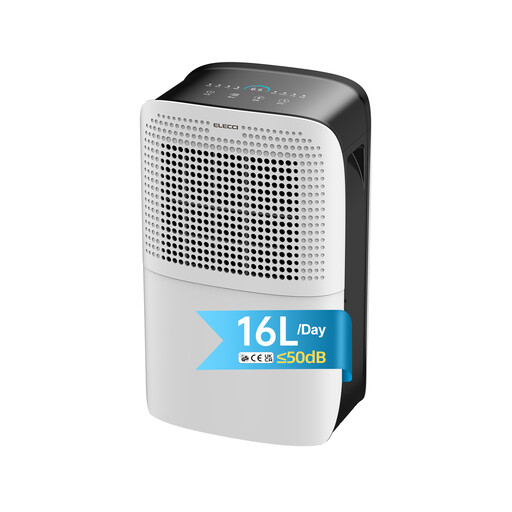 Image unavailable
ELECCI 16L/D with drainage hose
Worth considering if you’re looking for a portable appliance with a tank and drainage option for a room in a flat.
The title states 16 L/day, coverage for a room of up to 32 m², a 3.1 L tank and four modes. Check the conditions behind the stated capacity, the noise level and whether you can install the hose in your home.
View on Joybuy
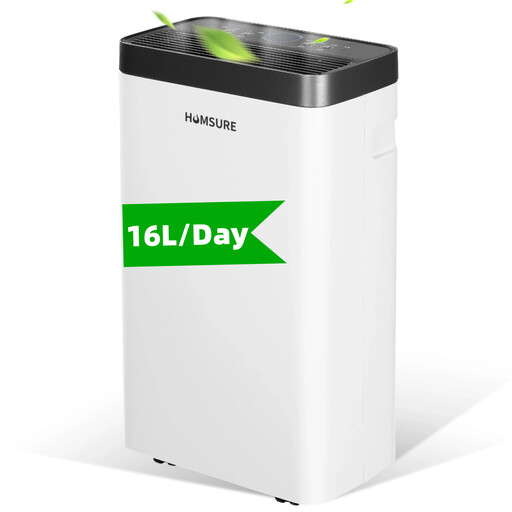 Image unavailable
HUMSURE 16L/Day for rooms up to 25 m²
Consider this if you’re comparing appliances for a room stated to be up to 25 m² and can manage a 1.4 L tank or install suitable drainage.
The title states 16 L/day, a 24-hour timer and automatic shut-off. It mentions three modes, while another description lists four. Confirm the modes for the version on sale and the test conditions for the extraction rate.
View on Joybuy
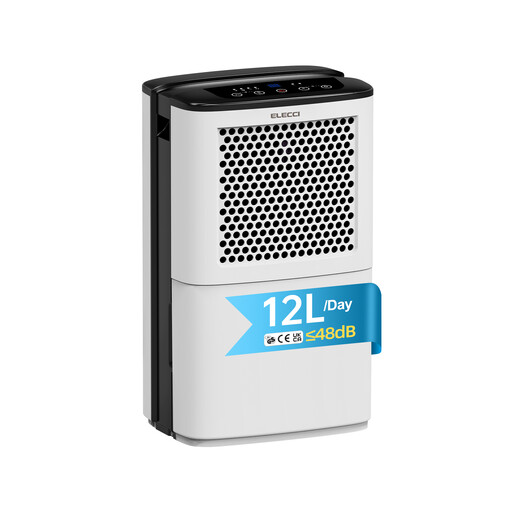 Image unavailable
ELECCI 12L/D with a 3.8 L tank
Worth comparing if tank capacity and the option of hose drainage matter to your daily use.
The title states 12 L/day for a room of up to 25 m², a 3.8 L tank and a 24-hour timer. Check the test conditions, the noise level in the mode you plan to use and whether there’s a suitable route for the hose.
View on Joybuy
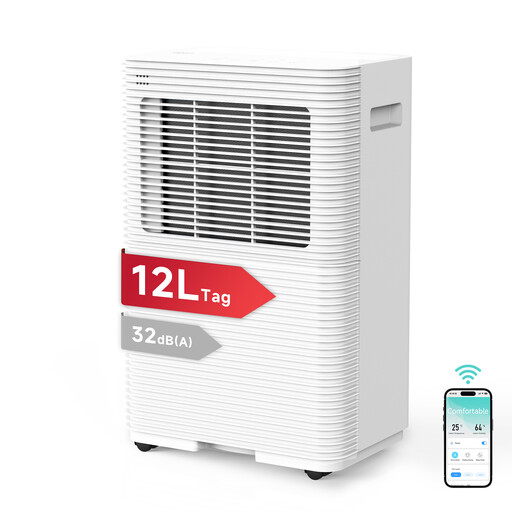 Image unavailable
VINO 12L Smart with Wi-Fi control
Worth a look if Wi-Fi control and a stated laundry mode suit the way you plan to use the appliance.
The title states 12 L/day, coverage for a room of up to 24 m², a 1.8 L tank and three modes: Auto, Dry and Sleep. The noise figures of 32 dB in Sleep mode and 38 dB(A) in the specifications need to be checked against the relevant mode and test method before using it overnight.
View on Joybuy
 Image unavailable
VINO 20L Smart with Wi-Fi control
Worth comparing for a larger room, based on the stated coverage, if you’re also looking for Wi-Fi control and a laundry mode.
The title states 20 L/day, coverage for a room of up to 40 m², a 2.5 L tank and three modes: Auto, Dry and Sleep. Compare the capacity against its test conditions, and check what the figures of 35 dB in Sleep mode and 40 dB(A) refer to before assessing the noise level.
View on Joybuy
Frequently asked questions
When should you look for the cause of damp rather than buy an appliance?
Persistent damp patches, mould, odours or condensation are a reason to check the ventilation and investigate the cause. ALEX Qualitel and France Rénov’ describe these as signs of damp in the home. If you suspect a leak or a building defect, get the problem looked at. A portable dehumidifier won’t fix it.
What does a stated capacity in litres per day mean?
It describes the stated amount of moisture extracted under specific temperature and humidity conditions, which you should check alongside the figure. Air&me gives a figure of 7 L/day at 30 °C and 80% relative humidity for Evel, while De'Longhi states 16 L/24 h under the same conditions for DEXD216RF. These figures don’t guarantee the same results in your flat.
Can a continuous drainage hose connect to any outlet?
No. For gravity drainage, the model must have the right connection and the outlet must be lower than the appliance, with the hose sloping down and free of kinks. Air&me highlights this drainage requirement. Otherwise, plan to empty the tank or check that the appliance explicitly includes a suitable pump.
Where should you position the appliance near a clothes airer?
Place it on a dry, level surface, follow the clearance and electrical safety instructions in its manual, and make sure water can’t drip into the grilles. Required distances vary between models: Air&me’s instructions specify at least 40 cm between a grille and other objects, while the Lary instructions call for 50 cm of clear space around the appliance.


