What should you check before choosing?
Start by distinguishing measured humidity in the air from a ventilation problem or water ingress. Then compare appliances for the room and intended conditions of use. Don’t assume the quoted litres per day are a reliable measure in every situation.
| Priority |
What to check |
What I need |
| Measurement and ventilation |
Measure relative humidity in the affected room with a hygrometer. Check the air vents and that the ventilation is working; look for the cause of any water marks or persistent damage. |
I want to know whether the air is regularly damp before buying an appliance, without masking a leak or inadequate ventilation. ADEME explains that mechanical ventilation continuously removes moisture; Qualitel also lists water ingress as a possible cause. |
| Capacity and room |
Compare the area or volume specified by the manufacturer with the room you want to treat. For a capacity quoted in L/24 h, check the temperature and relative humidity used for the measurement. |
The room I want to treat needs to match the stated conditions of use. A capacity measured in very hot, humid air doesn’t, by itself, tell me how well the appliance will perform in my home. |
| Noise |
Check the quoted noise level in dB(A), which mode it applies to and whether there are different fan speeds. Check these details for the exact model. |
In an occupied bedroom or office, I want to be able to judge the noise in the mode I’ll actually use, rather than relying on a general claim that the appliance is quiet. |
| Water drainage |
Compare the tank capacity and how easy it is to empty. For continuous drainage, check the connection, the hose route and any height restrictions specified in the manual. |
If the appliance needs to run for a long time, frequently emptying the tank could make it awkward to use. A hose will only help if the intended drainage setup is compatible with its installation. |
| Drying clothes |
Limit the moisture produced in the room and make sure it’s adequately ventilated. If you choose a dehumidifier, check the laundry mode, noise level and water management for the model you’re considering. |
When clothes are drying indoors, I want to avoid adding moisture to a room that’s already damp for an extended period. ADEME identifies air-drying clothes as a major source of indoor moisture. |
Which branded models should you compare?
These examples highlight features to look at on specific models; they don’t necessarily represent every product range from each brand.
Wood's
The MDX20P is worth considering if you’re focusing on water drainage and maintenance for regular use.
- Les Numériques describes this model as having a built-in pump and a 6 L tank.
- The same guide notes that noise levels vary and that the tank needs maintenance. Consider these points for the room where you plan to use it.
De’Longhi
The Tasciugo AriaDry Multi DEXD216RF is a good model to assess if you’re looking at humidity controls and continuous drainage for a compatible setup.
- De’Longhi quotes an extraction rate of 16 L/24 h for this model at 30 °C and 80 % relative humidity, as well as a noise level of 40 dB(A).
- The quoted capacity is based on these measurement conditions. Compare them with those for other appliances and with your intended use.
Rowenta
The Extrême Dry Compact+ DH5260F0 is worth considering if available space and drying clothes are important factors in your choice.
- For this model, Rowenta quotes 16 L/day, coverage of up to 40 m² or 100 m³, and a noise level below 40.5 dB(A).
- Check that the conditions of use and drainage setup are suitable for your room.
Trotec
The TTK 75 E is worth comparing for a room whose volume you know and where water drainage is an option.
- For this model, Trotec quotes coverage of up to 45 m² or 110 m³, an extraction rate of 20 L/24 h and a 3 L tank.
- These figures come from the manufacturer. Compare them with the room temperature and installation conditions.
Meaco
The Arete Two 20L is worth considering if you want to move the appliance between larger rooms in your home.
- Meaco says this model is suitable for rooms up to 50 m² and is fitted with castors.
- The stated coverage alone won’t tell you how much water it will extract in your room. Check the model’s conditions of use.
Dehumidifiers available on Joybuy
These models are electric dehumidifiers designed for home use. Compare their features with the room where you plan to use them, after checking the airflow and ventilation.
 Image unavailable
VINO 20L Smart WiFi, 2.5 L tank
Worth considering for a living space if you want to adjust the appliance and manage emptying a 2.5 L tank. The title lists an extraction rate of 20 L/day and three modes: Auto, Dry and Sleep. For a bedroom, check the noise level for the mode you’ll use. Also confirm that the stated extraction conditions are suitable for your room.
View on Joybuy
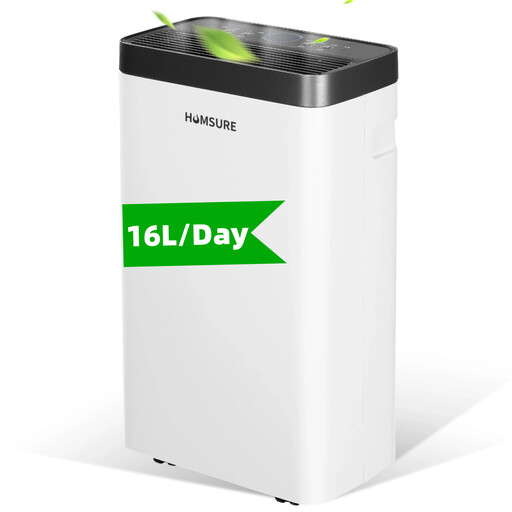 Image unavailable
HUMSURE 16 L/day, 1.4 L tank
If you can easily empty the tank in the room where you plan to use it, compare the 1.4 L capacity with how often you expect to run the appliance. The title lists 16 L/day, coverage of 25 m² and a 24-hour timer. Check the extraction measurement conditions and noise level for the mode you plan to use.
View on Joybuy
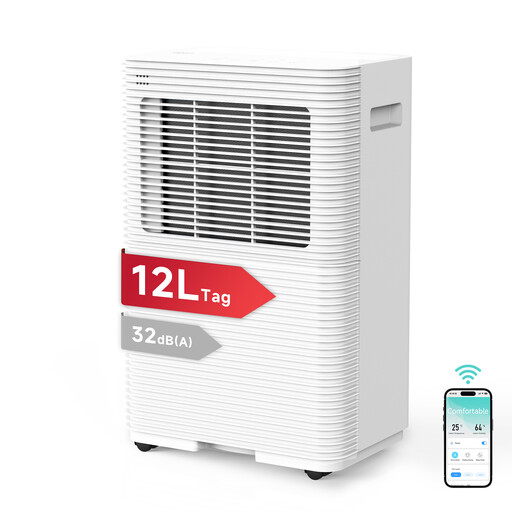 Image unavailable
VINO 12L Smart WiFi, 1.8 L tank
Worth comparing for a room that’s the right size for the stated use and where a 1.8 L tank is practical to empty. The title lists 12 L/day and three modes: Auto, Dry and Sleep. Before using it in an occupied room, check the conditions behind the quoted capacity and the noise level for your chosen mode.
View on Joybuy
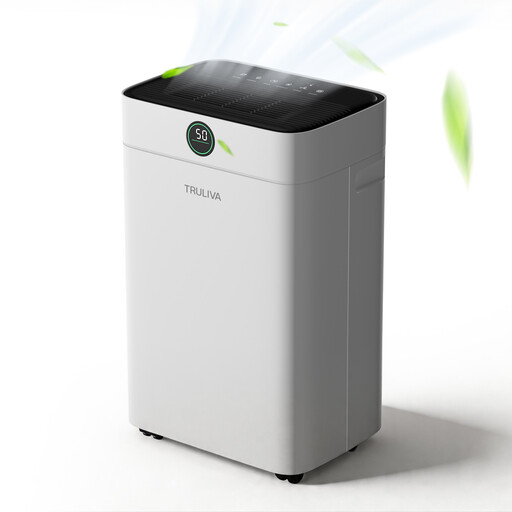 Image unavailable
TRULIVA 25 L/day, 2.8 L tank and hose
For drying clothes or extended use, the title mentions a laundry mode, a 2.8 L tank and a hose for continuous drainage. The stated extraction rate is 25 L/day. Check the measurement conditions, the suitable room size and whether you can connect the hose to your drainage point.
View on Joybuy
 Image unavailable
Comfee MDDN-10DEN7, 10 L/24 h
This model is worth comparing if you want to adjust dehumidification in a room where you’ve measured the humidity. The title lists 10 L/24 h and an LED display. Before deciding whether it’s right for your room, confirm the coverage area for this model, as the available coverage figures differ.
View on Joybuy
Frequently asked questions
Can a dehumidifier replace mechanical ventilation (VMC) or fix water ingress?
No. ADEME says mechanical ventilation continuously removes moisture from the home, while Qualitel lists water ingress and inadequate ventilation among the possible causes of damp. If water marks or damage persist, investigate the cause rather than relying on the appliance alone. Don’t switch off the VMC.
What humidity level should you aim for in a room?
Qualitel generally puts the relative humidity in a home between 40 % and 60 %. Measure it in the room concerned, and interpret any changes in context, taking into account factors such as temperature, ventilation, showering, cooking and drying clothes.
How do you choose a dehumidifier’s capacity?
Compare the model’s stated coverage area or volume with the size of your room, then check its capacity in L/24 h and the conditions under which it was measured. For example, De’Longhi quotes 16 L/24 h for the DEXD216RF at 30 °C and 80 % relative humidity, while Trotec quotes 20 L/24 h and coverage of up to 45 m² or 110 m³ for the TTK 75 E. These figures alone don’t predict how well the appliance will perform in your home.
Should you choose a tank or continuous drainage?
A tank works if you can empty it as often as needed, particularly if you move the appliance around. For extended use, consider continuous drainage only if the model supports it and the hose route follows the manufacturer’s instructions and suits your drainage setup.
What should you do with an old dehumidifier in France?
Take it to an appropriate collection point for electrical and electronic equipment rather than putting it in your household rubbish. The ministry responsible for the environment says this equipment may contain components that need special treatment. Check what take-back or collection options are available locally.


