Before buying a dehumidifier, clear the steam and check that your ventilation is working properly. An appliance can provide extra support, but it won’t make up for faulty ventilation. If the humidity persists, measure it, then choose a model to suit the room temperature and compare its capacity under the stated test conditions, noise level, tank, drainage options and power consumption.
Who are these options for?
Households that often dry laundry indoors
If you regularly dry laundry in an occupied room, managing the collected water and the appliance’s noise level matters just as much as its stated capacity. Anses recommends drying laundry outdoors or in a well-ventilated room.
People bothered by condensation after showering or cooking
The first step is to distinguish temporary steam from persistent humidity. Anses advises clearing steam after a shower and ventilating while cooking; ADEME highlights the role of continuous mechanical ventilation.
People using a cold, separate room
In a garage, a dry cellar or a lightly heated utility room, check the room’s usual temperature before choosing a type of dehumidifier. Meaco recommends some of its desiccant models for cold spaces, but you should check the operating range for the specific model you’re considering.
What should you check before buying?
For humidity caused by showering, cooking or drying laundry, start by airing the room and checking the ventilation, then see whether the humidity persists. If a dehumidifier is still useful, compare its features for the room and the way you plan to use it.
| What matters |
What to check |
Who this matters to |
| Understanding the cause |
Check the air inlets, vents and ventilation system; monitor humidity between activities that produce steam. |
If condensation appears after a shower or cooking, I want to know whether it clears once the steam has been removed before buying an appliance. Around 36% of consumers rank this check as their top priority. |
| Managing laundry and collected water |
Compare the litres per day with the conditions under which they were measured, then check the tank capacity and the requirements for continuous drainage. |
When I often dry laundry indoors, I want to use the appliance without having to interrupt drying frequently to empty the tank; this is the top priority for around 29% of consumers. |
| Reducing disruption in a living space |
Check the stated noise level for the mode you’ll use, as well as the appliance’s dimensions and how easy it is to move. |
Near a living room or bedroom, I don’t want to choose an appliance that I’ll end up switching off because it’s too noisy or bulky. This matters more than anything else to around 21% of consumers. |
| Using the appliance in cold conditions |
Check the model’s recommended temperature range and the conditions under which its capacity is stated. |
In a lightly heated utility room or garage, I need to choose an appliance designed for the room’s actual temperature; around 14% of consumers prioritise this. |
Mistakes to avoid
-
Using a dehumidifier instead of ventilation
A supplementary appliance won’t restore the continuous air extraction provided by a properly working ventilation system. ADEME notes that mechanical ventilation removes humidity and pollutants from the home.
Check that your ventilation is working and clear steam after activities that produce moisture before choosing an appliance.
-
Comparing litres per day alone
A stated capacity doesn’t tell you everything about noise, how often you’ll need to empty the tank or whether continuous drainage can be set up.
Read the capacity test conditions and check the tank, drainage, noise level and power consumption of the model.
-
Putting an appliance near the shower without checking the location
Electrical appliances aren’t automatically suitable for every part of a bathroom. Promotelec notes that installation depends on the bathroom’s electrical safety zones.
Check the intended location, the model’s instructions and your electrical installation. If you’re unsure, ask a qualified professional before using it in the room.
-
Choosing for a cold room based on the rated capacity alone
The stated capacity may have been measured in conditions that differ from those in a lightly heated room. Meaco’s advice distinguishes between use in warm rooms and use of its desiccant appliances.
Note the room’s usual temperature and check the operating range of the specific model.
Brands to compare
Rowenta
The Extrême Dry Compact+ compressor dehumidifier is a useful benchmark for a living space where laundry is dried indoors.
- For this model, Rowenta states a capacity of up to 16 L/day, a 3 L tank and a 1 m hose for continuous drainage.
- These specifications apply to this model only. Check the test conditions and whether you can set up the drainage at home.
Meaco
The brand offers both compressor and desiccant models, which you can compare based on the room temperature.
- Meaco recommends the desiccant DD8L Zambezi for certain cold spaces, including garages.
- This is a use recommended by the brand. Check the temperature range, noise level and power consumption of the model you choose.
Trotec
Some of the brand’s domestic compressor models let you compare target humidity settings and stated noise levels.
- Trotec states that the TTK 54 E has an adjustable target humidity of 35 to 85%, and that the TTK 75 E has a noise level of 43 dB(A).
- These figures relate to two different models and don’t apply to other Trotec appliances.
A Joybuy product for monitoring humidity
This hygrometer lets you monitor indoor humidity before deciding whether you need a supplementary appliance. It doesn’t remove water from the air or replace ventilation.
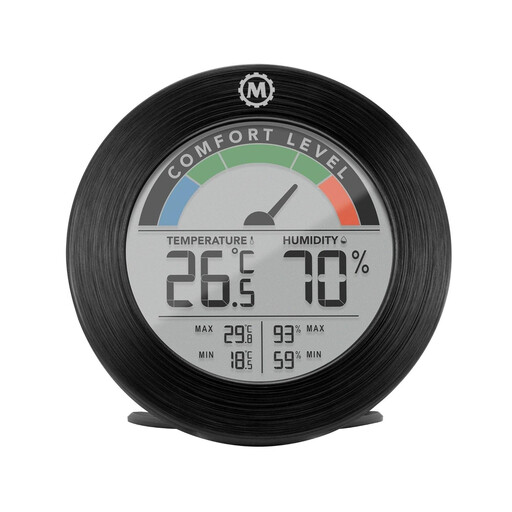 Image unavailable
Marathon Austin wireless indoor thermometer and hygrometer
Monitor the humidity in a room between showers or laundry-drying sessions, without removing moisture from the air.
Measures indoor temperature and humidity, with a comfort indicator and daily readings of minimum and maximum values. Check the model’s placement instructions if you plan to use it in a bathroom.
View on Joybuy
Frequently asked questions
Can a dehumidifier replace a mechanical ventilation system or airing?
No. For humidity produced by everyday activities, a dehumidifier is only a supplementary solution. Anses recommends clearing steam after a shower and airing the room while cooking, while ADEME notes that mechanical ventilation continuously removes humidity and pollutants.
Can I use a dehumidifier in the bathroom?
It depends on the location, the electrical installation and the model. Don’t assume a portable appliance is suitable near a shower or bath. Check its instructions and have the location assessed if you’re unsure; Promotelec notes that electrical safety zones restrict where electrical appliances can be used.
What should I check for continuous drainage?
Check that the model is designed for this, which hose is suitable and how it should be fitted to the drainage point. As an example specific to this model, Rowenta states that the Extrême Dry Compact+ has a 3 L tank and a 1 m hose.
When should I get the cause of the humidity investigated?
If the humidity persists despite airing the room and checking the ventilation, or if you notice a leak, water damage or lasting marks, have the cause investigated rather than relying on a supplementary appliance as your main solution. Qualitel recommends an appropriate assessment if the problem persists.


