If condensation persists in an occupied room despite adequate ventilation, a dehumidifier can help remove water from the air. Choose one based on the room temperature, how the water is drained and the level of noise you can tolerate. If marks appear on the walls, or you suspect a leak or poor ventilation, investigate the cause first: the appliance won’t fix it.
Who is this option for?
People using a heated living space
If condensation keeps returning in a bedroom or living room, an appliance can complement ventilation. Before choosing one, compare its stated capacity with the size of the room, and check its noise level, energy use and how you’ll empty the water. TROTEC describes condensation models as suitable for living spaces between 15 °C and 35 °C; check this range for each individual model.
People using a damp kitchen or bathroom
After cooking or taking a shower, start by clearing the steam: ADEME recommends ventilating these rooms and highlights the role of ventilation. If you then consider an additional appliance, check where its tank or optional drainage hose can be placed.
People noticing marks on the walls
France Rénov’ recommends having damp patches assessed to identify their cause. A portable dehumidifier is no substitute for investigating the problem, particularly if ventilation, insulation or drainage may be to blame.
What should you look for?
If condensation keeps returning in an occupied room, check the cause and ventilation before comparing an appliance’s features.
| What to consider | What to check | Consumers concerned |
|---|
| Cause of the damp |
Note when condensation appears. If there are persistent marks on the walls, have the cause investigated. |
If there are marks on the walls, buying an appliance without understanding where the water is coming from could leave the problem unresolved. Around 36% of consumers make finding the cause their priority. |
| Steam and collected water |
Check the tank capacity and how easy it is to access, then see whether you can connect a hose to the designated outlet. |
When showers, cooking or laundry cause spikes in humidity, you need to manage the water removed without neglecting ventilation. This is a priority for around 29% of consumers. |
| Comfort in the room |
Compare the stated noise level and energy use of the exact model, as well as how its automatic modes work. |
In a bedroom or living room, noise and how long the appliance runs matter just as much in everyday use as its stated extraction capacity. Around 21% of consumers prioritise ease of use. |
| Space and temperature |
Check the room size the appliance is designed for and the operating temperature range of the technology you choose. |
If you’re buying for a very small or cool room, check that the technology is suitable for the space rather than choosing based solely on litres per day. Around 14% of consumers prioritise finding an appliance that suits their room. |
What mistakes should you avoid?
-
Using the appliance to cover up marks on a wall
A leak, water ingress or ventilation problem won’t be fixed simply by removing water from the air. France Rénov’ recommends investigating the cause of damp patches.
Have the cause investigated before considering a dehumidifier as an additional measure.
-
Choosing based solely on litres per day
The stated capacity alone won’t tell you how noisy the appliance will be in a bedroom, what temperature it works at or how often you’ll need to empty it. Les Numériques assesses these criteria separately in its dehumidifier comparison.
Compare the conditions under which extraction was measured, then check the exact model’s noise level, energy use and drainage.
-
Assuming night mode reduces mechanical noise
Duux says that the night mode on its Bora dims the lights and silences the beeps, but does not change the appliance’s actual noise level.
For a bedroom, check the noise level of the exact model rather than relying on the name of its night mode.
-
Forgetting where the collected water will go
Depending on the model, you’ll either need to empty a tank or use continuous drainage. Don’t assume it comes with a pump to move water to a higher outlet.
Before ordering, check the tank, whether a hose can be connected, whether a pump is included and where the outlet is positioned.
Without suitable drainage, having to empty the tank repeatedly can become inconvenient.
Brands to know
De’Longhi
De’Longhi’s French website features the Tasciugo AriaDry Multi dehumidifier range; the DEXD216RF is also included in a Les Numériques selection.
- Several models are available, making it possible to compare the features of specific appliances.
- Check the capacity, noise level and drainage for the model you choose rather than applying an assessment of the DEXD216RF to the whole range.
Duux
The French range includes the Bora 12L and Bora 20/30L connected models.
- According to Duux, the Bora 20/30L has a humidistat and app control; its stated capacity depends on the variant.
- Duux says night mode on this Bora does not reduce its actual noise level, so check the stated noise level if you plan to use it in a bedroom.
TROTEC
TROTEC’s guide distinguishes between condensation, Peltier and desiccant technologies according to the type of space and its temperature.
- TROTEC recommends condensation models for temperate living spaces and desiccant models for rooms below 15 °C.
- These manufacturer recommendations don’t replace the need to check the operating range, noise level and water management for the model you choose.
Dehumidifiers available on Joybuy
These electrical appliances are designed to remove moisture from rooms in your home. If you’re looking for something to complement ventilation rather than fix a leak or unexplained marks on the walls, compare their size and any practical considerations for everyday use.
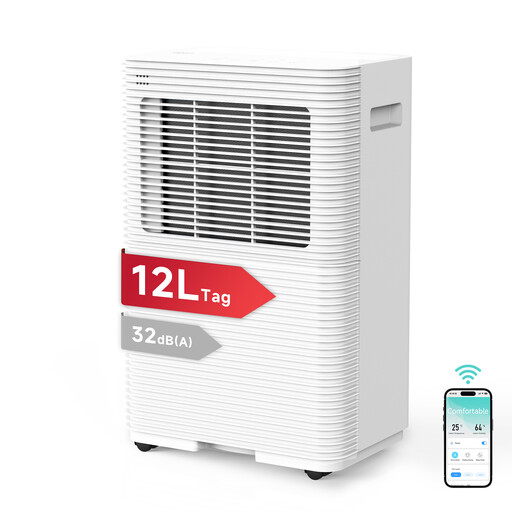 Image unavailable
VINO 12L Smart WiFi, 1.8 L tank
Consider this for a room that matches the area stated for the model, particularly if you’d like WiFi control. The title lists a 1.8 L tank and three modes: automatic, drying and sleep. Its extraction rate of 12 L per day is stated at 30 °C and 80% relative humidity; this may not reflect the results you’ll get in your room. The product listing gives conflicting noise figures: 32 dB in sleep mode and 38 dB(A) in the table. Check the measurement conditions before using it in a bedroom.
View on Joybuy
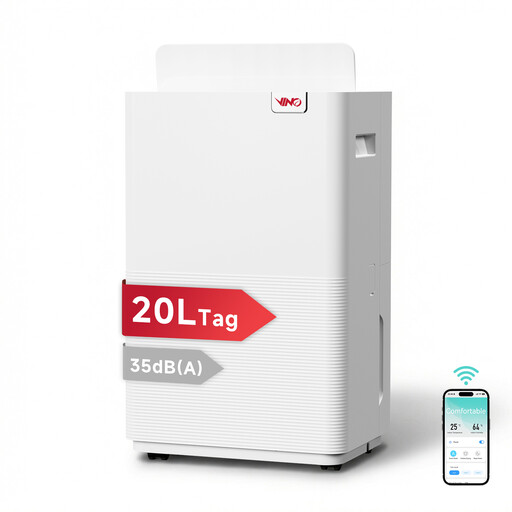 Image unavailable
VINO 20L Smart WiFi, 2.5 L tank
Consider this if you need to manage collected water in a room that matches the area stated for the model. The title lists a 2.5 L tank and automatic, drying and sleep modes. The stated capacity of 20 L per day is measured at 30 °C and 80% relative humidity. If you plan to use it in a bedroom, ask the seller to clarify the conflicting noise figures in the product listing: 35 dB in sleep mode and 40 dB(A) in the table.
View on Joybuy
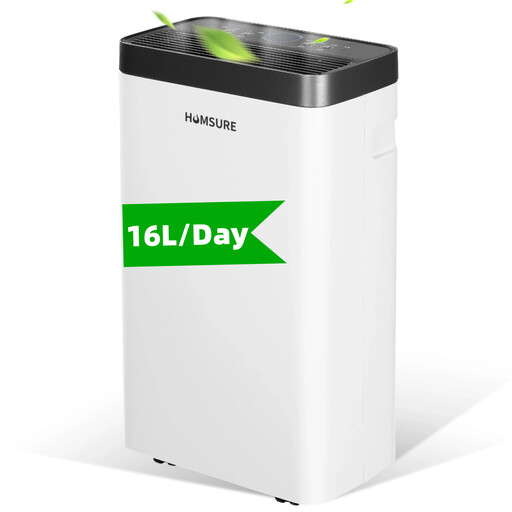 Image unavailable
HUMSURE 16 L/day, 1.4 L tank
Consider this if the 24-hour timer and water management features suit your needs. The title lists a 1.4 L tank, automatic defrost and three modes. Its capacity of 16 L per day is stated at 95 °F and 90% relative humidity, so compare the measurement conditions before comparing it with other capacities. If you’re using it in a cool room or bedroom, check the operating temperature range and the conditions under which the noise level was measured.
View on Joybuy
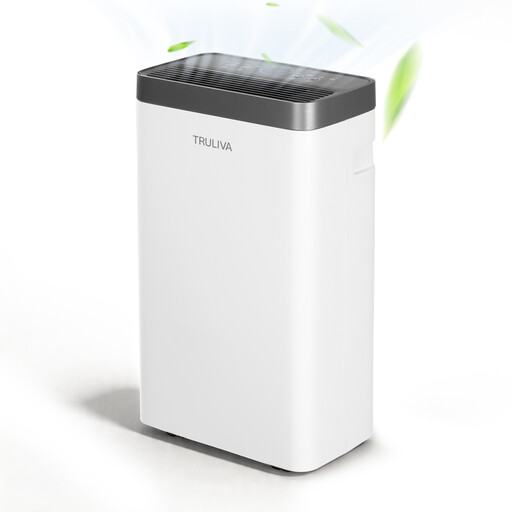 Image unavailable
TRULIVA AP10-2012EE, continuous drainage
Consider this if you have a suitable spot for the continuous drainage feature stated for this model. The title also lists a 24-hour timer, automatic defrost and a laundry-drying mode. Before choosing it for a particular room, confirm the suitable floor area: the title states approximately 32 m², while one description says 25 m². The humidity settings also vary between descriptions, so check which applies to the variant you order. If the appliance will be used in a bedroom, check its noise level too.
View on Joybuy
 Image unavailable
Comfee’ MDDN-10DEN7, 10 L/24 h
Compare this for a room in your home once you’ve confirmed the floor area it’s actually suitable for. The title states 10 L per 24 hours, approximately 40 m³ or 16 m², as well as an LED display and automatic dehumidification. The description gives a different floor area, so check which figure applies before buying. Also check the noise measurement conditions and operating temperature range if the room is cool.
View on Joybuy
Frequently asked questions
Is a dehumidifier enough if there are damp marks on a wall?
No. France Rénov’ recommends having the marks assessed to identify their cause. An appliance may be useful as an additional measure when appropriate, but it won’t fix a leak or a ventilation problem.
Should you still ventilate when using a dehumidifier?
Yes. ADEME recommends opening the windows wide for 5 to 10 minutes every day, and ventilating after a shower or when steam is produced in the kitchen. Mechanical ventilation also removes moisture continuously; a portable appliance is no substitute for it.
Does night mode make a dehumidifier silent?
Not necessarily. Duux says that night mode on its Bora dims the lights and silences the beeps without changing the actual noise level. If you’re using it in a bedroom, check the stated noise level for the exact model and the conditions under which it was measured.
Can you compare two appliances based solely on their litres per day?
No. Also compare the conditions under which each capacity was measured, the temperature of your room, the noise level and how the water is drained. A capacity stated at a given temperature and humidity doesn’t guarantee the same extraction in your home.


