Before buying a dehumidifier, measure the humidity and check the air inlets and ventilation. The appliance can complement these measures in a specific room, but it cannot replace them. ADEME, Anses and Qualitel recommend having persistent damp or damp accompanied by damage investigated. For occasional use, compare capacity conditions, noise levels and water management.
Who is it for?
Households with a room that stays damp
You notice recurring damp in a bedroom, living room, bathroom or utility room, despite being able to air it. Check the ventilation first before deciding whether an additional appliance is suitable. ADEME, Anses, Qualitel and France Rénov’ all highlight the importance of this step.
People who regularly dry laundry indoors
To reduce the need to empty the tank manually while drying laundry, continuous drainage is just as important as the stated capacity. If the water needs to be pumped up to a drain, an integrated pump can be decisive depending on your installation.
Tenants or homeowners dealing with persistent signs
Marks, deteriorating surfaces or damp that does not go away mean you need to investigate the cause. Qualitel recommends a professional assessment when damp persists. A portable appliance should not delay this process.
Criteria to compare
Measuring and checking the ventilation will help you understand the problem. You can then choose an appliance based on the room’s conditions and how you will be able to drain the water.
Hygrometer and monitoring
Choose this if: you want to monitor humidity at different times of day before selecting an appliance.
Good to know: a hygrometer measures the situation but does not deal with the source of the damp or diagnose a leak or structural fault.
Dehumidifier as a supplement
Choose this if: the ventilation has been checked and humidity remains high in a particular room where the extracted water can be managed.
Good to know: the stated capacity depends on the test conditions, while a small tank means frequent emptying without continuous drainage.
Ventilation and assessment
Prioritise this if: air inlets or vents are blocked, or if the damp is accompanied by stains, lasting condensation or damage to finishes.
Good to know: this solution may require an assessment or remedial work, but it targets a potential cause rather than temporarily reducing humidity in the air.
| Priority |
What to check |
Your needs |
| Measurement and ventilation |
Check the air inlets, accessible vents and how the ventilation is working. Use a hygrometer or humidistat to monitor humidity, without confusing it with a home assessment. |
I want to know whether an additional appliance is suitable for this room, rather than masking a cause linked to ventilation, a leak or water ingress. |
| Suitable capacity |
Compare the values in L/24 h with the temperature and humidity at which they were measured. Take account of the room’s volume, usual temperature and air exchange, not just the stated floor area. |
My room is cool, poorly heated or particularly large. I am looking for a capacity that matches its real conditions, without treating a stated value as a guaranteed performance level. |
| Noise and extracted water |
Check the noise level in the intended mode, tank capacity, full-tank shut-off and continuous drainage. Check the connection, whether a hose is included and whether a pump is fitted if the water needs to be lifted. |
The appliance must operate in an occupied room or while laundry is drying. I want to avoid emptying the tank too often and disruptive noise when it is in use. |
Mistakes to avoid
-
Buying before checking the ventilation
Ventilation continuously removes humidity and pollutants. A portable appliance cannot fix inadequate ventilation, a leak or water ingress. ADEME and Anses recommend making sure that ventilation systems are working properly.
Check accessible vents and air inlets, measure the humidity, then request an appropriate assessment if the situation persists or is accompanied by damage.
-
Relying solely on litres per day or square metres
Capacity depends on the test temperature and humidity. For example, De’Longhi states 14 L/24 h for the DEXD214RF at 30 °C and 80% relative humidity. This does not automatically describe performance in a cooler room.
Read the measurement conditions, estimate the room’s volume and usual temperature, then avoid choosing a model based purely on a marketing floor-area figure.
-
Underestimating extracted-water management
A full tank can stop the appliance. Continuous drainage requires a connection and an accessible drain. A pump may be needed when the water has to be lifted.
Before buying, check the tank capacity, full-tank shut-off, drainage type, supplied hose and whether an integrated pump is available if your installation requires one.
Frequent emptying or installing drainage accessories can make extended use more complicated.
-
Choosing based on connectivity alone
Noise varies depending on the mode and power level, and an app cannot replace emptying the tank or investigating the cause of the damp. Connectivity alone does not prove better dehumidification.
First compare capacity, drainage, placement and the stated noise level in the mode you will actually use. Treat the app as a secondary convenience feature.
Brands mentioned for their ranges and models
De’Longhi
Depending on the model, the Tasciugo AriaDry Multi range offers filtration, laundry-drying and continuous-drainage functions.
- For the DEXD214RF, De’Longhi states 14 L/24 h at 30 °C and 80% relative humidity, 40 dB(A), 300 W, an electronic hygrometer and a continuous-drainage hose included.
- These figures are manufacturer specifications that should be compared under identical conditions. They do not predict the result in a colder or drier room.
Wood’s
The brand positions some of its models for heated rooms and laundry drying, with an integrated pump on the MDX20P.
- According to Wood’s and Les Numériques, the MDX20P is intended for heated rooms at 18 °C, with a pump, continuous drainage, a 6 L tank and castors.
- The MDX20P’s specifications are specific to this model and do not automatically apply to the rest of the range.
Duux
According to the brand, the Bora 20/30L range is designed for humid rooms, with regulation via a humidistat or app.
- Les Numériques gives the Bora 20L DXDH20 a capacity of 20 L/day, a stated area of 40 m², a 4 L tank, continuous drainage and connectivity.
- Connected control does not replace checking the ventilation or identifying the cause of persistent damp.
Joybuy options
This Joybuy selection focuses on measuring humidity in the room before choosing a dehumidifier or continuing with ventilation checks.
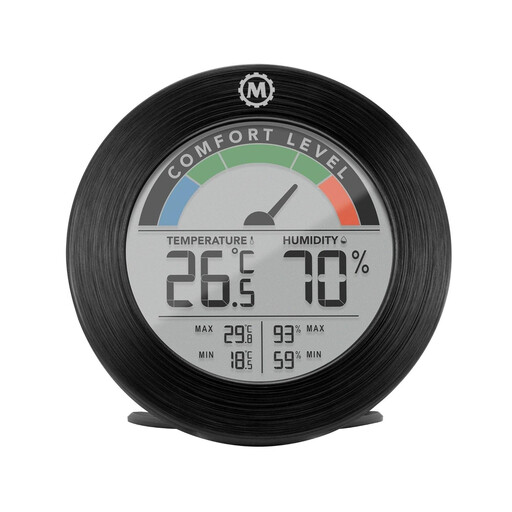 Image unavailable
Marathon Austin wireless indoor thermometer and hygrometer
It helps you monitor a room’s temperature and humidity before deciding whether an additional dehumidifier is suitable.
LCD screen, comfort indicator, battery-powered operation, compact design and daily recording of minimum and maximum readings.
Check the accuracy, measurement range and pack contents if the readings are to inform a technical decision.
Joybuy
Frequently asked questions
When is a dehumidifier a sensible addition?
After checking the air inlets and ventilation, it can complement airing the room by reducing humidity in a specific space. If there are persistent marks, deteriorating walls, a suspected leak or water ingress, prioritise an appropriate assessment rather than relying solely on the appliance.
What humidity level should you monitor before and during use?
Qualitel gives a general guide of 40% to 60% relative humidity in a home and notes that above 70%, the risk of condensation, mould and damage increases. This guide can help you monitor a room, but it cannot identify the source of the damp on its own.
Why do litres per day not guarantee the same result in my home?
The figure depends on the measurement conditions. For example, De’Longhi states 14 L/24 h for the DEXD214RF at 30 °C and 80% relative humidity. Extraction may differ in a cooler or less humid room. So compare models using their test conditions, not just the L/24 h figure.
Do you need a continuous-drainage hose or a pump?
A continuous-drainage hose is suitable if the water can flow to a drain positioned lower than the appliance and the connection can be made. A pump is useful when the water needs to be lifted. It is not automatically included with every model that has continuous drainage. Wood’s presents the MDX20P as a model with an integrated pump.


