
Livraison le jour même ou le lendemain

Qualité garantie

Débloquez vos offres de bienvenue: Livraison GRATUITE | Jusqu'à -80 % | 30 jours d'essai gratuits à JoyPlus
Téléchargez l'application
Condensation on windows, laundry that won't dry properly, musty smells in the cellar or a feeling of heavy air in the bedroom: a dehumidifier for the home can help reduce ambient humidity. But not all appliances are suited to every situation. A moisture absorber that doesn't need electricity works well in a cupboard, whereas an electric dehumidifier will be more effective in a utility room or a space that's regularly damp.
Before you buy, here are the main pitfalls to avoid and the criteria to consider.
A capacity of 10, 16 or 20 litres per day is usually measured under specific temperature and humidity conditions. It doesn't mean the appliance will actually collect that volume in a British home heated to a moderate temperature.
To compare two models, check:
A unit advertised at 10 L/day can suit a bedroom or a small bathroom. A model rated at 20 to 25 L/day will be more suitable for a cellar, a large utility room or a particularly damp property.
Noise level should be given in dB(A). A difference of just a few decibels can be noticeable, especially in a bedroom. Also remember to distinguish between night mode and full-power operation.
Even if it's described as quiet, a dehumidifier will still be audible: it contains a fan and, depending on the technology, a compressor. For sleeping, choose a night mode, a lower fan speed and the ability to set a timer to switch the unit off.
A small tank may need emptying several times a day when the air is very humid. In a cellar or a second home, this can quickly become a hassle.
For extended use, choose a dehumidifier with a drainage hose. The hose must be able to slope naturally towards a drain: without enough of a gradient, continuous drainage may not work. A safety feature that automatically stops the unit when the tank is full is also essential.
The advertised floor area shouldn't be taken as a universal guarantee. A cold, poorly ventilated or very damp room may need more power than a dry room of the same size.
An electric dehumidifier extracts more water over a given period, but it uses electricity and needs regular filter maintenance. You'll also need a power socket, enough space around the unit for air to circulate, and a stable surface.
A moisture absorber works without electricity and is silent. It's best suited to small, enclosed spaces. The refills usually turn moisture into liquid or gel: always keep the device out of reach of children and pets, and follow the precautions on the packaging.
Rubson Minifresh sachets, for example, are designed for spaces of 1 to 2 m², such as a drawer, a shoe cabinet or a wardrobe. A refill must be compatible with the size of the unit: a 450 g tablet won't necessarily suit a model designed for 300 g.
Before using a compressor model for the first time, some manufacturers recommend leaving the unit upright for several hours after transport. Check the manual, leave enough space around the air inlets and outlets, and clean the filter regularly.
Also check:
A "laundry drying" function can speed up indoor drying, but it doesn't replace proper ventilation. Claims about anti-condensation, anti-mould or anti-odour should be understood as features designed to reduce humidity and smells, not as a medical solution or a treatment for structural building problems.
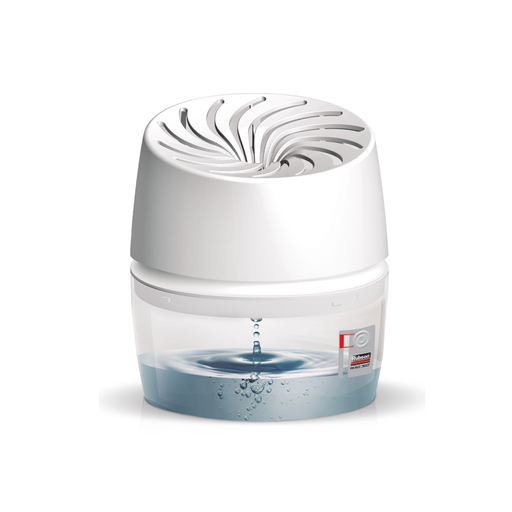
Why this choice suits this profile: It works without electricity and includes a 450 g refill. Its compact design is suitable for rooms up to 20 m², according to the information provided.
It doesn't rely on a power socket or an advertised noise level. The level indicator and pouring spout make monitoring and emptying easy.
Good air circulation around the refill, silent operation and a replaceable refill.
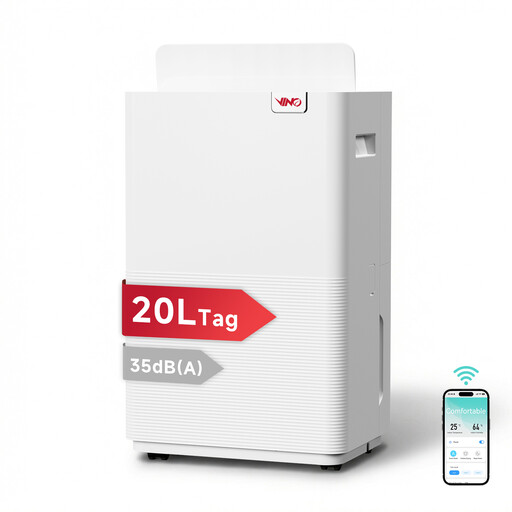
Why this choice suits this profile: App control, 24-hour programming and automatic, drying and night modes make it ideal for regular use in a room up to 40 m², according to the product sheet.
The capacity, the noise level stated in night mode and the two drainage options are clearly specified, rather than relying on a vague general promise.
2.5 L tank, continuous drainage hose, washable filter and swivel castors.
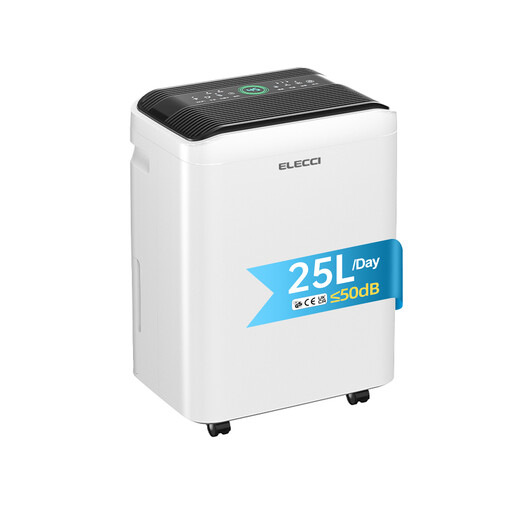
Why this choice suits this profile: Its advertised capacity of 25 L/day, 4.8 L tank and continuous drainage connection make it ideal for large rooms, cellars and very damp properties.
The inclusion of a hose, automatic shut-off and automatic defrost reduces the need for repeated intervention and prevents shutdowns caused by cold conditions.
Three fan speeds, 24-hour timer, laundry drying mode and 360° castors.
We've put together a comprehensive, real-time selection of products that meet these strict criteria and the requirements of European safety regulations.
The duration depends on the humidity level, temperature, room size and the result you're aiming for. In a very damp room, continuous operation with direct drainage can be practical. Once the target humidity level is reached, models with a built-in sensor can reduce or switch off the compressor. Remember to air the property when outdoor conditions allow.
To estimate it, multiply the power in watts by the number of hours of use, then by the price per kilowatt-hour shown on your bill. A 300 W unit used for 5 hours consumes about 1.5 kWh. The actual cost then depends on the operating cycles, the mode selected and the humidity level in the room.
Replace it when it's saturated, when the indicator shows it's full, or when the gel and liquid have reached the expected level. The lifespan of a refill varies depending on temperature and ambient humidity. Do not reuse a single-use sachet, and follow the handling and disposal instructions on the packaging.