
Livraison le jour même ou le lendemain

Qualité garantie

Débloquez vos offres de bienvenue: Livraison GRATUITE | Jusqu'à -80 % | 30 jours d'essai gratuits à JoyPlus
Téléchargez l'application
Condensation on windows, musty smells, laundry that takes ages to dry or dark marks in corners: excess moisture can quickly become a problem in any home. However, choosing a dehumidifier is not simply a matter of picking the model with the highest extraction capacity.
Some appliances are designed to treat an entire room, while a non-electric moisture absorber is better suited to a cupboard, car or caravan. Here are the key criteria to consider so you can avoid buying a product that is not right for your needs.
A capacity of 16 or 20 litres per day is generally measured in warm, very humid conditions, such as 30 °C and 80% relative humidity. In a cooler bedroom, like those found in most homes, the actual amount collected can be considerably lower.
So compare the stated capacity with the size of the room, its usual temperature and how often you plan to use the appliance. An oversized model may take up more space and use more electricity than a suitably sized one.
Crystal absorbers have the advantage of being silent and requiring no electrical socket. However, their coverage is limited. A sachet designed for 1 to 2 m² cannot replace an electric dehumidifier in a cellar, living room or utility room.
For a small room of around 10 to 20 m², a rechargeable absorber may be suitable if the humidity level is moderate. For drying laundry or dealing with persistent damp, however, an electric appliance — generally a compressor model — will be more appropriate.
A small-capacity tank will need to be emptied regularly. If the appliance needs to run for several hours in a cellar or utility room, choose a model with continuous drainage, ideally with a hose included.
The filter also deserves your attention. A washable filter, cleaned according to the manufacturer’s recommendations, helps maintain good airflow. Also check that the appliance switches off automatically when the tank is full.
Statements such as “up to 20 m²” or “up to 40 m²” are usage guidelines, not guarantees that apply to every home. A cold room, poorly ventilated cellar or utility room where laundry is drying may require more power.
For a small space, an odour-control moisture absorber may be enough. For a bathroom, damp bedroom or cellar, focus instead on the following:
A quiet dehumidifier is particularly useful in a bedroom. However, be careful not to confuse the stated noise level in standby or sleep mode with the level measured during normal operation. For example, the VINO 12L has a 32 dB sleep mode, while its technical specifications state 38 dB(A) as the reference noise level.
The appliance should be placed on a stable surface, with several dozen centimetres of clearance around it. Never block the air inlets or outlets with furniture, curtains or laundry.
The power rating in watts gives you an initial idea of energy consumption, but the cost also depends on how long the appliance runs. A timer, humidistat and automatic mode can help reduce unnecessary running time.
The models featured use R290 refrigerant. Follow the positioning instructions and allow the appliance to stand upright after being transported at an angle, in accordance with the instructions. Unplug it before cleaning and do not use it in an area exposed to splashing water.
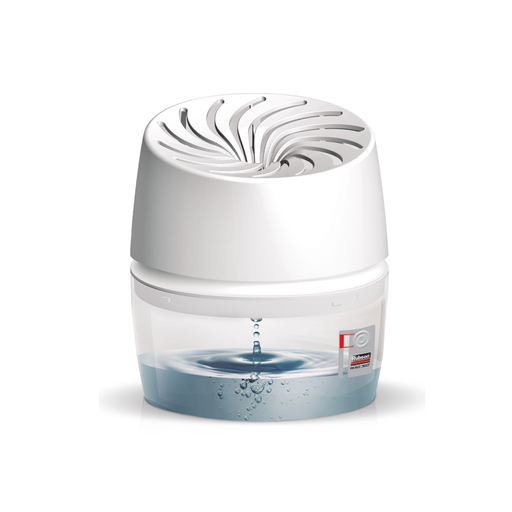
Why this choice suits this profile : This absorber works silently without electricity in rooms of up to 20 m². It is suitable for a bedroom, home office, bathroom or occasionally damp home.
Its recommended coverage is clearly stated, and the level indicator shows when the refill needs replacing.
Silent operation, 450 g refill included, pouring spout and top opening.

Why this choice suits this profile : Designed for rooms of up to 40 m², this model offers app control, 24-hour scheduling and several operating modes.
The specifications distinguish between the sleep mode, rated at 35 dB, and the reference noise level during operation, set at 40 dB(A). This makes it easier to compare the figures on a more realistic basis.
2.5 L tank, dual drainage, swivel castors, laundry-drying mode and remote control.
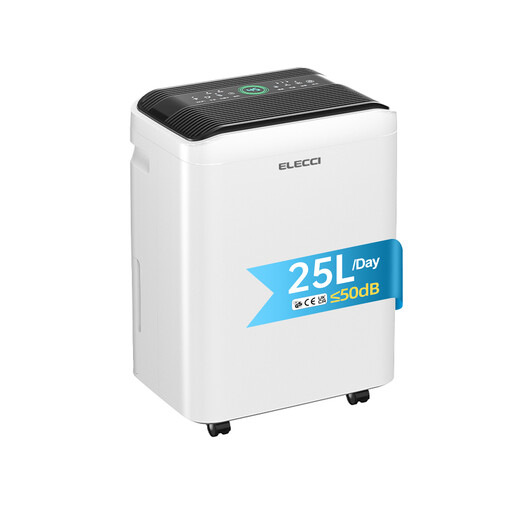
Why this choice suits this profile : Its stated capacity is suitable for spaces of up to 50 m², such as a cellar, utility room, garage or large, poorly ventilated room.
Its 4.8 L tank and continuous drainage hose mean fewer emptying trips during extended use.
Stated output of 25 L/day under specific conditions, drying mode, automatic defrosting and stated noise level of 36 dB.
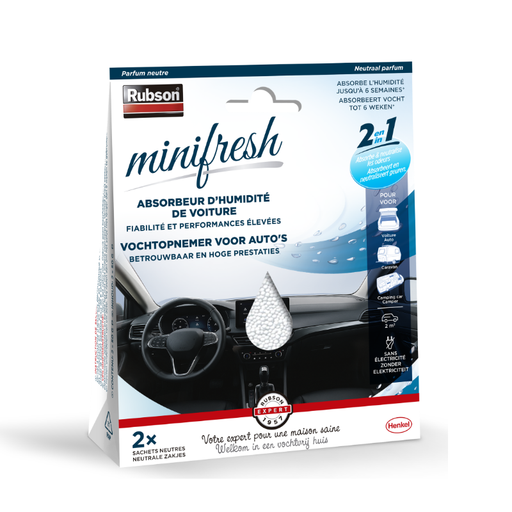
Why this choice suits this profile : These sachets are designed for cars, caravans, cupboards and storage spaces measuring 1 to 2 m², with no cable or electrical installation required.
Its limited coverage prevents you from mistakenly choosing it for an entire bedroom or cellar.
Two sachets, moisture transformed into gel and unpleasant odours neutralised.
We have put together a comprehensive, real-time updated list of products that meet these strict selection criteria and European safety regulations.
A dehumidifier helps reduce ambient humidity, but it is not a substitute for proper ventilation, repairing a leak or treating water ingress. If condensation returns despite suitable use, first look for the underlying cause.
It all depends on the measured humidity level, the temperature and the size of the room. Thanks to its humidistat, an automatic mode can stop and restart the appliance according to the selected threshold. To dry laundry, use the dedicated programme and make sure there is sufficient space around the appliance.
A non-electric absorber does not use energy, but it does require refills. An electric model uses energy according to its power rating and how long it runs. A timer, precise humidity setting and continuous drainage make it more convenient to use while limiting unnecessary cycles.
If the humidity is slight and keeping noise to a minimum is the priority, a crystal absorber may be sufficient. In the event of recurring condensation, laundry drying or a larger room, choose an electric appliance with a sleep mode, automatic shut-off and a clearly stated noise level.