
Livraison le jour même ou le lendemain

Qualité garantie

Débloquez vos offres de bienvenue: Livraison GRATUITE | Jusqu'à -80 % | 30 jours d'essai gratuits à JoyPlus
Téléchargez l'application
Condensation on windows, laundry that won’t dry, a musty smell in the cellar or mould patches in the bathroom – a dehumidifier can make a real difference to your everyday comfort, provided you pick a model that suits the room and your habits.
Product listings often highlight a high capacity in litres per day or a ‘quiet’ operation. Yet these figures alone aren’t enough to separate the best from the rest. Performance varies depending on temperature, humidity levels and air circulation.
A 25 L dehumidifier can extract up to 25 litres of water per day under specific temperature and humidity conditions. That doesn’t mean it will remove that amount in a heated, low-humidity bedroom. Always check the measurement conditions stated by the manufacturer.
For a flat or a medium-sized room, a 16 L dehumidifier or a 20 L dehumidifier can be perfectly adequate. More powerful models are better suited to large rooms, very damp homes or regular laundry drying.
Noise varies depending on the mode selected. An appliance marketed as a quiet dehumidifier can be noticeably louder in powerful mode or when the compressor kicks in. For a bedroom, look at the noise level quoted in night mode, but also consider automatic restarts and vibrations transmitted through the floor.
A small tank needs emptying regularly. If the appliance is destined for a basement, utility room or second home, choose a dehumidifier with a drainage hose. The connection must remain gravity-fed: avoid bends and upward runs that could block the flow.
The daily extraction capacity is a useful indicator, but it doesn’t replace a proper assessment of the room. In particular, consider:
A dehumidifier for the home installed in a living room or bedroom won’t necessarily face the same demands as one used in a cold basement. When the temperature drops, automatic defrost helps limit ice build-up on the heat exchanger. However, it doesn’t turn the appliance into a model designed for very cold conditions.
A large tank reduces how often you need to empty it, but doesn’t eliminate the task when the appliance is running at full power. A fill alert and automatic shut-off are especially useful for preventing overflows.
Before buying, also check:
The nominal power rating allows you to compare appliances, but the running cost depends mainly on how long it operates and the humidity level. A hygrostat that can stop or slow the appliance once the target is reached avoids unnecessary running hours.
The refrigerant R290 is used in several models featured below. It’s a fluid found in some domestic refrigeration appliances. As it is flammable, follow the manufacturer’s instructions carefully: keep the appliance upright, maintain clear space around it, never modify it, and unplug it before maintenance.
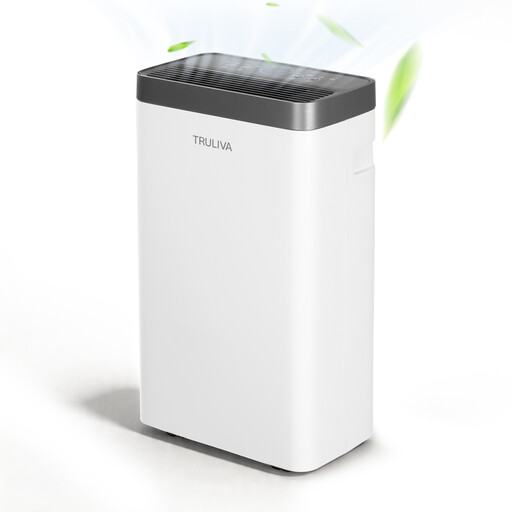
Why this choice suits this profile: its compact size and castors make it easy to move from a bedroom to a bathroom or small utility room.
The 16 L/day capacity is stated with its measurement conditions. The 1.35 L tank has a fill alert, and the appliance supports continuous drainage.
24-hour timer, laundry drying and sleep modes, removable filter and dimensions of 28.7 × 17 × 49.8 cm.
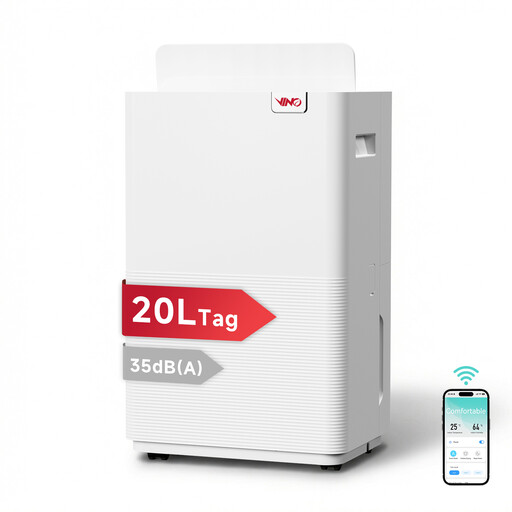
Why this choice suits this profile: app control and remote scheduling are ideal for those who want to manage humidity without staying near the appliance.
The noise level quoted in sleep mode is 35 dB, while the spec sheet states 40 dB(A) under other conditions. This distinction helps you better interpret the appliance’s real noise.
Stated capacity of 20 L/day at 30 °C and 80% relative humidity, 2.5 L tank, Wi-Fi, 24-hour timer and dual drainage.
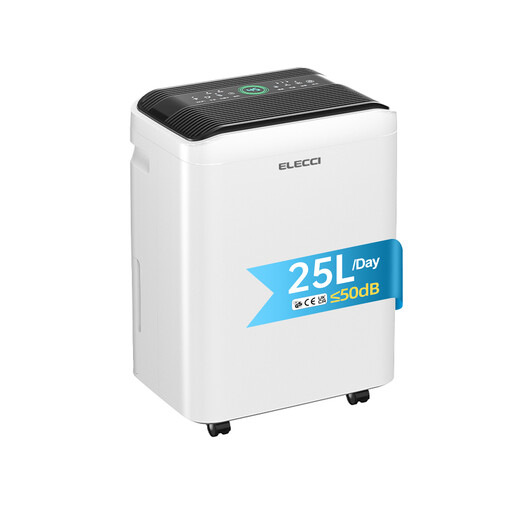
Why this choice suits this profile: its large tank and stated extraction capacity make it ideal for big rooms, basements, garages or intensive laundry drying.
The spec sheet distinguishes the 25 L/day capacity at 30 °C and 80% relative humidity from the real-world performance. Continuous drainage reduces the frequency of manual emptying.
4.8 L tank, three speeds, laundry drying mode, automatic defrost, 24-hour timer and swivel castors.
We’ve compiled a complete, real-time selection of products that meet these demanding criteria, as well as European safety standards.
Place the appliance on a flat, stable surface with plenty of clearance. Follow the free space recommended in the manual and never cover the air intake or outlet grilles. If the appliance has been transported tilted, leave it upright for the time recommended by the manufacturer before plugging it in.
Clean the filter as often as advised – typically every two weeks during heavy use. Empty the tank before moving the appliance and unplug it before any maintenance. In a bathroom, avoid direct water splashes and only use a socket that’s suitable for your home’s electrical installation.
It depends on the initial humidity level, temperature and room volume. Set the hygrostat to a reasonable target, then observe the change over several hours. Laundry drying mode can run temporarily at high power, while automatic mode is better for maintaining a stable humidity level day to day.
Power consumption depends on the wattage and the number of hours it runs. To estimate it, multiply the power in kilowatts by the running time, then by your electricity rate. A timer, hygrostat and suitable drainage can help reduce unnecessary cycles, though savings aren’t guaranteed in every home.
In a basement, position it in a central, clear area, away from damp walls and heat sources. In a bathroom, run the appliance after a shower with the door closed if ventilation allows, while keeping it protected from splashes. Always check the manual for the minimum temperature and usage conditions.