
Livraison le jour même ou le lendemain

Qualité garantie

Débloquez vos offres de bienvenue: Livraison GRATUITE | Jusqu'à -80 % | 30 jours d'essai gratuits à JoyPlus
Téléchargez l'application
Condensation on windows, musty smells, laundry that stays damp, or a basement that's hard to air out – a dehumidifier can help you get indoor humidity under control. But you need to choose a model that suits your needs. Room size, temperature, how often you need to empty the tank, and noise levels all have a direct impact on everyday comfort.
An appliance marketed as a 20L dehumidifier won't necessarily extract 20 litres of water in a typical British home. This figure is usually measured in particularly hot and humid conditions, for example at 30 °C and 80 % relative humidity. In a cool cellar or a less humid bedroom, the volume extracted will be noticeably different.
It's better to compare the stated capacity with the coverage area, the minimum operating temperature, and whether it has automatic defrost.
A small tank can mean emptying it several times a day in a very damp room. For prolonged use, especially in a basement or utility room, go for a dehumidifier with a drainage hose. However, gravity drainage needs to slope towards the outlet, and the hose must not be kinked.
Noise depends on the mode selected, the fan speed, and the compressor operation. A figure quoted in sleep mode won't necessarily reflect the noise level in laundry drying mode. In a bedroom, check the decibel rating given, as well as whether it has a programmable timer.
For a small bedroom, study, or bathroom, a 12L dehumidifier can be enough when humidity levels are moderate. 16 L models are better suited to medium-sized rooms, while a 20L or 25 L dehumidifier will be more at home in a large living room, utility room, or persistently damp basement.
These figures are just a guide: a cold, poorly ventilated, or very humid room will need longer running time than a heated, regularly aired one.
An appliance with a built-in hygrostat lets you set a target humidity level, usually between 40 % and 60 % relative humidity depending on the model. It will stop or slow down when the set level is reached, then restart when the humidity rises again.
Here are the features that can really make a difference:
The built-in hygrometer is mainly a guide. Readings can vary depending on where the appliance is placed, draughts, and the sensor's position.
The wattage alone isn't enough to estimate running costs. How long it runs, the room's humidity, and the setting you choose all play a part. To keep the airflow efficient, clean the filter as the manual advises – often every two weeks.
An appliance using R290 refrigerant must be kept upright and placed on a stable surface, leaving about 20 to 25 cm of free space around the air inlets and outlets. If it has been transported tilted, follow the manufacturer's instructions on how long to wait before plugging it in. Never use an electric dehumidifier in an area exposed to water splashes.

Why this suits this profile: Its size is ideal for a first dehumidifier in a bedroom, bathroom, or small flat of around 16 m². The LED display makes everyday adjustments simple.
The stated capacity comes with a suggested room size, a visible 2.1 L tank, and auto shut-off when the tank is full.
LED display, continuous drainage compatible with a hose, automatic defrost, and noise level rated up to 45 dB.

Why this suits this profile: App control and 24-hour programming are ideal for those who want to manage their dehumidifier remotely.
The product page clearly distinguishes the maximum capacity of 20 L/day, measured at 30 °C and 80 % relative humidity, from the noise level during operation.
2.5 L tank, auto, drying and sleep modes, two drainage options, swivel castors, and child lock.
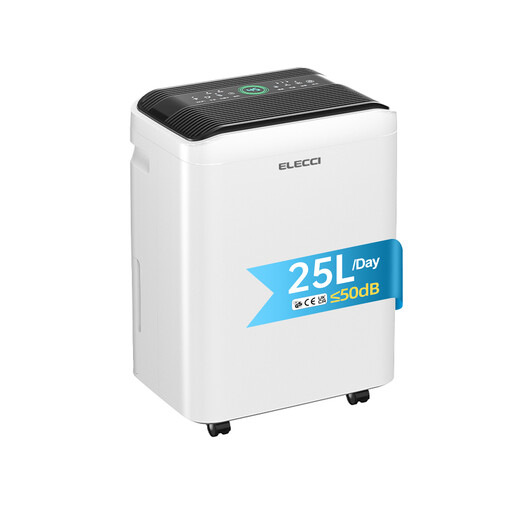
Why this suits this profile: Its stated capacity and large tank make it suitable for a basement, garage, utility room, or a space up to around 50 m², depending on conditions.
The large tank reduces how often you need to empty it, while the hose allows for continuous drainage where the setup permits.
Three speeds, laundry drying mode, 24-hour timer, automatic defrost, noise level rated at 36 dB, and 360° castors.
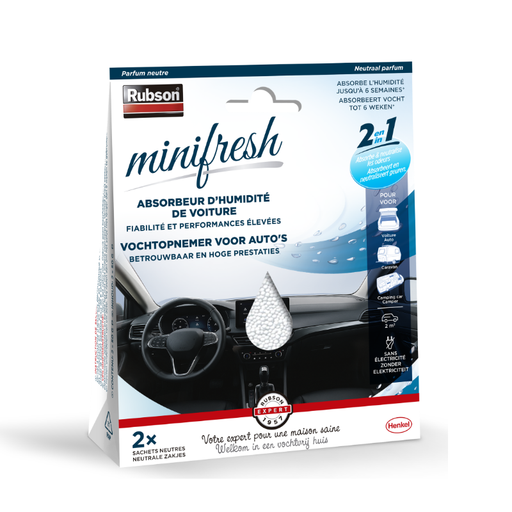
Why this suits this profile: These electricity-free sachets are ideal for cars, caravans, cupboards, lockers, and enclosed spaces of 1 to 2 m².
It is not designed to treat a large room – its use is limited to the small, enclosed spaces stated.
The hygroscopic beads turn into gel, and the sachet helps neutralise odours. It needs to be replaced once saturated.
We've put together a comprehensive, real-time selection of products that meet these exacting criteria, as well as European safety standards.
Place it on a stable floor, away from walls, curtains, and furniture. Make sure not to block the grilles, and keep the windows closed while it's running, unless the manual says otherwise. At night, activate sleep mode and check that the noise level is comfortable for you.
The cost depends on the wattage, the price per kilowatt-hour, and how many hours you use it. To estimate it, multiply the power in kilowatts by the running time, then by your electricity tariff. Auto mode and the timer help cut down on unnecessary running time.
It depends on the quality of the installation, how well you maintain the filter, whether you let it rest after transport, and how often you use it. Clean the filter regularly, empty the tank before moving the appliance, and switch it off immediately if you notice an unusual smell, smoke, or strange noise.