
Livraison le jour même ou le lendemain

Qualité garantie

Débloquez vos offres de bienvenue: Livraison GRATUITE | Jusqu'à -80 % | 30 jours d'essai gratuits à JoyPlus
Téléchargez l'application
Condensation on windows, a musty smell, laundry that takes too long to dry or cold walls in a cellar: an air dehumidifier can help you manage indoor humidity more effectively. However, not every appliance meets the same needs. A compact model designed for a cupboard will not be powerful enough for a utility room, while a compressor dehumidifier may be oversized for a small bathroom.
Before buying, it is best to avoid three common pitfalls:
Appliances often advertise a capacity of 10 to 25 litres per day. This figure should be considered alongside the room’s size, temperature and humidity level. A model rated at 12 L/day may be suitable for a bedroom or medium-sized bathroom, while an appliance rated at 20 to 25 L/day will be better suited to a cellar, utility room or several rooms used one after another.
Area recommendations are primarily commercial guidelines. In a very damp home, a cold room or a poorly ventilated space, it is better to leave some leeway rather than choose an appliance that is only just powerful enough.
A dehumidifier with continuous drainage connects to a hose directed towards a drain positioned lower than the appliance. This is particularly useful in a cellar, utility room or bathroom, especially during extended use.
Check the following points:
A large tank, such as the 4.8 L tank on the ELECCI 25L/D, reduces how often it needs emptying, but it does not replace a permanent connection if the appliance needs to run unattended.
For a bedroom, a bedroom dehumidifier should offer a night mode, a timer and a clear display that is not too bright. Stated figures should be treated with caution: the VINO 12L product page indicates a sleep mode at 32 dB, while the technical specifications mention 38 dB(A). Noise levels can vary depending on fan speed, measuring distance and the characteristics of the room.
A laundry-drying function speeds up air circulation around clothes, but does not remove the need to ventilate your home properly. The 24-hour timer lets you schedule operating periods, while Wi-Fi control can be useful for monitoring the appliance remotely. However, remember to check compatibility with a 2.4 GHz network when this requirement is specified.

Why this choice suits this profile : Its format is suitable for rooms of around 16 m². The LED display, castors and humidity-level adjustment make it very easy to use.
The stated capacity, 2.1 L tank and automatic shut-off are clearly specified, making it easier to compare with an underpowered appliance.
Stated output of 10 L/day, continuous drainage, automatic defrosting and a noise level of approximately 45 dB.
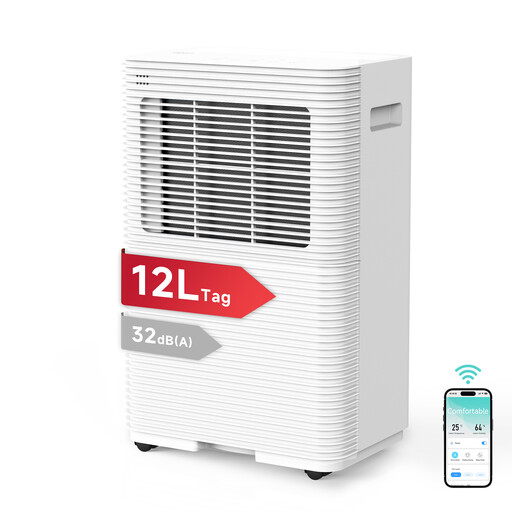
Why this choice suits this profile : App control, 24-hour scheduling and a laundry-drying mode meet the needs of regular domestic use.
The product page distinguishes between the different stated noise levels and specifies both drainage options, so you are not left relying on a single marketing claim.
Stated extraction of up to 12 L/day, Wi-Fi app, 1.8 L tank, PET antibacterial filter and adjustable castors.
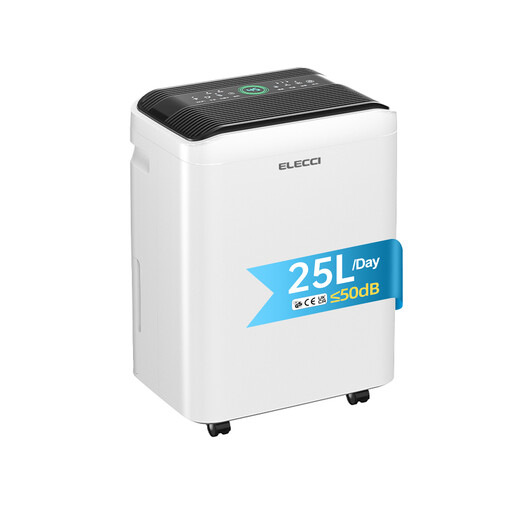
Why this choice suits this profile : Its stated capacity and 4.8 L tank are suitable for cellars, utility rooms and spaces of up to around 50 m², depending on the conditions.
Hose connection, full-tank shut-off and automatic defrosting reduce the demands associated with extended use.
Up to 25 L/day under the stated conditions, three speeds, 24-hour timer, laundry-drying mode and R290 refrigerant.
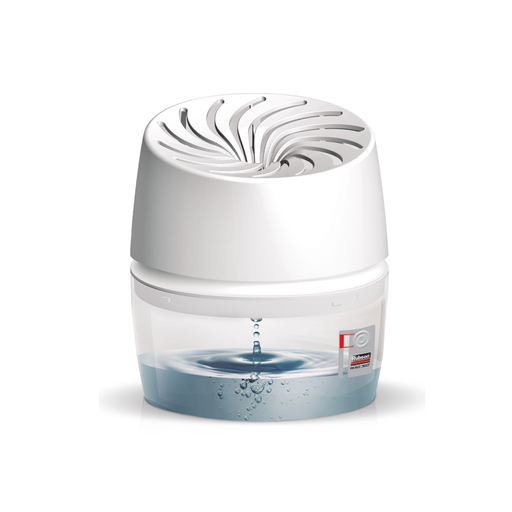
Why this choice suits this profile : This electricity-free format is suitable for rooms of up to 20 m², cupboards, caravans and small spaces without a power socket.
Its use is clearly limited to small spaces: it does not claim to replace an electric appliance in a cellar or very damp home.
Quiet operation without a power supply, refill indicator, pouring spout and 450 g refill included.
We have put together a complete, real-time updated selection of products that meet these demanding selection criteria and European safety standards.
Place the appliance on a stable surface, leaving at least 20 to 25 cm of clearance around the air inlets and outlets. After transporting it in a tilted position, leave it standing upright for the length of time specified in the manual before plugging it in. Never use an electric dehumidifier in an area exposed to water splashes.
Clean the filter regularly, generally every two weeks if the appliance is used frequently. A dusty filter reduces airflow and can increase energy consumption. Before moving the appliance, switch it off, unplug it and empty the tank.
It depends on the initial humidity level, the temperature and the size of the room. Start with a few hours, then use the automatic setting or a timer. Keep the windows closed while the appliance is running and ventilate separately when outdoor conditions are suitable.
Consumption varies depending on the appliance’s power, how long it is used and how the compressor operates. To keep it down, set a reasonable target humidity level, clean the filter and use the timer. A crystal moisture absorber does not use electricity, but is only suitable for small spaces and requires its refills to be replaced regularly.
Yes, provided you position the appliance away from the bed, on a stable surface, and choose a night mode that is quiet enough for your comfort. Check the stated noise level in dB(A), activate the timer and make sure you do not block the ventilation grilles.